A utility bill looks like a safe document. It has a logo, an account number, a service address, and a due date. That is why it is one of the most common ways tenants prove where they live, and one of the easiest to fake. Anyone with a free utility bill template and ten minutes can build a bill that passes a quick glance.
This guide shows landlords how to spot a fake utility bill or proof of address on a rental application. You will learn the red flags, a five step way to verify a bill, and what to do when something does not add up. If you want the wider picture first, read our guide to signs of fraud in rental applications.
Why a Fake Utility Bill on a Rental Application Is a Problem
A landlord asks for proof of address to confirm that the applicant lives, or has lived, where they say. The proof of address ties the name on the application to a real place. It also helps you check the rental history the tenant gives you, and it matters before you collect a security deposit or sign a lease, because a rental history only means something if the address is real.
A forged document breaks that link. A tenant might submit one to hide a recent move, a past eviction, or an address tied to unpaid rent. In other cases, the bill is part of a larger set of false documents that also includes pay stubs and an ID. Fraud rarely stops at one document. When a bill is fake, you should ask what else in the file is fake too.
Most renters who send a document are honest. They are simply sending the paper you asked for. The goal of this check is not to treat every applicant as a suspect. The goal is to run the same simple review on every proof of address, so fraudulent applicants cannot slip through while good renters wait.
What Counts as Proof of Address or Proof of Residency for a Tenant?
Property owners usually accept a few types of documents as proof of address. A utility bill is only one of them.
Common options include:
A recent utility bill for electricity, water, gas, internet, or sewer service
A bank statement or credit card statement that shows the mailing address
A current or past lease agreement with the landlord's contact details
Official mail from a government agency, a school, or an insurer
A pay stub or tax form that lists the home address
Each one has a different weakness. A statement is easy to edit. A bank statement is harder to fake but shows more private data. A lease agreement can be written by a friend. No single document is perfect, which is why the best approach is to compare two or more. Some applicants are also new to a city, live with family, or have bills in someone else's name, so a missing utility document is not a red flag by itself. Ask for another document and move on.
Utility Bill Template and Bill Generator: Where Fakes Come From
Most fake bills start with a utility bill template. Free templates, editable PDF files, and online bill generator tools are easy to find, and they let anyone type in a company name, an address, and a few charges. Some tools build an invoice style page in minutes. Anyone can customize a template, and that saves a forger the hard work of designing anything, so a bill that looks neat is not proof that it is real.
Others take a real bill and edit it. They change the name, the service address, or the amounts, then save the file again. These edits can leave small traces, such as uneven spacing around the changed text. They are harder to spot than a pure template, which is why you need a repeatable review rather than a quick look.
What an Authentic Utility Bill Includes
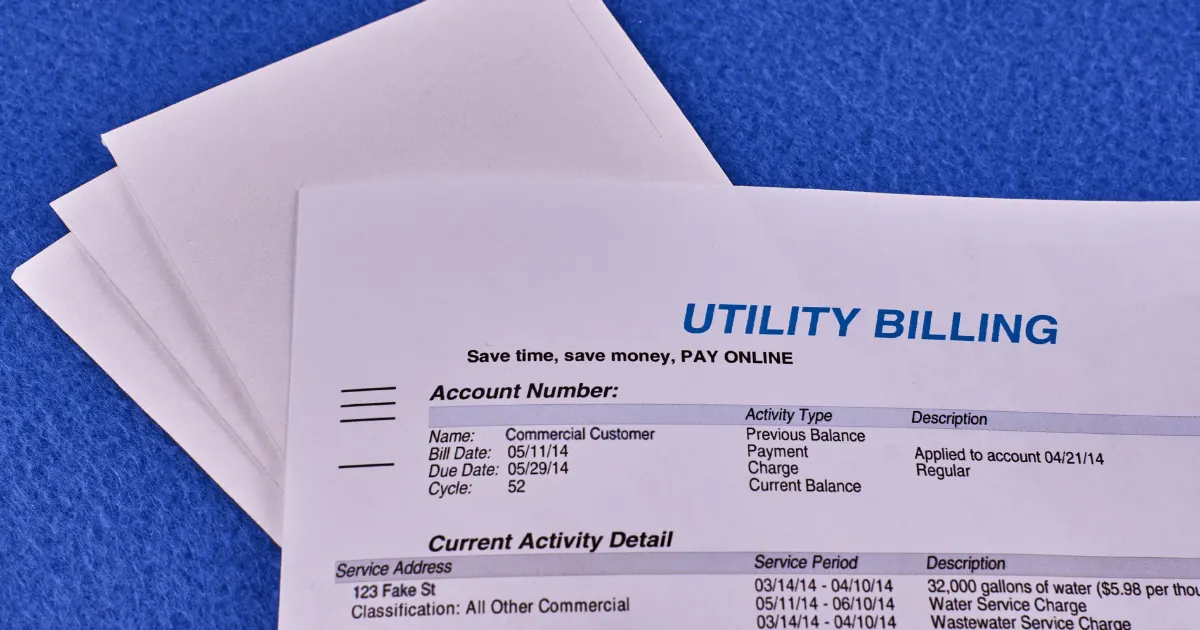
Knowing what a real one holds makes fake ones easier to catch. An authentic utility bill usually lists the account name, the account number, and the service address. It shows the billing period, the statement date, and the due date. It also breaks out the charges, taxes, and fees, and it shows utility usage for the month. For electricity, gas, and water, that usage often comes from meter readings with a start and an end figure.
A real bill also carries the service provider's contact details, a balance or payment history, and ways to pay. It may arrive as a hard copy in the mail or as a PDF via email. The customer information, such as the account name and mailing address, should match the person who holds the account. Missing billing details are a warning sign. So is a page that has every detail but contradicts itself, such as a monthly utility total that does not match the line items.
Red Flags That a Utility Bill Is Fake
Fakes tend to share a few traits. Real bills come from billing systems that follow strict formats, while fake ones are built by hand or by a bill generator. Look closely at these details:
The logo is blurry, stretched, or an old version of the company's brand.
Fonts change between sections, or numbers and names look slightly different from the text around them.
The account number is too short, too long, or in a format the provider does not use.
The service address is formatted differently from the mailing address, or the spelling does not match the application.
The billing period, due date, and statement date do not fit together.
The math is wrong. Charges, taxes, and the total do not add up.
Usage looks odd, such as the same electricity use every month or meter readings that do not fit the dates.
There is no payment history, no customer service number, and no payment options.
The date is more than a couple of months back, or the balance never changes.
The name is slightly off from the name on the ID.
One flaw does not prove the document is fake. Utilities change their layouts, send paperless bills, and sometimes make mistakes. Several flaws together, or a flaw plus an address that does not match the ID, are a good reason to look closer.
How to Verify a Utility Bill in Five Steps
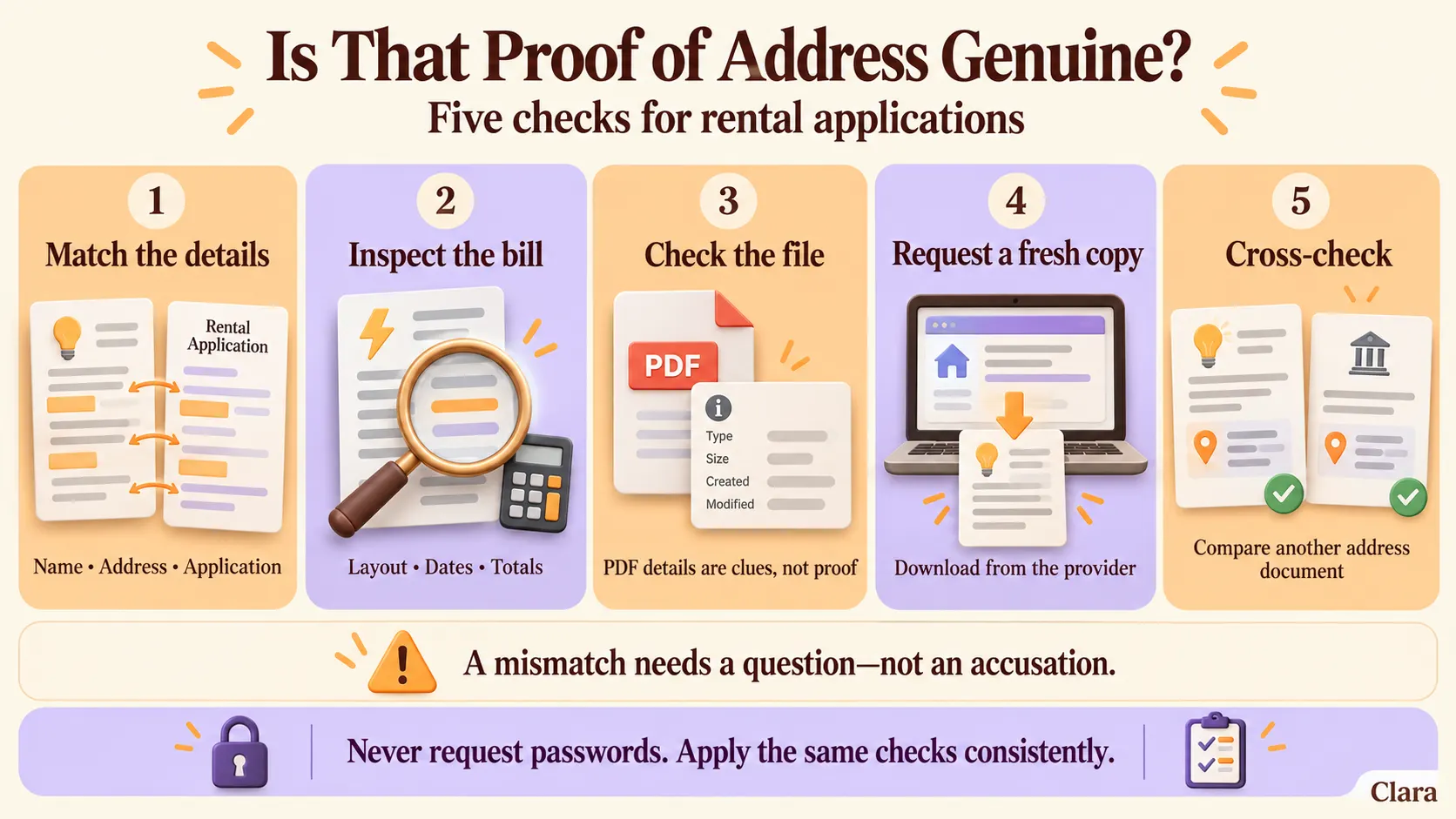
You do not need special software to review a utility bill. A careful, repeatable process catches many of the cases that matter. Follow these steps in order for every applicant.
Step 1: Match the Name and Address to the Application and ID
Start with the basics. Compare the name, the service address, and the mailing address with the application and the government ID. Small differences matter. A missing apartment number, a middle initial that changes, or a street spelled two ways can be a sign that the document was built from the wrong details.
If the address differs from the one on the ID, ask why. People move, and a driver's license often lags behind. A calm question gives an honest applicant an easy answer, and it tells you a lot when the answer does not hold together.
Step 2: Inspect the Document Closely
Open the file at full size and zoom in. Look at the logo edges, the alignment of columns, the spacing of numbers, and the fine print at the bottom. Real bills are produced by software, so the layout is clean and consistent from top to bottom. Check the billing period, the due date, and the total. Add up the line items yourself.
Compare the document to a sample from the same provider when you can. Many utilities show a sample on their website to explain each section. Matching the structure, such as where the account number and service address appear, is a useful check. Do not rely on a sample alone, since layouts differ by region and by service type.
Step 3: Check the PDF and the File Details
A PDF can tell you something the page does not. Open the file's properties and look at the creation date, the modified date, and the software that made it. A file that was created yesterday in a photo editor or a free document tool, when it claims to come from a utility two months ago, deserves a question. Keep in mind that this is only a clue. Some utilities export files through tools that look unusual, and metadata can be removed or changed.
Be careful with screenshots and photos. They are easier to edit and harder to inspect, because the file details are often gone. If an applicant sends a screenshot, ask for the original PDF from the provider or a download from their online account.
Step 4: Ask for a Fresh Copy From the Online Account
This is the strongest simple check. Ask the applicant to download the latest bill from their online account, or to share their screen for a short video call while they log in. A real account holder can do this in a couple of minutes. An applicant with a fake often stalls, says the account is in someone else's name, or offers excuses.
You do not need to see the login or the password. You only need to see that the account exists, that the name and address match, and that the page on screen looks like the one you were sent. Never ask anyone to hand over a password. A live look at the account is a real-time check that a template cannot fake.
Step 5: Cross Check With a Second Document
One document is never enough. Compare the document with a bank statement, a lease agreement, or a letter from a past landlord. The same name and address should show up across the file. If the story changes from one document to the next, slow down.
You can also test the address itself. Look it up on a public map or a county property record to confirm that it is a real home and that it is not a vacant lot, a commercial building, or a mailbox store. Pair this review with our guide to spotting fake pay stubs, since a fake statement and a fake pay stub often travel together.
When a Fake Utility Bill Points to a Bigger Problem
A fake utility bill is rarely the only issue. Applicants who forge one document often have other gaps, such as a made up job, borrowed income, or an identity that does not belong to them. In the worst cases, a fraudster uses a stolen name and builds the paperwork and the pay stub to match. Our article on identity theft in rental applications explains how that scheme works and what the early signs look like.
This is why identity checks matter alongside document checks. A document can look perfect and still belong to a different person. Confirming that the applicant is who they claim to be closes that gap. If you want to understand the basics, read what identity verification for renters involves. Rent with Clara also offers tenant ID verification as part of screening, so you can confirm the person behind the paperwork.
Can Landlords Call the Utility Company to Verify a Bill?
Most owners can try, but the answer is usually limited. Many utility providers will not discuss an account with anyone other than the account holder, and privacy rules limit what they can share. A call may confirm very little.
The better route is to involve the renter. Ask for written permission, or ask the applicant to request a service letter or a fresh copy from their provider. You do not need the full account history. You need a simple answer to one question: does this person receive service at this address?
Are Digital Utility Bills and Online Statements Acceptable?
Yes, in most cases. Many people receive paperless bills now, and a digital copy downloaded from the provider's website or app is often as good as a mailed one. What matters is the source. A PDF downloaded from the account, or a screen share of the live account, is far more trustworthy than a screenshot or a photo that has been resized and compressed.
Set a clear rule for your rental property and apply it to everyone. For example, ask for a bill from the last 60 days, in PDF form, from the provider's site. A consistent standard is fair to renters and helps simplify your review.
Can Software Detect a Fake Utility Bill?
Yes, to a point. Document fraud tools scan files for edits, compare layouts to known templates, and run validation checks on totals and dates. Some flag counterfeit documents in seconds, which beats checking each one manually. This kind of automation can help when you review many applications, but it is not magic. Treat a software flag as a prompt to look closer, and treat a clean result as one signal rather than a verdict.
If you review documents yourself, a short calculation check catches many forgeries. Itemize the charges, apply the stated tax, and compare the result with the total due. Then confirm that the service provider's name, address, and phone number match what the provider shows on its own site. If something is off, raise a question with the renter before you dispute anything. A simple mistake on a real statement is far more common than a forgery, and compliance with fair screening rules means treating every applicant the same way.
What to Do If You Think a Utility Bill Is Fake
Stay calm and stay factual. You may be wrong, and an accusation can backfire. Use these steps instead:
Tell the applicant that something on the document does not match and ask for a new copy or another proof of address.
Ask for the same extra documents you would ask from any applicant in the same spot.
Write down every discrepancy you saw, what you asked, and how the applicant answered, with dates.
Decide using the screening criteria you set in advance, and apply them to every applicant in the same way.
If your decision rests partly on a tenant screening report, the FTC explains what landlords need to do in its guide on using consumer reports, including how to notify the applicant. Rules for rentals vary by state and city, so check what applies where you operate.
Faking a document to win a lease is serious. Depending on the facts and where you live, it may be treated as fraud or forgery, and an attorney in your state can tell you what applies. If you believe the applicant used someone else's identity, the FTC's guidance on recovering from identity theft explains the next steps and points victims to IdentityTheft.gov for a free recovery plan. Do not confront the applicant or contact the person whose name was used before you have thought it through.
Frequently Asked Questions
Is it illegal to fake a utility bill?
Making a fake utility bill to win a lease can be treated as fraud or forgery, depending on the facts and the state. The penalty differs by location. If you find a forged document, keep copies and notes, and speak with a local attorney before taking any step beyond denying the application.
How do you identify a fake utility bill?
Look for mismatched fonts, a blurry or stretched logo, an account number in the wrong format, math that does not add up, and an address that differs from the ID. Then ask for a fresh copy from the applicant's online account. Several small flaws together are a stronger signal than any single one.
How do landlords verify a utility bill submitted with a rental application?
Start by comparing the name and address with the application and ID. Then inspect the layout and totals, and check the PDF details. The strongest step is asking the applicant to download a new bill from their online account or share their screen. A second document, such as a bank statement, adds more confidence.
How can I show proof of utilities or address for a rental application?
Send a recent bill as a PDF downloaded from your provider's website or app, ideally from the last 60 days. If the bill is not in your name, offer a bank statement, a lease agreement, or official mail instead. Make sure the name and address match your application and ID.
What documents can I use as proof of address or residency?
Common choices are a utility bill, a bank or credit card statement, a lease agreement, and official mail from a government agency, school, or insurer. A pay stub or tax form that lists your home address can also work. Many owners accept two documents when one is not available.
Can I use a digital utility bill as proof of address?
Usually yes. A PDF downloaded straight from your utility account is widely accepted, and many providers now send only paperless bills. Avoid screenshots and photos, because they cannot be inspected as closely. Some owners may ask you to share your screen during a call to confirm the account is real.
Check the Bill, Then Check the Person
A utility bill is a useful clue, but it is only a piece of paper. Match the details to the ID, inspect the layout, check the file, ask for a fresh copy from the online account, and compare it with a second document. That short routine will catch many fakes before they reach a lease.
No single check catches everything, so build a routine you can repeat for every applicant. Confirm the document, confirm the person, and keep notes. Rent with Clara helps rental owners confirm identity during tenant screening, so a clean looking document is never the only thing standing between you and a bad lease.
Taylor Wilson
Founder
Taylor Wilson is the Founder of Rent with Clara, a modern renter screening platform built to streamline the rental application process. As both a renter and an independent landlord, Taylor sits on both sides of the lease, and built Clara to give renters control over what they share while giving landlords reliable and verified applications.
Read Articles
1099 Tenant Proof of Income: Complete Verification Guide For Landlords