Heads up: We're screening experts, not lawyers. This article is here to help you understand the topic, but it's not legal advice. Laws vary by state and locality, and they change. If you have questions about your specific situation, talk to a qualified attorney.
Filing a claim rarely goes smoothly for landlords who are figuring out the process for the first time while a rental sits mid-repair. Landlord insurance helps protect a rental investment against exactly this kind of setback, and knowing the order of operations before something happens brings a measure of peace of mind that's hard to put a price on.
This guide walks through what to do first, who to call, and what to expect once an adjuster gets involved.
Key Takeaways
Document the situation with photos, video, and a written timeline before you call your carrier. Adjusters move faster when the file is already organized.
Landlord coverage is designed to protect a rental property specifically, and typically costs more than standard home insurance because rental properties see more claims overall.
A claim and a security deposit deduction solve different problems. Know which one applies before you file.
Most carriers require notice within days of discovering an issue, not months, so speed matters as much as accuracy.
"The owners who move through a claim the fastest usually aren't the ones with the most experience. They're the ones who kept a simple folder of photos and records for the property all along, so nothing had to be reconstructed from memory."
Taylor Wilson, CEO of Rent with Clara
Wind and hail remain among the most common triggers for a home insurance or landlord insurance claim in a given year. For landlords, the odds run higher still. Rental properties tend to see more claims overall than owner-occupied homes, since a tenant uses a building differently than an owner would, and normal wear can tip into something more serious faster than expected. That reality makes having the right insurance in place, and knowing how to use it, as important as the coverage itself.
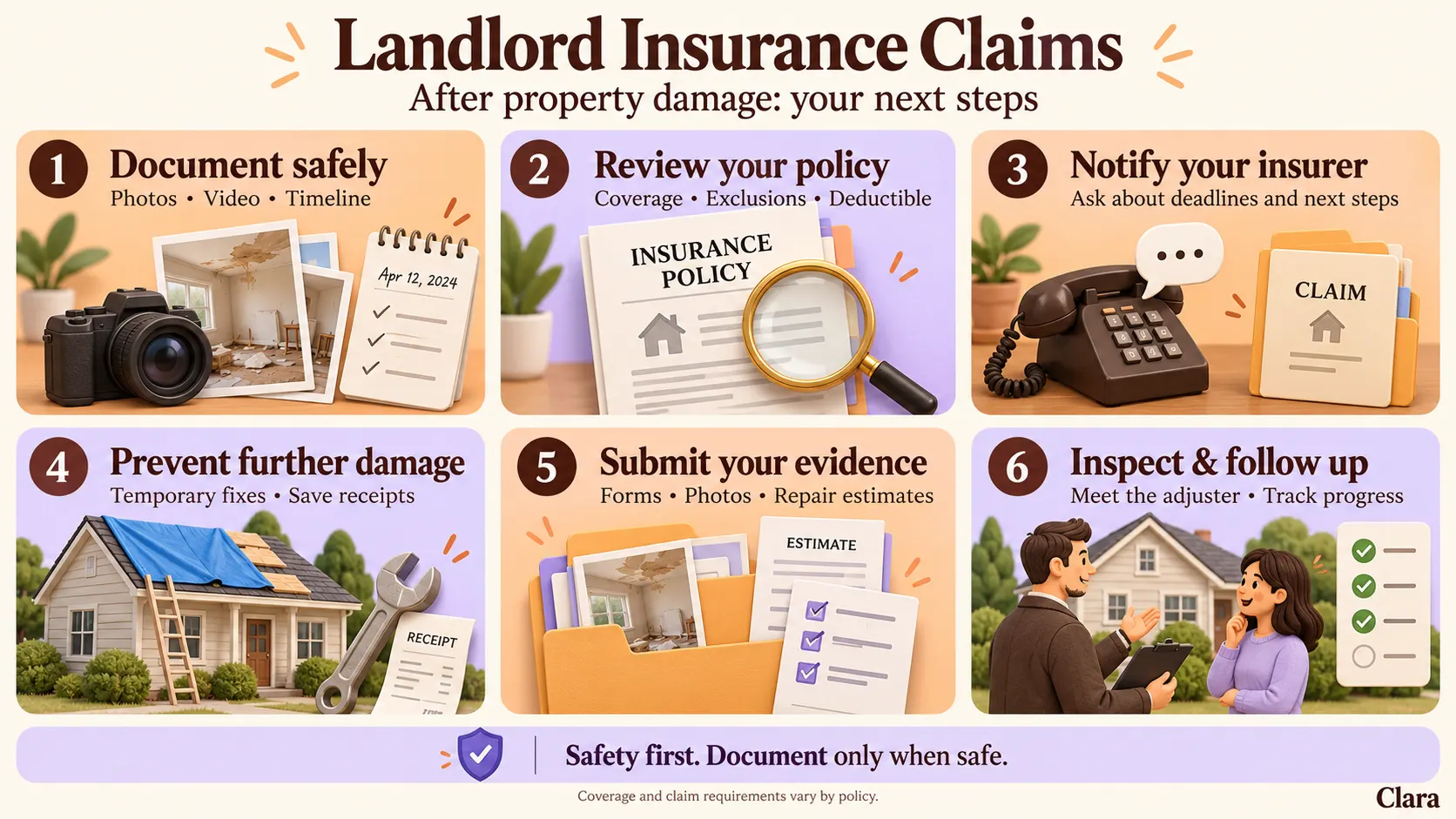
This guide reflects patterns landlords report while managing claims across rental properties on Clara's platform, from a burst pipe in a duplex to storm harm on a single-family rental. Here are the 7 steps that get a claim paid without unnecessary delays.
1. Document the Damage Before You Touch Anything
Photograph and video the affected area from multiple angles before you clean up or start repairs. Capture wide shots of the room or structure, then close-ups of the specific problem, including any visible cause like a cracked pipe or a hole in the roof. Note the date you discovered it and how you believe it happened.
If a break-in, vandalism, or theft causes damage to the property, file a police report first and keep the report number, since carriers often ask for it before opening a claim tied to a crime. A mistake landlords often make is starting repairs immediately to keep a rental income-ready — that instinct is understandable, but repairing before documenting can leave you without proof of the original loss, which slows down or shrinks a settlement.
2. Review Your Landlord Insurance Policy Coverage
Pull your landlord coverage documents and confirm what's included before you call your carrier. Most landlord policies include dwelling coverage for the structure itself, landlord-owned appliances and fixtures, and protection against liability claims if a tenant or visitor gets hurt on the property. Some also include coverage for lost rental income if a unit becomes uninhabitable during repairs, though this varies by carrier and isn't automatic.
Most policies exclude flood, earthquake, normal wear and tear, and a tenant's personal belongings — landlord insurance won't cover those items, since they typically fall under the tenant's own policy.
Does landlord insurance cover tenant damage?
Landlord coverage can help cover sudden, accidental harm a tenant is responsible for, like an overflowing tub that damages flooring. It typically excludes gradual harm from neglect or ordinary use.
Those situations are usually handled through the security deposit or a direct claim against the tenant, not through insurance. Check your deductible too — if repair costs sit close to or below it, filing may not be worth the potential increase at renewal.
3. Contact Your Insurance Company Right Away
Call your carrier or agent as soon as you've documented the situation. Most policies set a notice window measured in days, not weeks, so waiting can put a claim at risk even when the underlying loss is covered.
Ask directly what your deadline is, since it varies by carrier and by state. During this call, ask what documentation the adjuster will need, whether you can pursue temporary repairs in the meantime, and how long the review typically takes.
Write down the claim number and the adjuster's direct contact information — a general customer service line works for the first call, but a direct line saves time later.
4. Make Temporary Repairs to Prevent Further Damage
You're generally responsible for reasonable steps to stop a situation from getting worse, like tarping a damaged roof, shutting off water to a leaking pipe, or switching on a backup sump pump if one's already installed. Skipping this step can affect how much a carrier pays, since carriers expect landlords to prevent avoidable, additional harm.
Save every receipt for materials, contractor visits, and temporary fixes — these are typically reimbursable as part of a settlement, but only if you can show what was spent and why. Some carriers treat coverage for these interim steps as optional, so it's worth confirming ahead of time rather than assuming.
Keep repairs genuinely temporary; full repairs usually wait until the adjuster has assessed the property, unless told otherwise.
5. Complete the Claim Forms and Submit Your Documentation
Fill out the forms your carrier provides as completely and accurately as possible. Gaps or vague answers are one of the most common reasons claims stall in review. Attach photos, videos, receipts, and any police report alongside the forms.
Landlords who keep a simple digital folder per property, with past inspection photos and maintenance records already organized, tend to move through this step in a fraction of the time it takes someone starting from scratch.
Landlord insurance vs homeowners insurance explains a few coverage differences worth double-checking before you submit, since landlord and homeowners forms aren't interchangeable.
6. Prepare for and Attend the Adjuster's Inspection
Your carrier will typically send an adjuster to inspect the property in person, especially for larger claims. Be present if you can, or arrange for your property manager to walk the property with them.
Point out everything affected, not just the most obvious issue, since secondary problems like water intrusion behind drywall are easy to miss.
Get at least two independent repair estimates if your carrier allows it. Competing bids give you a stronger position if the adjuster's number comes in lower than what local contractors are actually charging.
Landlord insurance cost 2026 breakdown covers how claims history can affect a premium at renewal, worth reviewing before deciding whether a smaller claim is worth filing at all.
7. Track the Claim Through to Payment
Most states require carriers to acknowledge a claim within roughly two weeks and to pay promptly once they agree to cover it. Follow up if you haven't heard back in that window — a short, polite call asking for a status update is normal and expected, not pushy.
How long does a landlord insurance claim take to pay out?
Most straightforward claims pay out within two to six weeks after the adjuster completes the inspection. Complex claims involving structural issues, disputes over cause, or large payouts can take longer.
Staying organized and responsive to requests is the biggest factor landlords control. If your carrier denies a claim or offers a settlement that doesn't match your documented loss, you can request a written explanation and escalate to a claims manager.
Rent with Clara’s ultimate guide to renters insurance is a useful companion resource if the situation also affects a tenant's personal property, since that loss runs through a separate policy entirely.
Requirements That Keep Your Landlord Insurance Coverage Valid
Most policies come with conditions attached, and they matter more than landlords expect until a claim tests them. Carriers typically require working smoke and carbon monoxide detectors in every unit, prompt repair of known hazards once you're aware of them, and notice if a property will sit occupyless — that is, empty — beyond a set stretch.
Missing any of these doesn't always void coverage outright, but it gives an adjuster grounds to reduce or delay a payout on an otherwise valid claim. Pull your declarations page once a year, not just after something goes wrong.
Coverage details shift at renewal more often than landlords realize, and a requirement that didn't apply last year can quietly appear on this year's paperwork.
What Renters Insurance Covers That Yours Doesn't
A tenant's personal possessions, temporary housing if a unit becomes unlivable during repairs, and liability for harm a tenant causes beyond a sudden, accidental event typically fall under the tenant's own renters insurance, not your landlord coverage.
Some leases require proof of renters insurance before move-in specifically to draw this line early, so there's less confusion later about what is and isn't part of your coverage.
This distinction tends to surface fastest mid-claim, when a tenant assumes harm to their belongings will be handled the same way as harm to the structure. Setting that expectation in the lease itself, before they ever move in, saves a difficult conversation later.
Building a Relationship With an Agent Before You Need One
If you don't already have someone at your insurance agency you can call directly, it's worth finding one now rather than mid-claim. Ask how the agency handles claims, whether estimates get reviewed in-house or sent to a separate adjusting team, and what counts as adequate documentation for your type of property.
If you're still shopping, take the time to find a landlord-friendly agency that understands the right insurance fit for a rental specifically, since requirements and exclusions can differ meaningfully from a standard home insurance policy.
An agent who already knows the property before a loss happens moves faster once a claim opens. They're not starting from a blank file, and that familiarity often shaves real time off a review that would otherwise sit in a general queue.
Ways to Save Money on Landlord Insurance Coverage Going Forward
A few habits tend to lower the cost of landlord insurance over time: raising the deductible if the property can absorb it, bundling landlord and home insurance under the same agency, and asking directly whether safety upgrades like a monitored alarm or updated wiring qualify for a discount.
Requesting a free landlord insurance quote from more than one agency at renewal, rather than letting coverage auto-renew, is one of the simpler ways to bring down the cost of landlord insurance, since loyalty rarely translates into a better rate once a claim history exists.
It's also worth weighing whether a small claim is worth filing at all. Buying insurance to cover a loss that sits close to the deductible can end up costing more across future premiums than paying for the repair directly, so it's rarely a straightforward call to file just because coverage technically allows it.
Frequently Asked Questions
Does landlord insurance cover accidental damage caused by a tenant?
Yes, in most cases. Landlord coverage typically extends to sudden, accidental harm, like a tenant accidentally starting a small kitchen fire.
It generally excludes harm from neglect, pets, or normal wear, which usually falls to the security deposit instead.
What's the difference between filing an insurance claim and deducting from a security deposit?
A claim covers larger, sudden losses tied to a specific covered event, paid by your carrier. A security deposit deduction covers smaller harm beyond normal wear and tear, paid by the tenant.
Most landlords use the deposit first and reserve a claim for loss that exceeds it.
Will filing a landlord insurance claim raise my premium?
It can, especially with more than one claim within a few years, since carriers weigh claims history heavily when setting rates. For minor harm close to your deductible, it's often worth comparing the repair cost against a likely increase in the cost of your landlord insurance before deciding to file.
How long do I have to file a landlord insurance claim?
Most policies require notice within a matter of days after you discover the issue, though the exact window depends on your carrier and state. Check your paperwork or call your agent directly, since missing the deadline can affect whether a claim gets paid.
Does landlord insurance cover a tenant's personal belongings?
No. Landlord coverage protects the structure, your own fixtures and appliances, and your liability exposure.
A tenant's personal belongings are only covered if the tenant carries their own renters insurance.
Final Thoughts
A landlord insurance claim moves faster when the paperwork is ready before you pick up the phone. Build the habit of photographing a rental at every turnover and keeping maintenance records current, so if something happens, you're not starting from zero.
Clara helps independent landlords screen renters more confidently before move-in, through a portable rental application covering identity, credit, criminal, eviction, and income verification — free for landlords to use. A well-screened tenant won't prevent every claim, but it's one of the more overlooked ways to lower how often you need to file one.
Rental property insurance guide is a good next read if you're still shopping for the right coverage before a claim ever becomes necessary.
Taylor Wilson
Founder
Taylor Wilson is the Founder of Rent with Clara, a modern renter screening platform built to streamline the rental application process. As both a renter and an independent landlord, Taylor sits on both sides of the lease, and built Clara to give renters control over what they share while giving landlords reliable and verified applications.
Read Articles
1099 Tenant Proof of Income: Complete Verification Guide For Landlords