Heads up: We're screening experts, not lawyers. This article is here to help you understand the topic, but it's not legal advice. Laws vary by state and locality, and they change. If you have questions about your specific situation, talk to a qualified attorney.
This guide draws on common patterns seen in landlord-tenant deposit disputes and general principles that apply across most states.
Every lease ends the same way: the tenant hands back the keys, and the landlord decides how much of the deposit to return. Handled well, that moment barely registers.
Handled poorly, it becomes the single most contested part of the entire tenancy — and one of the easiest disputes to prevent with the right habits.
Key Takeaways
Move-out disagreements over damage or repair costs are one of the most common sources of friction between landlords and tenants, making clear deduction documentation one of the highest-value habits a landlord can build.
Landlords can deduct unpaid rent and damage beyond normal wear and tear, but courts consistently reject vague or inflated charges.
Most states require a landlord to send a written noticewith an itemized statement within a set window after move-out, or risk forfeiting the right to deduct anything at all.
Bad faith withholding can cost a landlord far more than the deposit itself, including the tenant's legal fees, in many states.
“Itemizing a deduction sounds like busywork until you're the one trying to defend a charge with nothing but a memory of what the carpet looked like. It's not glamorous, but it's the difference between a conversation and a dispute. We tell landlords all the time: the five minutes it takes to write it down properly is the cheapest insurance you'll ever buy."
Taylor Wilson, CEO of Rent with Clara
Introduction
The security deposit isn't a landlord's money to spend freely. It's the tenant's money, held to cover specific, legally defined costs tied to the rental period. Get the deduction process right and you protect your investment without the dispute.
Get it wrong and you risk losing the entire security deposit, along with your credibility if the matter ever escalates.
Understanding both sides' rights and responsibilities from day one — what a tenant owes for damage, and what a landlord owes in terms of notice and documentation — is what keeps most deposit disputes from ever reaching small claims court.
Normal Wear and Tear vs. Damage: Where Landlords Draw the Line
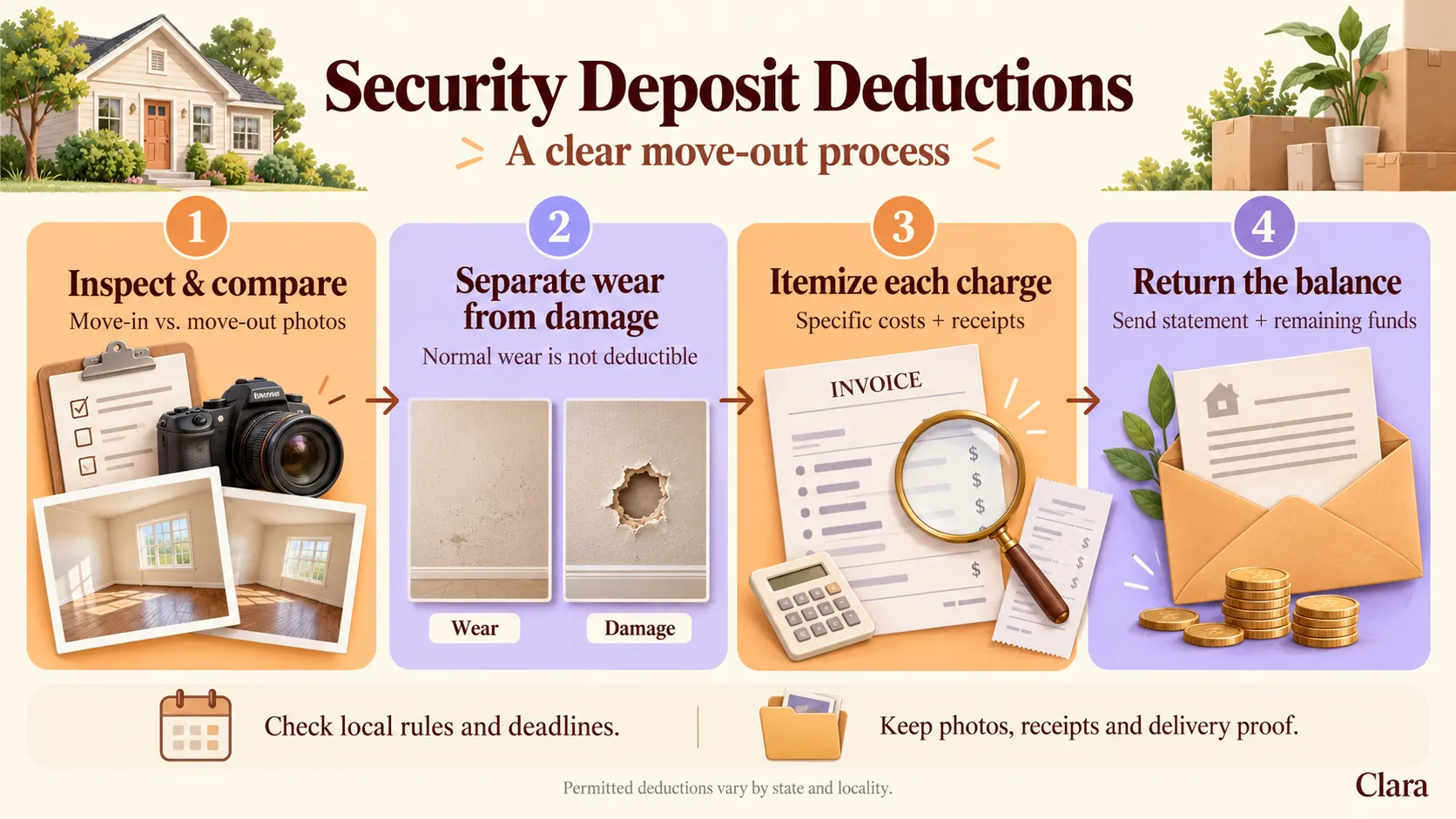
Normal wear and tear covers the gradual deterioration that happens just from someone living in a space — faded paint, worn carpet fibers, small nail holes from picture frames, loose door hinges. It can include deterioration that simply comes with time and ordinary use, and a landlord cannot deduct for any of it, no matter how much it bothers them at move-out.
Damage is different: it's the result of negligence, accident, or abuse, like a cracked window, a burn mark on a counter, or pet stains soaked into a subfloor.
This distinction causes more disputes than any other part of the security deposit process, mostly because landlords and tenants define "normal" differently. The test courts apply is simple: would this condition exist even if the tenant had taken reasonable care of the rental unit?
If yes, it's wear and tear. If not, it's deductible. Documenting the unit's condition at move-in, room by room, with dated photos, removes most of the guesswork later.
What can a landlord legally deduct from a security deposit?
A landlord can deduct from security deposits for unpaid rent, damage beyond normal wear and tear, unauthorized alterations, and above-normal cleaning. A tenant is generally responsible for the damages they or their guests caused, but not for routine turnover cleaning or cosmetic issues from ordinary daily use.
Deductions must be itemized in writing with supporting documentation wherever possible.
What a Landlord May Deduct From a Security Deposit
Every state allows landlords to make deductions for unpaid rent, including a final balance if the tenant leaves owing money, and for damage beyond normal wear and tear, unauthorized alterations like an unapproved paint color, and cleaning that goes well beyond standard turnover.
Some states also permit deductions for specific lease violations, like early termination costs or unpaid utility bills the tenant agreed to cover — but the rules aren't uniform, and what's allowed in one state may not fly in another.
Landlords should regularly check their state law library or local housing authority for the specifics that apply to their rental property, since deposit rules are one of the areas most likely to change without much notice.
How to Itemize a Security Deposit Deduction the Right Way
A deduction that isn't itemized properly is a deduction a landlord probably can't keep. The landlord must give the tenant a clear, written list of each charge, the specific damage or service it covers, and supporting documentation such as a receipt or invoice wherever possible.
Vague line items like a generic "cleaning fee" invite a challenge; a specific description tied to an actual invoice usually doesn't.
Attach before-and-after photos from the inspection whenever possible — they turn a subjective claim into an objective one and are often what settles a dispute before it reaches court. Mail the statement by certified mail, and keep a copy for your own records along with proof of delivery and timing.
State Law and Your Security Deposit Deadline
Timing matters as much as the deduction itself. Most states require a landlord to provide an itemized statement and return any remaining funds within 30 days of move-out, though the exact window varies — some states use a shorter deadline when there's no claim at all, and a longer one when deductions apply.
Miss that deadline and the consequences can be severe: in many states, missing the statutory window means the landlord must return the deposit in full, regardless of legitimate damage.
How long does a landlord have to return a security deposit?
The deadline depends on state law, typically security deposit within 14 to 30 days of move-out. Some states start the clock when the tenant returns keys; others start it when the tenant provides a forwarding address.
Missing the deadline can forfeit the landlord's right to any deduction, even a legitimate one.
When a Tenant Abandons the Rental
Abandonment complicates the standard timeline. If a tenant disappears without notice, stops paying rent, and leaves belongings behind, a landlord can't simply treat the unit as vacated the moment it looks empty — most states require a specific legal process, often involving a formal notice period, before the unit can legally be re-let.
The security deposit to cover unpaid rent accrued up to the point of legal abandonment, plus any damage found on inspection, is generally fair game, but the itemization and notice requirements still apply even when the tenant is unreachable.
The safest approach: document the date the unit was confirmed empty, follow the required notice process before disposing of any left-behind property, and handle the deposit accounting exactly as if the tenancy had ended through a normal move-out.
What Happens When a Landlord Gets It Wrong
Penalties for improper withholding are designed to sting. Many states allow a court to award the tenant a multiple of the wrongfully withheld amount on top of their legal fees when the landlord acted in bad faith or simply ignored the rules.
Deposit disputes are also one of the more common categories of landlord-tenant cases that end up in small claims court, and most of them settle once the tenant sees documented evidence rather than reaching an actual hearing.
Can a tenant sue a landlord over security deposit deductions?
Yes — a tenant can sue the landlord in small claims court if they believe deductions were improper or the return deadline was missed, typically for the wrongfully withheld amount plus any state-mandated penalty.
Courts tend to favor tenants when the landlord fails to send proper documentation or misses the statutory notice window.
Helping Tenants Get Their Security Deposit Back
Most disputes are preventable long before move-out day. Sharing the move-in inspection report at signing, giving tenants a written move-out checklist, and offering a walkthrough a week or two before the lease ends all help turn the return of the security deposit conversation from something adversarial into something predictable.
None of this guarantees a tenant gets back the deposit in full — legitimate damage is still deductible, and a tenant may end up owing more than expected if the unit wasn't cared for. But a tenant who knows upfront what they're getting back — the deposit minus any documented deductions — is far less likely to dispute a charge that was clearly earned, and far more likely to leave the rental unit in good condition on the way out.
Frequently Asked Questions
Can a landlord deduct for carpet replacement if the tenant only lived there a year?
Generally no, not for the full cost. Courts typically prorate carpet and similar items based on their remaining useful life, so a tenant who stayed for only a small fraction of that lifespan should only be charged a proportional share — and only if actual damage occurred beyond normal wear.
Can a landlord use the security deposit for last month's rent?
Only if the lease explicitly allows it, or if the tenant left owing rent. Some states restrict this entirely unless the lease specifically states the deposit can be applied to the final month.
Landlords should check state law and their own lease language before assuming this applies.
What should a tenant do if they disagree with a deduction?
A tenant may send a written dispute letter, listing the specific deductions being contested along with supporting evidence like move-in photos.
Most disputes settle at this stage; if not, small claims court is the standard venue, and most jurisdictions don't require an attorney.
Bottom Line
The deposit process rewards landlords who document early and communicate clearly. A dated move-in inspection with photos, a lease that spells out what counts as damage, and a habit of providing an itemized breakdown for every deduction will keep most disputes from ever starting.
For state-specific legal information, official self-help resources are usually the best starting point.
For California-specific rules, the California Courts' self-help guide to security deposits is a solid starting reference.
Getting tenant screening right from the start — verifying identity, income, and rental history before signing a lease — is one of the best ways to avoid ending up in a deposit dispute in the first place, which is where Clara's screening tools come in.
Taylor Wilson
Founder
Taylor Wilson is the Founder of Rent with Clara, a modern renter screening platform built to streamline the rental application process. As both a renter and an independent landlord, Taylor sits on both sides of the lease, and built Clara to give renters control over what they share while giving landlords reliable and verified applications.
Read Articles
1099 Tenant Proof of Income: Complete Verification Guide For Landlords