Heads up: We're screening experts, not lawyers. This article is here to help you understand the topic, but it's not legal advice. Laws vary by state and locality, and they change. If you have questions about your specific situation, talk to a qualified attorney.
This guide draws on patterns seen across thousands of rental applications processed through Clara's platform, plus current insurance industry data on landlord insurance policies, coverage, and cost.
No state in the country legally requires a landlord to carry landlord insurance. That surprises a lot of new property owners.
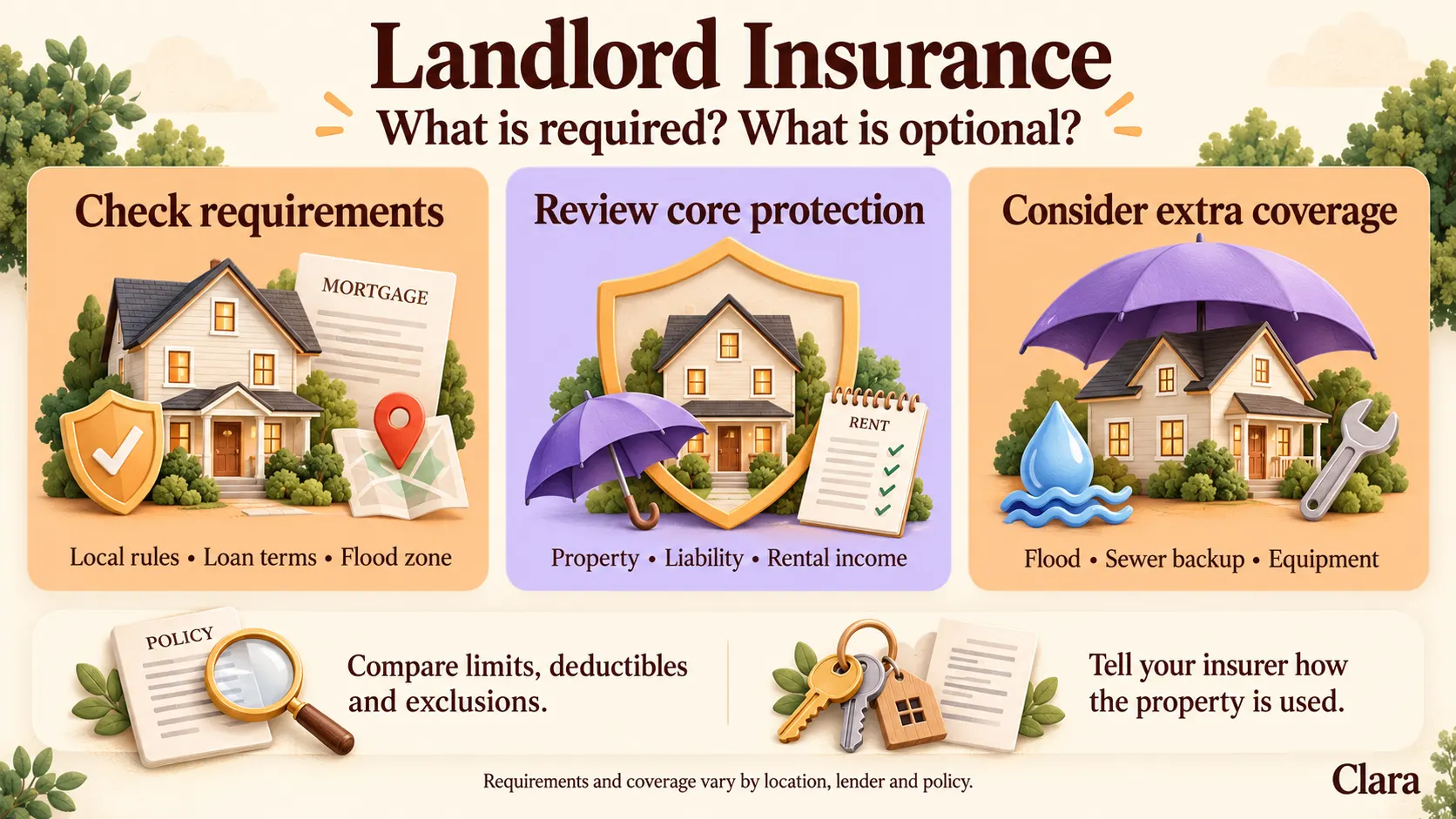
The mandatory part of the equation comes from somewhere else entirely: your mortgage lender, your flood zone, and sometimes your own risk tolerance. Landlord insurance policies typically cost noticeably more than a comparable homeowners policy on the same house, and that gap alone tells you why so many landlords assume there's a law behind it. There isn't.
What there is instead is a patchwork of lender rules, federal flood requirements, and financial exposure that makes coverage feel mandatory even when it technically isn't.
The decision to carry landlord insurance usually comes down less to the law than to what's actually at stake once you're becoming a landlord — location, financing, and how much risk you're willing to hold onto. What follows breaks down what drives that decision, from lender requirements to the coverage worth adding once the basics are in place.
Key Takeaways
No U.S. state requires landlords to carry landlord insurance by law, but mortgage lenders almost always make it a condition of the loan.
Flood insurance is the one coverage that can be legally mandatory, triggered by a federally backed mortgage on a property in a FEMA high-risk flood zone.
Landlord insurance typically costs more than homeowners insurance on the same property, and premiums vary sharply depending on where the rental property is located.
A standard homeowners policy will not cover a rental property once you start collecting rent, regardless of what your current policy says.
No state requires tenants to carry renters insurance, but landlords can build it into the lease as a condition of tenancy.
"Protecting a rental property was never just about the structure — it's about protecting the income that property is supposed to generate, and the people, both owner and tenant, who depend on that income holding steady."
Taylor Wilson, CEO of Rent with Clara
Is Landlord Insurance Required by Law in Any State?
No state has a law requiring property owners who rentout housing to carry landlord insurance. In that narrow legal sense, coverage is optional everywhere, from Texas to Vermont — the requirement almost always comes from somewhere other than the statute books.
What trips people up is assuming a homeowners policy carries over once they start renting out a property. It doesn't.
The moment rent starts coming in, an insurer can deny a claim on the grounds the home is now used commercially, a use a residential homeowners policy explicitly excludes. Landlord insurance closes that gap, covering property and liability exposure — plus lost income — that a homeowners policy was never built to handle.
Landlord Insurance vs. Home Insurance: What's the Difference
The two policies sound alike, which is usually where the confusion starts. A standard home insurance policy assumes the person filing a claim also lives in the house full-time.
Once that assumption breaks because a tenant is paying rent to live there instead — the type of property insurance built around it breaks too, even though the structure itself hasn't changed.
The practical differences show up in what each policy actually covers. Landlord insurance prices in the added risk of tenant turnover and use, drops coverage for tenant's personal belongings almost entirely since those were never the owner's to insure, and adds protection against loss of rental income that a homeowners policy has no reason to include.
Comparing the two side by side makes the split clear: one protects a home you live in, the other protects a rental home you don't.
When Lenders Make Landlord Insurance Mandatory
This is where "optional" becomes practical reality for most owners. Anyone who financed a rental property almost certainly has a lender that requires proof of active landlord insurance for the life of the loan, the same way it would require homeowners insurance on a primary residence.
Skip a renewal and the lender can force-place a policy on the owner's behalf — usually pricier and built to protect the lender's stake in the structure, not the owner's.
Landlords who own a property outright, with no mortgage attached, are the one group with genuinely zero requirement from any source. That doesn't remove the exposure.
A burst pipe or a slip-and-fall claim costs the same whether or not a lender is watching, which really comes down to a choice: protect your investment on your own terms, or leave it exposed.
Flood Insurance: The One Coverage That Can Actually Be Mandatory
Flood damage sits outside every standard landlord or homeowners policy. Under the federal Flood Disaster Protection Act, flood coverage becomes a legal requirement — not just a lender preference — when two things line up: the property sits in a FEMA-designated high-risk flood zone, and the loan is federally backed or federally regulated, which covers the large majority of conventional, FHA, VA, and USDA mortgages.
Meet both conditions and the lender must enforce coverage for as long as the loan exists. Outside a mapped high-risk zone, flood coverage isn't required, though a meaningful share of flood claims nationally come from moderate-risk zones that never triggered a mandatory purchase requirement in the first place.
Checking FEMA's flood map for the exact address, rather than assuming last year's zone still applies, is worth the five minutes it takes.
What Landlord Insurance Actually Covers
A landlord policy typically covers three things: damage to the structure itself, liability protection if someone gets injured on the property, and loss of use coverage if the unit becomes uninhabitable during a covered repair. None of that comes standard on a home insurance policy, and none of it extends to a tenant's own belongings.
That last point matters more than most owners expect. The policy protects the property owner's structure and liability exposure — it does nothing for what a tenant keeps inside the unit, which is exactly why so many leases include a renters insurance requirement.
Additional Coverage Worth Adding to a Landlord Policy
The base policy covers structure, liability, and lost income if a unit goes vacant after damage, but it stops well short of everything a rental property can throw at an owner. Landlords who've been through a claim usually come away with a longer list of what they wish had been included the first time.
A few endorsements come up often enough to be worth a real conversation with an agent. Ordinance or law coverage pays for additional construction expenses tied to building up to code after major damage — a cost that catches older properties especially hard.
Higher liability limits, sometimes paired with a separate umbrella policy, matter more for owners with several units or larger households, where an injury claim carries more exposure. Vandalism, equipment breakdown, and sewer backup are common exclusions that may not be covered unless added on purpose, which is why it's worth reading a policy's declarations page in full rather than skimming it.
What Landlord Insurance Costs by State
Location influences the cost more than almost any other factor. Wind, hail, wildfire, and hurricane exposure get priced into a policy at the ZIP code level, which is why the cost of landlord insurance varies so much depending on where a rental property is located — coastal and storm-prone states tend to run well above the national average, while lower-risk regions land closer to it.
A few variables move that number regardless of state: the property's rebuild cost, roof age, deductible, and whether loss of use coverage is included. It's worth taking those specifics straight to an agent rather than assuming a quote on a similar-sounding home down the street will match; check with your insurance agent about what's actually priced into a specific address before renewing.
How to Shop for the Best Landlord Insurance Quotes
Renewing the same policy year after year without comparison shopping is one of the more common ways landlords end up overpaying for coverage that hasn't kept pace with the property's actual rebuild cost.
Getting multiple landlord insurance quotes before each renewal, not just at the start, gives an apples-to-apples view of what different carriers are pricing in for the same risk.
A few questions are worth asking of every quote. Whether a policy is written on a named-peril or open-peril basis changes what's actually covered by default, and it's easy to miss in a quick side-by-side of premiums alone.
Whether the payout is based on replacement cost or actual cash value matters just as much, since actual cash value factors in depreciation and can leave a real gap after a total loss.
An independent agent who regularly writes policies for rental property, rather than a generalist who mostly handles owner-occupied homes, tends to spot these distinctions faster.
How to Decide What Coverage You Actually Need
Start with what the lender requires, then layer in what the actual risk looks like.
An owner in a wildfire or hurricane zone needs a different conversation with an agent than someone renting a duplex in a low-risk Midwest market — the right type of coverage depends on exposure, not just on what a neighbor carries.
Ask specifically what a policy excludes on any quote under comparison; flood, earthquake, and ordinance-related rebuild costs are common gaps that surprise owners after a loss, not before one.
For flood-zone specifics, FEMA's Flood Map Service Center lets an owner check the exact address rather than relying on assumptions about the area — a quick check that can save a longer conversation with an insurer after a claim is denied.
Insurance for Landlords with Multiple Rental Properties
A single-property policy stops making sense once an owner holds more than one rental home. Renewing separate policies on different schedules, with different carriers and different deductibles, turns into an administrative headache that also tends to leave gaps between properties nobody notices until a claim exposes them — and the exposure looks different for a long-term rental than it does for a vacation rentalwith weekly turnover.
Many insurers offer a schedule or portfolio policy instead, bundling multiple addresses under one renewal date with consistent terms across the portfolio. This matters most for liability, since a claim tied to one address can draw in an owner's other holdings depending on how the policy and any personal umbrella coverage are structured.
The same principle carries over to tenant risk: owners who rent out their property across several addresses have more exposure to track, not less, and managing that consistently — rather than property by property — is what actually protects the business as it scales.
FAQs
Does homeowners insurance cover a rental property?
No. Homeowners insurance is written for residential property that's owner-occupied and typically excludes claims once it's rented out.
An insurer can deny coverage entirely if it discovers a "homeowners" policy is actually insuring a rental. Owners need a dedicated landlord policy, sometimes called a DP-3 or fire policy, once tenants move in.
Can a landlord require tenants to carry renters insurance?
Yes, in nearly every state. No state law prohibits landlords from requiring a renters insurance policy as a lease condition, and none currently mandates it either.
The requirement has to be written into the lease with a clear minimum coverage amount, and owners typically ask to be named as an interested party so they're notified if the policy lapses.
Is landlord insurance tax deductible?
Yes. Landlord insurance premiums are generally deductible as a business expense on a rental property under federal tax law.
That treatment extends to add-on coverage like liability protection or loss of use coverage, since both relate directly to operating the rental as a business.
Bottom Line
Insurance is one piece of protecting a rental property. The other is protecting it from the person who's about to live in it, which starts with knowing who you're renting to before you hand over the keys.
Taylor Wilson
Founder
Taylor Wilson is the Founder of Rent with Clara, a modern renter screening platform built to streamline the rental application process. As both a renter and an independent landlord, Taylor sits on both sides of the lease, and built Clara to give renters control over what they share while giving landlords reliable and verified applications.
Read Articles
1099 Tenant Proof of Income: Complete Verification Guide For Landlords