

Heads up: We're screening experts, not lawyers. This article is here to help you understand the topic, but it's not legal advice. Laws vary by state and locality, and they change. If you have questions about your specific situation, talk to a qualified attorney.
This guide draws on patterns seen across thousands of rental applications and lease files processed through Clara's platform, along with current IRS guidance on rental recordkeeping.
An IRS letter, a tenant dispute, or a routine question from an accountant all come down to the same test: can you find the paperwork? Most independent landlords manage their rental properties without a dedicated bookkeeping team, which means recordkeeping habits fall entirely on the landlord.
Good rental property record keeping isn't glamorous, but it's the difference between a smooth audit and a stressful one.

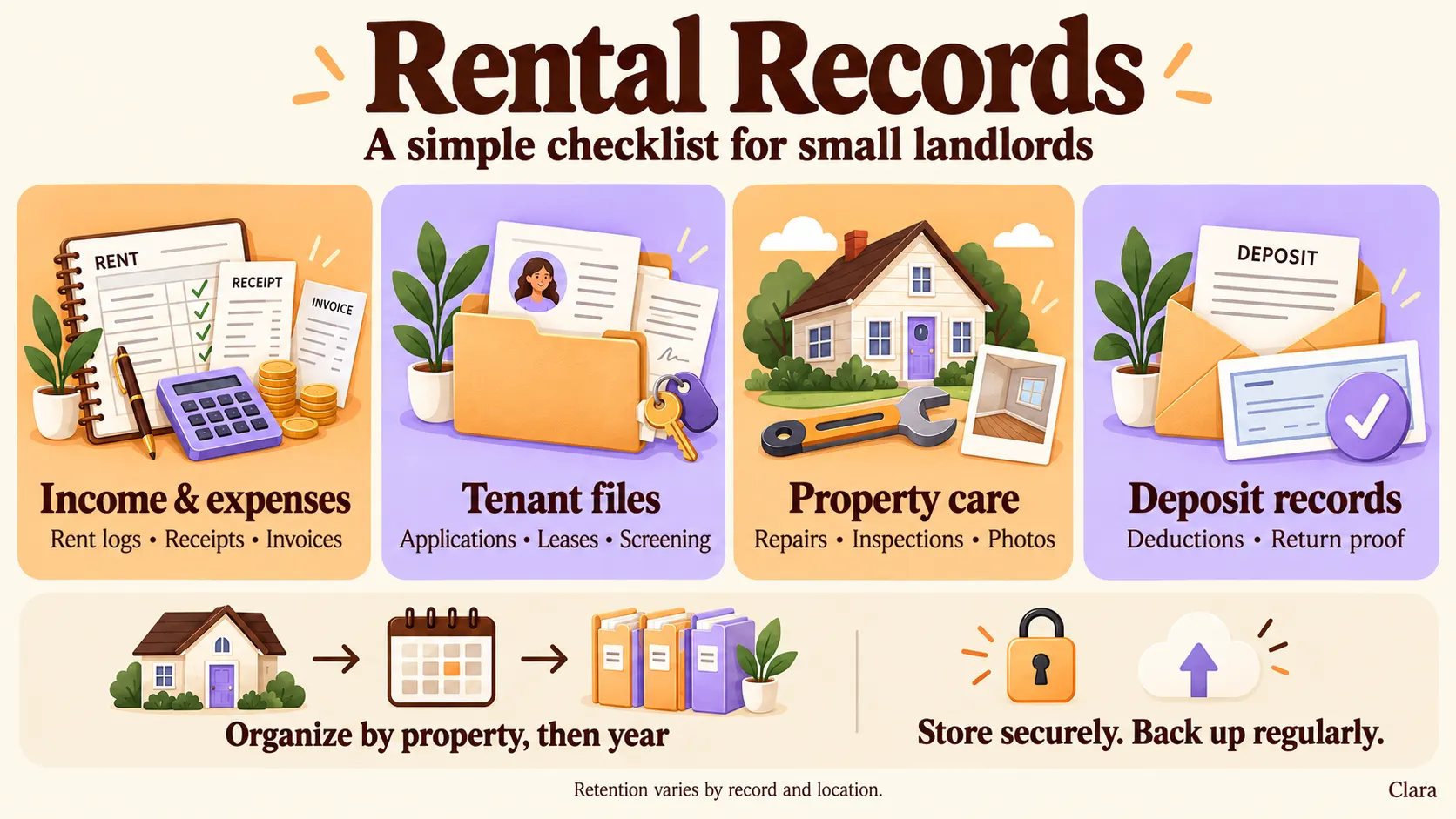
Start with income and expense records for each rental property, tracked separately rather than combined into one general pile. If you own more than one property, the IRS expects you to report each one's income and expenses on its own line of Schedule E, so mixing them together just creates work later.
Every rent payment, late fee, and utility reimbursement counts as income. Every repair, insurance premium, and management fee counts as an expense, and each one needs a receipt, invoice, or canceled check behind it.
Documentation matters more than the ledger entry itself. A plumbing repair logged in a spreadsheet means little to an auditor without the invoice and the payment record to back it up.
Keep lease agreements, move-in and move-out inspection reports, and any warranty documents tied to major appliances or systems in the property, since these often resolve disputes before they become a lawsuit.
Once a landlord owns more than one property, the way records are organized matters as much as what's kept. Set up a separate folder, spreadsheet, or accounting tool for each property instead of combining everything into one file, so every rent payment, repair, and invoice can be traced back to the correct unit.
This is what keeps income and expense figures accurate when it's time to report each property on its own line.
As a portfolio grows, a dedicated accounting system, even a simple one, makes it easier to see which property is costing more to maintain and cuts down on the errors that come from re-sorting a shared spreadsheet at the end of the year. Landlords who treat each property as its own set of books tend to spend far less time reconstructing what happened months later.
Most tax-related rental records should be kept for as long as the IRS's standard audit window stays open. If the IRS suspects underreported income, that window extends further, so many accountants recommend holding onto records well past the minimum as a safe cushion for both taxes and tenant disputes.
Tenant-related records deserve their own system, separate from your financial ledger. Applications, background check results, income verification documents, and signed lease agreements all contain personal information, including Social Security numbers and account numbers, so store them somewhere secure with limited access, not in a shared drive or an open filing cabinet.
Keep applicant files even for renters you turn down. Fair Housing complaints and disputes over screening decisions can surface well after the application was submitted, so most landlords keep applicant and tenant files well beyond the lease term to stay covered during that litigation window.
Security deposit records deserve particular care. Photos from move-in and move-out inspections, itemized deduction statements, and proof of when the deposit was returned all protect you if a former tenant challenges a deduction later.
If you hire a property manager, maintenance staff, or a resident manager, you take on a different layer of record keeping. Payroll tax records, withholding forms, and employment tax returns need to be kept for a set period under IRS rules, though several states require longer.
Check with your state tax agency directly, since requirements vary and change more often than federal rules do.
As a portfolio grows, or hands-on record keeping becomes unmanageable alongside a full-time job, many landlords choose to hire outside help. A property management company can take over day-to-day tasks like rent collection logs and maintenance invoices, while a bookkeeper or accountant can handle income and expense categorization and tax filing.
Hiring either one doesn't remove the landlord's responsibility to keep records, it just shifts who's doing the filing. Confirm upfront how records will be stored, who has access, and how quickly documents can be produced if requested, since ownership of the property, and the liability that comes with it, stays with the landlord even when the day-to-day work is outsourced.
For landlords running rentals as a small business, this is the same decision any small business owner faces when weighing whether to bring on outside accounting help.
Yes. The IRS accepts digital records as long as they're accurate, secure, and accessible if you're audited.
Scanned receipts, PDF lease agreements, and cloud-stored bank statements all count as supporting documentation, provided you can produce them when asked.
Wherever records live, whether a locked cabinet or a cloud folder, tenant and applicant files contain personal information that needs real protection. That means limiting access to only the people who need it, using password protection or encryption for electronic records, and avoiding shared drives with default permissions left open to anyone.
When you store records long-term, keep tenant files in a separate, access-controlled location from your income and expense records, since the two serve different purposes and carry different risks if exposed.
Deciding in advance where documents go and who can see them is what turns recordkeeping from an afterthought into a habit that holds up under both an audit and a tenant records request.
Most independent landlords don't need expensive software to stay organized, just a consistent habit. Open a separate bank account for rental income and expenses so your personal and business finances never blend together.
That single habit makes tax season faster and gives you a clean paper trail if a dispute ever ends up in front of a judge.
Build a simple filing structure by property and by year: one folder for income and expenses, one for the lease and tenant file, one for maintenance and receipts. Whether that's a labeled cabinet or a cloud folder, the goal is the same: when you need a document, you know exactly where to look instead of digging through a stack of statements.
According to the IRS, good records help landlords track deductible expenses, monitor each property's performance, and support what's reported at tax time.
Record keeping isn't the exciting part of being a landlord, but it's what keeps a routine tax season routine and turns a tenant dispute into a quick, documented resolution instead of a drawn-out fight.
Start with one habit this month, whether it's opening a dedicated bank account or scanning last year's receipts, and build from there.
Landlords using Clara already have verified applicant data and screening reports stored in one place, which covers a good chunk of your tenant record keeping automatically.



.png)

.png)
.png)

.png)

.png)