Posting a rental on Facebook Marketplace or Craigslist takes about ten minutes, and the messages start almost right away. That speed is the appeal. It is also the risk. When a tenant from Facebook Marketplace writes to you, you often know a first name, a profile photo, and one sentence about why they want the place.
This guide shows independent landlords how to screen a tenant from Facebook Marketplace or Craigslist without slowing down a good lease. You will learn the red flags to watch for in messages, a six-step screening process, and how to keep your own listing and payments safe. If you want a quick refresher first, start with our guide on how to pre-screen tenants.
Is Facebook Marketplace a Good Place to Find a Tenant?
It can be. Both sites are free or low cost, and they put your rental listing in front of a large local audience. Many landlords fill a vacancy there in days. For a single family home, an apartment, a duplex, or a room, that reach is hard to beat.
The tradeoff is that these platforms are built for selling items, not for renting homes. They do not screen applicants for you. Facebook, often shortened to FB, makes it easy to create a profile, and anyone can send "Is this still available?" to your listing or leave a comment under it. A serious renter and a fraudster can look the same in the first message.
That is not a reason to avoid these sites. It is a reason to treat every inquiry as a lead, not a tenant. A lead becomes a tenant only after identity, income, and rental history are confirmed.
Why Applicants From Marketplace and Craigslist Need Extra Screening
Applicants who come from a referral, an agent, or a paid rental site usually have a stronger paper trail. They often arrive with a completed form and a clear reason for moving. A tenant found online may arrive with only a message.
Three things make these leads harder to read. First, the platforms are anonymous by design. Second, conversations move fast and stay informal, so it is easy to skip steps. Third, these platforms also attract fraudsters, and some pose as applicants to steal money or collect personal data. AI tools can also make a fake message or photo look polished. A consistent process protects you from all of these problems.
Red Flags in Messenger and Email Inquiries
Most messages are harmless. Some patterns deserve a closer look. Watch for these:
The message never mentions the property, the rent, or the move-in date.
The sender will not give a full legal name or a phone number.
They want to rent without seeing the unit, or they say they are out of the country.
They offer to pay extra, pay many months upfront, or send a check for more than the amount owed.
They push you to move the chat to another app, or to skip the application.
Their story changes between messages, or the profile looks brand new with few photos or friends.
The writing sounds copied, with odd phrasing or a generic reason for moving.
One flag does not prove a scam. Plenty of honest people use new accounts and short messages. Several flags together, or one flag plus a refusal to follow your normal steps, mean it is time to slow down. Our article on communication red flags during the tenant application covers more warning signs.
Common Mistakes Landlords Make With Marketplace Leads
Most problems with online leads come from rushing, not from bad luck. These mistakes show up again and again:
Taking a "holding deposit" by chat before the applicant has seen the home or filled out an application.
Skipping the showing because the person is "traveling" or "relocating soon."
Treating a friendly conversation as a reference, instead of calling a prior landlord.
Asking one applicant for more documents than another, which can look unfair later.
Sharing private details, such as the lockbox code or a tenant's full address, in an open chat.
Each mistake has the same fix. Slow the conversation down, and move it from chat into a process you control.
Facebook Marketplace vs Craigslist vs Other Rental Sites
Each platform brings a different kind of lead, and Facebook Marketplace rentals tend to bring the most casual ones. On FB Marketplace, people message you through Messenger, and you can see a public profile if the person leaves it open. A profile is only a clue, because accounts can be fake or borrowed. On Craigslist, contact usually happens by email or phone, and you may know even less about the sender.
Rental platforms such as Zillow often collect more information up front, but they also bring a different crowd of renters. A mix often works best. Our guide to the best sites to market rental listings compares your options. Whatever site you use, a clear listing filters out many poor leads before they write. Include the rent, move-in date, pet rules, and your screening criteria so weak leads opt out early.
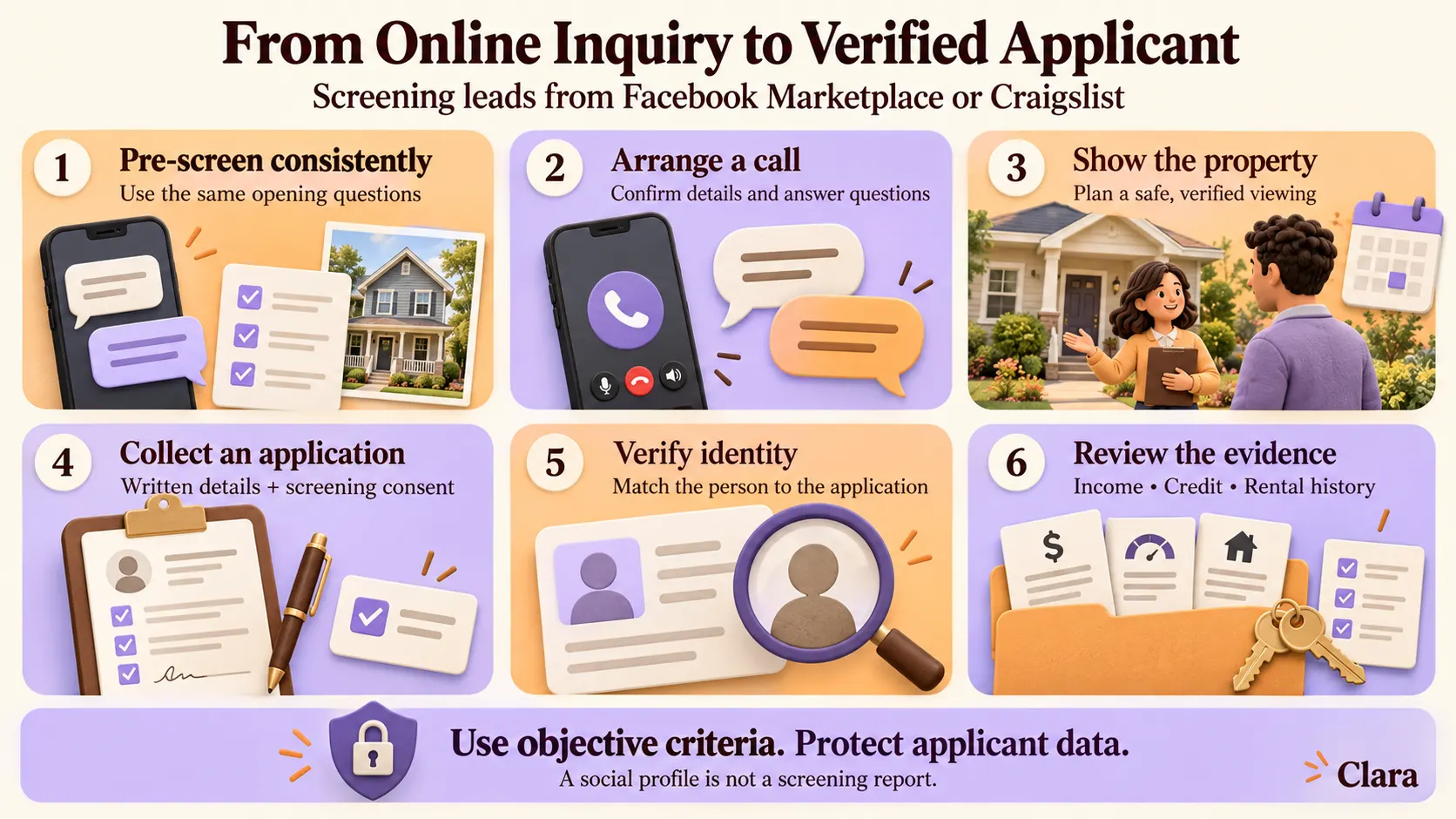
How to Screen a Tenant From Facebook Marketplace in Six Steps
The steps below work for Craigslist and other classified sites too. Run them in order for every serious applicant, no matter how friendly the first message sounds.
Step 1: Reply With the Same Pre-Screen Message Every Time
Save a short reply and send it to every inquiry. Ask for full name, phone number, desired move-in date, number of people who will live in the home, and whether they can see the property in person. Add your rent and your basic requirements so people can opt out early.
Here is a simple version you can adapt: "Thanks for your interest in the home on Maple Street. The rent is $1,500 a month, and the home is available on the first of next month. Please send your full name, your phone number, your ideal move-in date, and how many people will live here. If it still looks like a fit, I will set up a call and a showing, and I will ask for a written application and a screening check before any lease is signed." Adjust the details to your rental, and never include an unlisted address or code.
Using one message for everyone keeps your process fair and saves time. It also separates real renters from copy-and-paste senders, who often ignore questions they cannot answer.
Step 2: Move to a Phone or Video Call
A five minute call tells you a lot. You can hear how the person talks about their situation, confirm that the details match their messages, and answer questions about the home. If someone refuses to speak by phone or video, treat that as a red flag.
Step 3: Meet at the Property
Show the home in person. Tell a friend where you will be, and meet during daylight when you can. Do not accept a deposit or a key hand-off during the tour. A showing is a chance to see how the applicant behaves and to confirm that they are who they say they are.
Step 4: Require a Full Rental Application
Do not rent on a chat alone, and do not send a rental agreement before the screening is done. Ask each serious applicant to complete the same written application, with consent to run screening reports. A strong form collects the details you need to verify later, such as past addresses, employer, income, and references. Our guide on how to build a strong rental application shows what to include.
Step 5: Verify Identity Before You Trust Any Document
Identity is the step most informal landlords skip. Compare the name on the application with a government ID, and confirm that the photo matches the person you met. Our overview of what identity verification for renters involves explains the basics. Rent with Clara also offers tenant ID verification as part of screening, so you can confirm the person behind the application.
This matters because a polished pay stub or utility bill does not prove who is holding it. Fraudulent applicants can edit documents or use someone else's name. Matching a real identity to the paperwork closes that gap.
Step 6: Run Credit, Background, Income, and Rental History Checks
Once identity is confirmed, review the rest of the file. Pull a credit report and a background check with the applicant's written consent. Verify income with pay stubs, bank statements, or a call to the employer. Call prior landlords to confirm that rent was paid on time. Then compare everything against criteria you set in advance. A tenant screening scorecard keeps your decisions consistent.
No chat history or social media profile can replace these checks.
What to Do If an Applicant Looks Like a Fraudster
Do not argue or accuse. Stop sharing details about the property, and do not send or accept money. Save the messages and take screenshots of the profile, the phone number, and any payment request. Then block the sender and report the account to the platform. If money or personal data was involved, report it to your local police and to the FTC.
If the person is a real applicant who simply refuses your steps, you can decline and move on. A good applicant with nothing to hide will usually follow a clear process.
Should You Look at an Applicant's Facebook Profile?
It is tempting, especially when the person found you through a social site. Be careful. A profile can show things you should not use to decide, such as family status, religion, national origin, disability, race, or sex. Under the Fair Housing Act, housing discrimination based on those protected characteristics is prohibited. Even a quick look can create a record that you saw information you should not use.
A safer approach is to base your decision on written, objective criteria, such as income ratio, verified rental history, and screening results, and to apply them to every applicant. If you do check public information to confirm that an account is real, keep it limited to that purpose and keep notes. Fair housing law differs by state and city, so check what applies where you rent.
How to Protect Your Own Listing and Payments
Landlords can be targets too. Fake rental ads and fraudulent listings are common, and the FTC reports that scammers often copy real rental listings and swap in their own contact details, then collect fees or deposits from people who think they are dealing with the owner. If someone says they sent money to "you" and you never heard from them, a copied listing may be the reason.
Social media is also a common starting point. According to an FTC data spotlight on rental scams, nearly 65,000 rental scams were reported to the agency from January 2020 through June 2025, with about $65 million in losses, and Facebook was the most reported platform. Those figures come from people who reported a scam, so they do not show the whole picture, but they show why caution makes sense.
Here are a few habits that help:
Add a line to your listing that you only rent through your own contact details and a signed lease.
Search for your listing now and then to see whether someone has copied it, and report any copy to the platform.
Take rent, deposits, and fees only after a signed lease and only by traceable methods that give you a receipt.
Never accept an overpayment and send back the difference, since the original payment may turn out to be fake.
Keep applicant data private, never post it in comments or public replies, and store IDs and reports securely.
Keep Your Process the Same for Every Applicant
A fast platform tempts you to bend the rules for a friendly applicant. Resist that. Use the same questions, the same application, and the same criteria for everyone, and write down what you did. If a property management company handles showings for you, give it the same checklist. A consistent process protects good applicants from bias, and it protects you if a decision is disputed later. If you must decline, state your reason clearly and follow the rules for adverse action. The FTC explains what landlords need to do in its guide on using consumer reports.
Frequently Asked Questions
How do you screen a tenant from Facebook Marketplace?
Send the same pre-screen questions to every inquiry, then talk by phone and meet at the property. Require a full application, confirm identity with a government ID, and run credit, background, income, and rental history checks with written consent. Compare the results against criteria you set before you listed the home.
Is Facebook Marketplace safe for finding tenants?
It can work, but safety depends on your process. The platform does not screen applicants, and scammers use it, so treat every message as a lead and verify the legitimacy of each applicant. Meet in person, keep payments traceable, require an application, and verify identity. Landlords who follow the same steps for everyone avoid most problems.
How can I tell if a Facebook Marketplace rental is legitimate?
Renters should confirm who owns the property through public records or the property manager's own website. Visit the home in person, compare the listing to other sites, and be wary of rent far below market. Never pay a deposit before you see the unit and sign a lease.
How do I list a property for rent on Facebook Marketplace?
Create a rental listing from the Marketplace section of the app, then add clear photos, the rent, the location, the number of bedrooms and bathrooms, and your key rules. Menus change, so follow the steps in the help pages. Keep the exact unit number and your screening details off the public post.
Is it safe to pay a rental deposit through Facebook Marketplace?
Treat any deposit sent before a signed lease and an in-person visit as risky. Scammers often ask for money early and use payment methods that are hard to reverse. Use traceable payments, get a written receipt, and confirm the owner's identity before sending anything.
Can landlords check an applicant's Facebook profile?
Landlords can see what is public, but it is risky to use it. Profiles reveal protected details, such as family status or religion, that cannot influence a rental decision. Base your decision on written criteria, verified screening results, and the same steps for every applicant, and keep notes.
Taylor Wilson
Founder
Taylor Wilson is the Founder of Rent with Clara, a modern renter screening platform built to streamline the rental application process. As both a renter and an independent landlord, Taylor sits on both sides of the lease, and built Clara to give renters control over what they share while giving landlords reliable and verified applications.
Read Articles
1099 Tenant Proof of Income: Complete Verification Guide For Landlords