Heads up: We're screening experts, not lawyers. This article is here to help you understand the topic, but it's not legal advice. Laws vary by state and locality, and they change. If you have questions about your specific situation, talk to a qualified attorney.
Owning a rental property and actually running one are two different skills. The first is a purchase decision; the second is everything that happens after, across the entire rental process from choosing a tenant to keeping the property in good repair to knowing when to bring in outside help.
This guide walks through what that day-to-day work looks like for independent landlords, and what separates a landlord with systems in place from one who's constantly putting out fires.
Most independently owned properties are self-managed rather than outsourced to a property management company, which means hands-on property management isn't a specialty reserved for professionals — it's the default for most rental property owners.
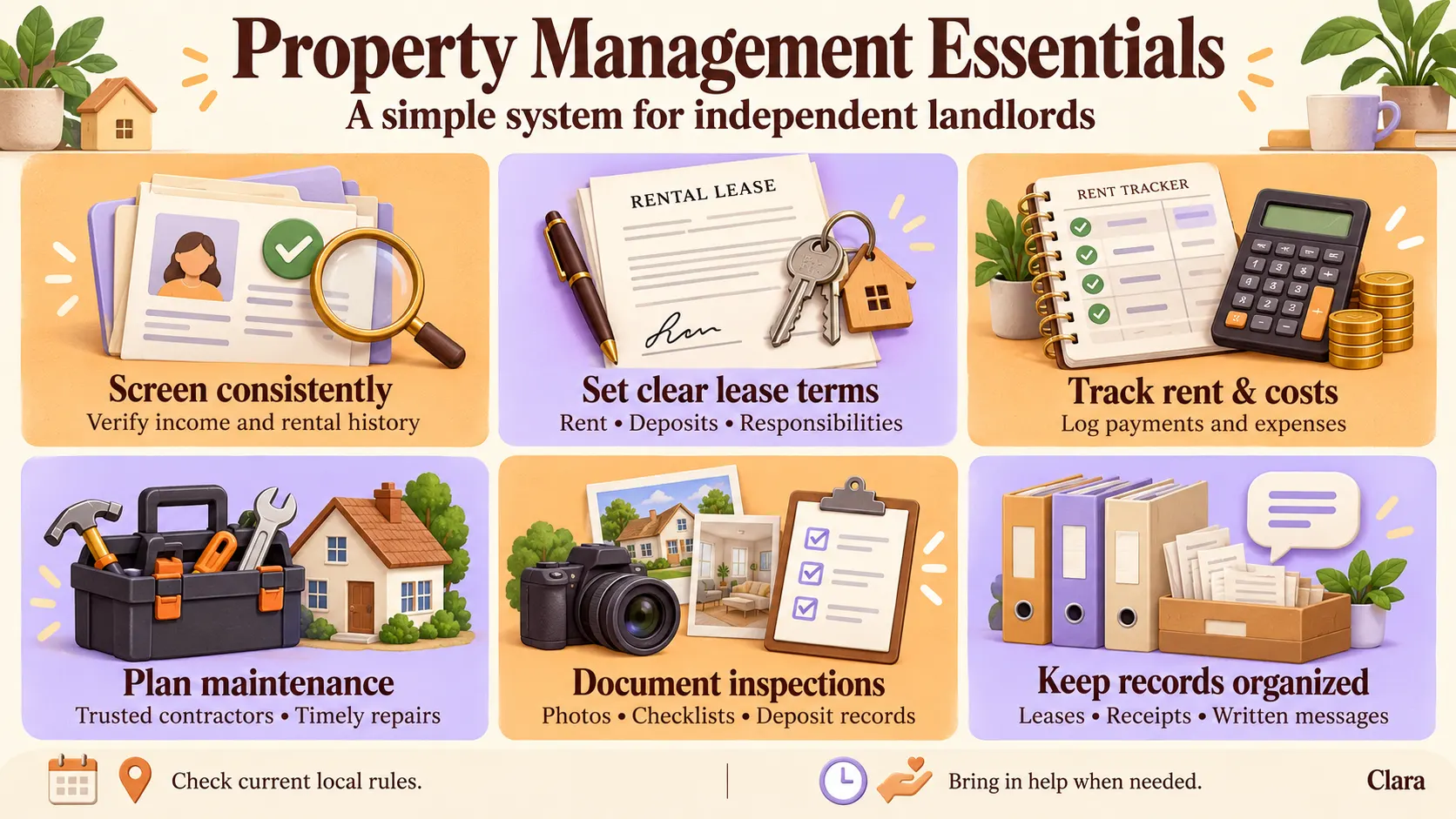
Property management covers everything that happens after you buy a rental unit and before you sell it: choosing tenants, drafting a lease, collecting rent, handling repairs, running inspections, and staying on top of legal obligations that vary by state and city.
Landlords who treat these as separate, ad-hoc tasks tend to burn out fast; landlords who build a repeatable system tend to stick with the business.
Most landlords spend far less time on this than they assume going in. A single well-maintained property with a reliable tenant in place often runs on autopilot most weeks, with the workload clustering around specific moments instead of spreading evenly across the month — turnover, screening a new applicant, or a maintenance issue that needs coordinating.
If you manage your property without a plan for those moments, the time cost feels heavier than the average suggests.
Every other part of property management gets easier or harder depending on who's living in the unit. A tenant who pays on time, communicates early about problems, and takes care of the property will barely register on your calendar; one who doesn't will consume more of your time than every other task combined.
That's what makes choosing tenants carefully worth the extra effort upfront.
A solid tenant screening process goes beyond a credit score. Landlords need to verify income against the actual rent amount, check rental history with previous landlords, and run a background check that's consistent across every applicant — not just the ones who seem risky.
Consistency matters as much as thoroughness: applying different standards to different applicants creates fair housing exposure on top of the practical risk of ending up with a difficult tenant instead of good long-term tenants.
A lease is the rulebook for the entire tenancy, so vague language creates problems months later, once memory fades and expectations shift. At minimum, a solid lease spells out the rent due date, late fee terms, security deposit handling, maintenance responsibilities, and the conditions under which the lease can end early — the basics that keep both sides clear on their legal obligations to each other.
A templated lease saves time but still needs local customization. State and local landlord-tenant laws vary widely on notice periods, deposit limits, and required disclosures, and using a generic template without checking local rules is one of the more common mistakes new landlords make.
Landlords with systems in place for reviewing lease terms against current local law before each signing avoid most of these problems entirely.
Rent collection sounds simple until a payment is late and you're deciding how firmly to enforce your own lease terms. Building a consistent process for handling late rent before it happens, not during it, keeps the relationship professional instead of personal — and protects the rental income the property is supposed to generate in the first place.
Property managers who handle rent collection, maintenance coordination, and tenant communication on a landlord's behalf typically charge property management fees structured as a share of collected rent, plus a separate one-time leasing fee when they place a new tenant, all spelled out in a management agreement before work begins.
For an independent landlord evaluating whether to hire out this work, that fee needs to be weighed against the actual hours it would save, not just the sticker price.
Screening gets a tenant into the unit; staying on top of tenant issues is what keeps them there without turning into a headache. A renter who received clear expectations from day one is easier to work with when a repair comes up, a rent increase is on the table, or a lease renewal date approaches.
Managing a rental well after move-in comes down to a few habits: responding to maintenance requests within a set window, sending renewal notices with enough lead time to plan, and keeping communication in writing so there's a record if a dispute comes up.
Landlords who let these management duties slide, or who don't delegate tasks they genuinely don't have time for, are often the ones who end up shopping for a property manager once self-managing starts to feel like triage instead of a system.
Reactive maintenance costs more than regular maintenance, both financially and in tenant goodwill — a landlord who responds quickly to a small leak spends far less than one who waits until it becomes a hazard covered under local habitability law.
Staying ahead of repairs and maintenance is one of the clearest ways a landlord protects both the property and the relationship with the tenant living in it.
Building a short list of trusted contractors before you need one is worth the upfront effort. Landlords who wait until an emergency to start calling around usually get whoever's available, not whoever's best.
[INTERNAL LINK: maintenance request tools]
Move-in and move-out inspections are the single best protection landlords have against security deposit disputes. Documenting the condition of the property with photos and a written checklist at both points removes the guesswork when it's time to return, partially withhold, or fully withhold a deposit.
This is also where a lot of avoidable conflict starts. A tenant who feels a deduction was unfair and undocumented is far more likely to dispute it than one who signed off on a detailed move-in report and can compare it directly to the move-out photos.
Move-in checklists, lease copies, maintenance receipts, rent payment history, move-out photos — on their own, each document feels minor. Together, they're what separates a landlord who can respond to a dispute in minutes from one digging through email threads trying to reconstruct what happened months earlier.
Good rental property management treats recordkeeping as a system, not a scramble: storing lease documents, inspection reports, and repair records somewhere you can actually find them again, consistently, for every unit and every renter.
Landlords managing multiple rental properties often turn to property management software to keep this organized, though a simple folder system, digital or physical, works fine for real estate investors with just one or two units.
Fair Housing Act compliance and local rental law aren't optional reading — they shape how you advertise a vacancy, how you screen applicants, what you can ask during a showing, and how you handle everything from repairs to eviction.
Rules differ by state and even by city, and change often enough that what applied last year may not apply now.
Legal compliance is the one area where a knowledgeable friend's advice isn't a substitute for legal expertise. Landlords managing their own properties should build a habit of checking current guidance rather than relying on what worked for someone else's rental down the street.
What It Actually Costs to Manage a Rental Yourself
Self-managing gets described as the free option, and it can seem that way on paper. In practice, a landlord who manages the property solo is still spending money in smaller, less visible pieces: tenant screening reports, notice-of-entry mailings, locksmith calls for lockouts, mileage back and forth for inspections and showings.
None of that comes close to what a property manager would charge, but it's worth tallying up before assuming self-managing costs nothing. A landlord who tracks these smaller expenses alongside their own time gets a clearer overall financial picture — and a better sense of whether self-managing still makes sense or whether hiring out is worth it for the income the property is meant to generate.
The right choice depends on portfolio size, location, and how much of this work you actually want to do yourself. Landlords with one or two nearby single-family homes, reliable systems, and the temperament for tenant communication often self-manage comfortably.
Landlords with multiple rental properties, out-of-state ownership, or limited time tend to see more value in professional property management, even with the added fee.
Many landlords who start out self-managing eventually bring in outside help within two years, often after underestimating the real time cost of doing it alone. That's not a failure — it's worth planning from day one, especially for landlords treating their housing units as a long-term real estate investment rather than a side project.
The landlords who manage rental properties well aren't the ones who never hit a problem. They're the ones who built systems for screening, documentation, and rent collection before a problem forced their hand — the difference between running a rental business and just owning a rental unit that happens to have a tenant in it.
Being a good landlord in a rental market that keeps shifting means starting with whichever piece feels weakest today, whether that's screening consistency or move-out documentation, and tightening it before the next tenant moves in.
If tenant screening is the piece you'd rather not manage manually, Clara's tenant screening tools are built specifically for independent landlords who want verified applicant data without chasing paperwork.