This guide draws on patterns seen across thousands of rental applications and property risk profiles reviewed through Clara's platform.
Standard liability limits on landlord policies typically start at $100,000, and most insurance professionals recommend a floor of $300,000 for a single-family rental and $1 million for multifamily properties. That ceiling sounds like plenty, until a tenant slips on an icy walkway, tears a knee, and racks up medical bills, lost wages, and a lawsuit that outpaces the policy in a single incident.
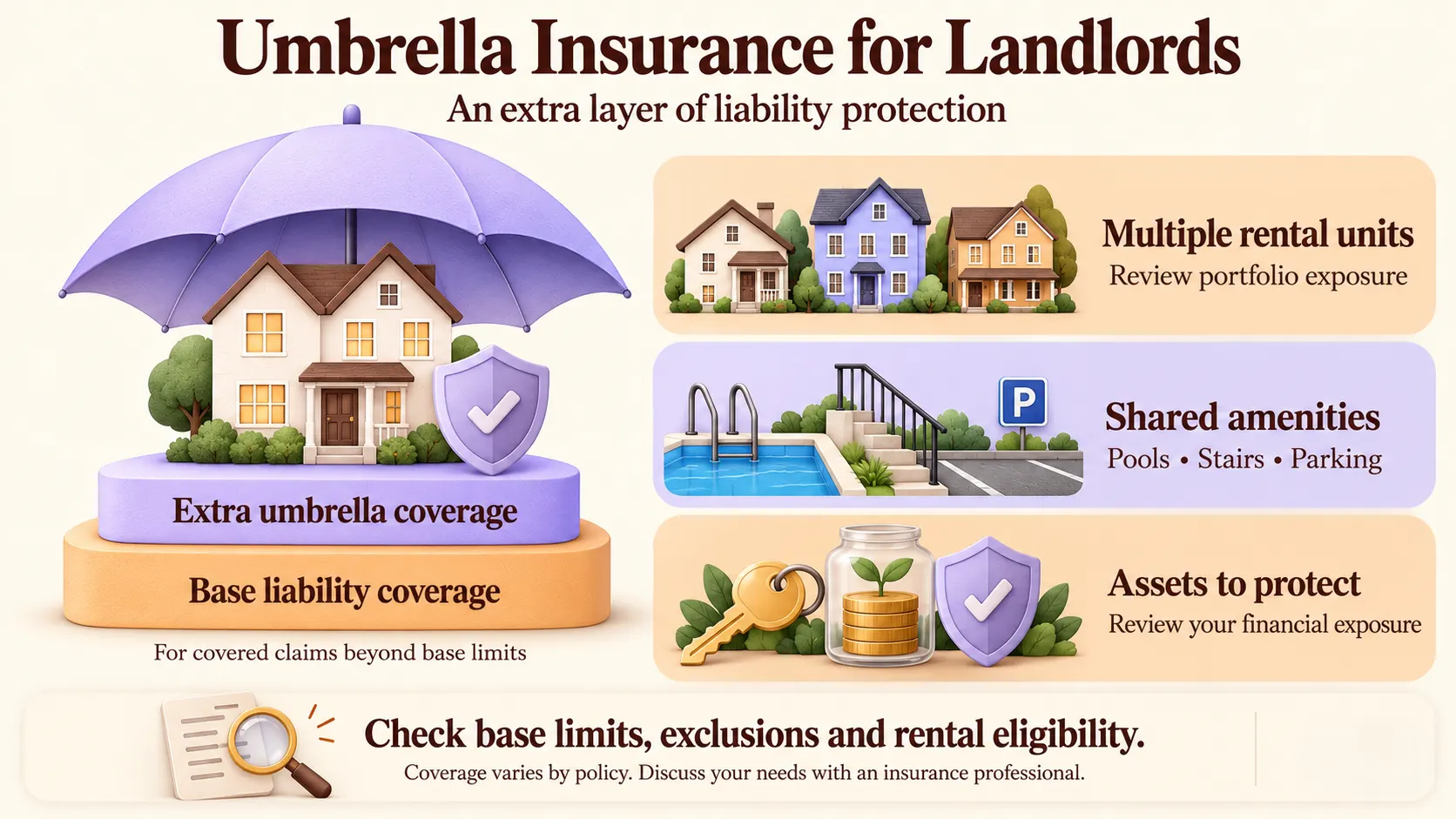
Landlord umbrella insurance exists for exactly that gap. It's an extra layer of liability protection that sits on top of your existing landlord or property policy and kicks in once the underlying limit runs out.
This article breaks down what umbrella coverage actually does, who genuinely needs it, what it costs, and how to think about the decision without overbuying or underbuying protection you can't use.
Key Takeaways
Standard landlord policies usually cap liability at $100,000 to $1 million, but a single tenant injury claim can exceed that ceiling fast, especially with surgery, lost wages, and legal fees involved.
Umbrella insurance adds $1 million to $5 million in liability protection on top of your existing landlord or property insurance, often for $200 to $400 a year per $1 million of coverage.
Landlords who own multiple units, high-traffic properties (pools, parking lots, shared stairwells), or hold significant personal assets face the most exposure and benefit most from an umbrella policy.
Umbrella coverage extends to claims your base landlord policy may exclude, including libel, slander, false arrest, and wrongful eviction disputes with tenants.
“There's a pattern with landlords who've scaled to a few properties: the risks don't just add up, they compound. Recognizing that moment, when a portfolio has outgrown its original coverage, is one of the harder judgment calls in this business."
Taylor Wilson, CEO of Rent with Clara
What Does Landlord Umbrella Insurance Actually Cover?
Umbrella insurance provides an extra layer of protection against liability claims that exceed the limits of your current landlord or property insurance policy. Once your underlying coverage is exhausted, the umbrella policy pays the remainder, up to its own policy limit, which typically runs from $1 million to $5 million.
In practice, that means a tenant injury lawsuit, a slip-and-fall on a shared staircase, or a dog bite on the property doesn't stop at your base policy's ceiling. The umbrella coverage extends beyond the limits and continues paying legal defense costs, settlements, and judgments.
It also picks up claim types many landlord insurance policies exclude outright, like libel, slander, false arrest, and wrongful eviction disputes with a tenant. Those are the claims most landlords never see coming, which is exactly why they're worth planning for in advance.
What Isn't Covered by an Umbrella Policy?
An umbrella policy doesn't cover your own property damage, your own injuries, or intentional wrongdoing. It also won't activate until your underlying landlord policy limit is fully used up.
Every exclusion varies by insurance company, so reading the policy language before you buy matters more than the sales pitch.
How Much Does Umbrella Coverage Cost for Landlords?
A personal umbrella policy usually starts around $200 a year for $1 million of coverage, according to NerdWallet, with landlord-specific premiums often landing between $150 and $400 annually depending on the number of properties and claims history. That's a modest premium relative to what a single uninsured judgment could cost.
Pricing depends on a handful of factors: how many rental units you own, whether you manage high-traffic properties with pools or parking structures, your prior liability claims, and the underlying limits on your existing landlord policy. Most carriers require a minimum underlying liability limit, often $300,000, on your landlord and auto policies before they'll underwrite an umbrella policy on top.
If your current limits fall short, raising them is usually the first step before an umbrella quote makes sense.
[PERSONAL EXPERIENCE] Landlords who wait until after a claim to shop for umbrella coverage often find premiums have already been priced in that history. Buying before you need it, not after, is what keeps the cost manageable.
Who Actually Needs an Umbrella Policy?
Not every landlord needs one. A single rental with modest personal assets and a policy limit that matches local settlement norms may be adequately covered without it. But exposure rises fast for a few common landlord profiles.
Portfolio landlords managing several properties face compounding risk, since one serious claim on any unit can threaten the entire portfolio, not just the property where it happened. Landlords with pools, playgrounds, elevators, or shared parking structures carry more foreseeable hazards and, by extension, more liability exposure.
And landlords who've built up meaningful personal assets, savings, home equity, retirement accounts, have more to lose if a judgment exceeds their landlord policy's limit and reaches into personal wealth.
Does an LLC Replace the Need for Umbrella Insurance?
No. An LLC can limit personal liability in some circumstances, but it doesn't replace liability insurance.
Courts can still pierce LLC protection in cases of negligence tied directly to property management, and an LLC provides no coverage for legal defense costs, medical bills, or settlement payouts the way an umbrella policy does.
How Umbrella Insurance Fits With Your Landlord Policy
An umbrella policy isn't a replacement for your landlord insurance, it's an extension of it. Your landlord policy handles property damage, standard liability, and often loss of rental income. The umbrella policy exists purely for additional liability protection once that base coverage is exhausted.
This layered structure matters because insurance companies underwrite each piece separately. Your landlord policy limit, your liability history, and even the number of units you own all factor into what an umbrella insurer is willing to write and at what premium.
Landlords juggling several properties across different insurance policies often find the coordination confusing, which is where working with a broker who understands rental property risk, rather than a generic personal-lines agent, tends to pay off.
Getting a Quote: What to Have Ready
Before you get a quote, pull together your current landlord insurance policies, their liability limits, your claims history for the past three to five years, and a count of units and any high-risk features like pools or shared amenities. An insurance company will use all of it to price the umbrella policy and confirm your underlying coverage meets their minimum threshold.
If your existing limits fall short, expect the insurer to require you to raise the underlying landlord policy limit first. That extra layer of protection only works if the base policy is strong enough to support it.
The Bottom Line for Independent Landlords
Umbrella insurance isn't a fit for every landlord, but for anyone managing multiple units, higher-traffic properties, or meaningful personal assets, the math tends to favor it. A few hundred dollars a year buys peace of mind against a lawsuit that could otherwise reach well past what a standard landlord policy pays out.
For further reading on how umbrella coverage compares to other landlord protection options, see the National Association of Insurance Commissioners' consumer guide on liability insurance and NerdWallet's breakdown of how umbrella coverage works.
Frequently Asked Questions
Is landlord umbrella insurance worth it for a single rental property?
It depends on your assets and risk exposure. If your landlord policy already carries a $500,000 or higher liability limit and you own limited personal assets, a single rental may not need umbrella coverage. Once you add a second property, a pool, or significant savings, the calculation usually shifts toward yes.
Does umbrella insurance cover eviction-related lawsuits?
It can, depending on the policy. Many umbrella policies extend to wrongful eviction and related personal liability claims that standard landlord policies exclude. Confirm this specifically with your insurance company, since exclusion language varies significantly by carrier and state.
How much umbrella coverage should a landlord carry?
A common guideline is coverage equal to your net worth, rounded up to the nearest million. Landlords with $700,000 in combined assets, for example, would typically look at a $1 million umbrella policy as a starting point, then scale up with additional properties or higher-risk features.
Can I buy umbrella insurance without raising my landlord policy first?
Usually not. Most insurers require your underlying landlord and auto policies to meet a minimum liability threshold, often $300,000, before they'll issue an umbrella policy on top. If your limits fall short, plan to raise them first.
Does umbrella insurance cover legal fees even if I'm not found liable?
In most cases, yes. Umbrella policies typically cover legal defense costs during a covered claim, regardless of the outcome, in addition to any settlement or judgment. That defense coverage alone often justifies the premium for landlords facing frequent tenant-related disputes.
Bottom Line
Extra liability coverage isn't about expecting the worst, it's about making sure one bad incident doesn't undo years of building a rental portfolio. Start by checking your current landlord policy's liability limit, then talk to a broker about whether an umbrella policy closes the gap.
Clara's screening tools won't sell you insurance, but reducing the odds of a bad tenant, and the disputes that come with one, is part of the same risk-management picture landlords already think about when they choose umbrella coverage.
Taylor Wilson
Founder
Taylor Wilson is the Founder of Rent with Clara, a modern renter screening platform built to streamline the rental application process. As both a renter and an independent landlord, Taylor sits on both sides of the lease, and built Clara to give renters control over what they share while giving landlords reliable and verified applications.
Read Articles
1099 Tenant Proof of Income: Complete Verification Guide For Landlords