
Most landlords set their screening criteria once and then treat them as permanent. A credit score threshold is set during the first vacancy, a rent-to-income ratio is chosen based on advice from a forum or another landlord, and those numbers stay in place indefinitely. The problem is that the tenant screening criteria are age-based. Laws change. Rental markets shift. What was reasonable and legally compliant two years ago may not be either of those things today.
This guide draws on the patterns most commonly seen in how independent landlords and property management teams approach the screening review process — and where those approaches tend to break down.

Screening criteria serve two purposes: they help landlords identify reliable tenants through consistent selection, and they provide a documented, defensible basis for leasing decisions. Both purposes depend on the criteria being up to date.
On the legal side, fair housing laws and FCRA requirements evolve. State legislatures pass new rules governing application fees, criminal history screening, and income verification standards. Local ordinances sometimes go further than state law. A landlord still running a blanket criminal record exclusion in a jurisdiction that has since passed ban-the-box legislation is applying screening policies that could expose them to a housing discrimination complaint — not because their intent is discriminatory, but because they haven't kept up with the law.
On the practical side, a credit score threshold set during a soft rental market may be excluding otherwise qualified prospective tenants in a tighter one. An income requirement calibrated to rents from three years ago may no longer reflect the unit's actual lease cost. Outdated screening criteria create friction in the rental application process without any corresponding benefit to the landlord.
No. Once you've begun accepting applications for a specific vacancy, the screening criteria must remain the same for every applicant in that pool. Changing criteria mid-cycle, even with good intentions, creates a fair housing liability — it can appear that the change was made to favor or exclude a specific renter based on a protected characteristic. Any update to written criteria takes effect at the start of the next application cycle, not partway through the current one.
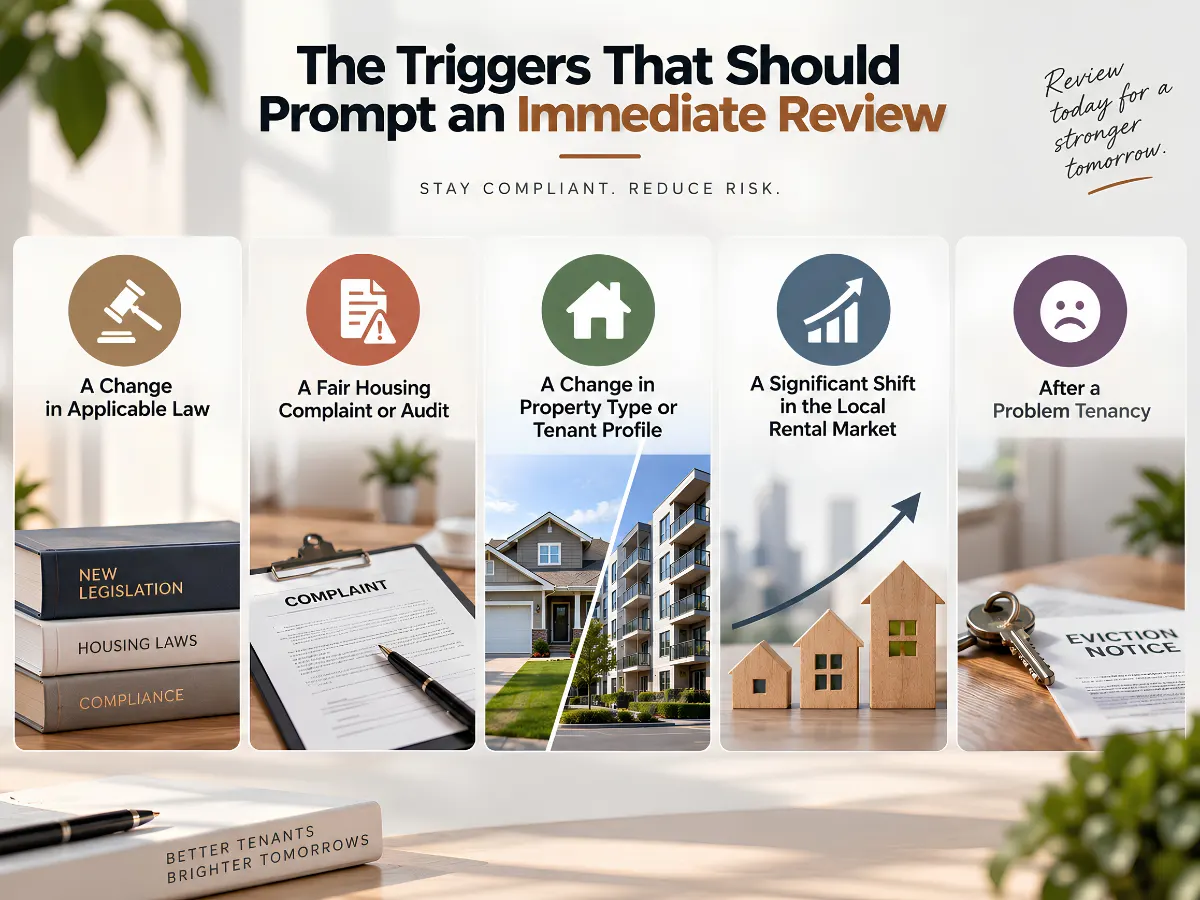
Some updates to tenant screening criteria should happen on a fixed schedule. Others need to happen immediately upon a specific event. Understanding the difference matters for any landlord who wants to stay compliant and avoid liability between vacancies.
A change in applicable law. This is the most time-sensitive trigger. When new legislation affects how landlords can use criminal history, eviction records, credit reports, or income verification in screening decisions, existing criteria may need to be revised before the next vacancy opens. Changes to screening fee limits and application fee caps at the state or local level are particularly easy to miss. Waiting for the annual review after a law has already taken effect means operating out of compliance in the interim. State-level screening requirements change frequently enough that checking for updates annually is the minimum, not the target.
A fair housing complaint or audit. If a landlord has faced a complaint, even one that was resolved in their favor, the screening policy that prompted it needs to be reviewed. A resolved complaint doesn't mean the criteria are sound — it may simply mean the complaint couldn't be proved. Using the same criteria without revision in subsequent vacancies repeats the exposure.
A change in property type or tenant profile. Criteria calibrated for a long-term unfurnished rental may not fit a furnished unit or a property being marketed to a different tenant demographic. Screening tenants for furnished versus unfurnished rentals involves different risk profiles, and the criteria should reflect that.
A significant shift in the local rental market. When rents rise sharply, income thresholds tied to old rent levels may exclude applicants who can genuinely afford the current unit. When vacancy rates climb, criteria set for a competitive market may be unnecessarily restrictive. The screening process should reflect current conditions, not historical ones.
After a problem tenancy. A bad tenant experience isn't just costly — it's information. If a renter who met every criterion on paper caused significant problems, reviewing those criteria to understand what was missed is a productive response. This doesn't mean making criteria more restrictive across the board; it means asking whether the right data points were being measured.

Beyond event-driven updates, tenant screening criteria benefit from a structured annual review. The goal isn't to rewrite the policy every year — it's to confirm that what's on paper still reflects current law, current market conditions, and current leasing goals.
A useful annual review covers four areas:
Legal compliance check. Review any changes to state or local landlord-tenant law, FCRA guidance, and fair housing protections since the last update. Pay attention to changes in how criminal records and eviction history are used, as these have been the most active areas of legislative change in recent years. Application fee limits and screening fee caps are also worth verifying, as these vary by jurisdiction and change more often than most landlords expect.
Financial thresholds. Review the income-to-rent ratio and credit score standards against current market rents and local income levels. When reviewing credit checks, consider whether the current minimum score still reflects an applicant's realistic ability to pay on time. If the unit's rent has increased, the income threshold needs to be recalculated. Look at how late payments, judgments, and prior bankruptcy entries in a credit report are being weighted — a blanket score cutoff may be excluding applicants whose recent financial behavior is strong despite older negative entries.
Consistency audit. Review recent application decisions and confirm that the written criteria were applied consistently. Do denial reasons map to the documented policy? Were exceptions made, and if so, were they documented in a way that's defensible? Inconsistent application of screening criteria is one of the most common sources of fair housing exposure, even when the criteria themselves are legally sound.
Documentation review. Confirm that the written criteria are stored, up to date, and accessible. The tenant screening criteria template and the underlying policy documentation should be treated as live documents, not filed and forgotten. If the criteria need updating, the revised version should replace the old one and include a clear effective date.
Not necessarily. Criteria can be tailored to specific properties as long as the variation is based on legitimate, property-specific factors — unit type, rent level, local market conditions — and not on the demographics of the applicant pool a landlord expects to attract. A landlord with a furnished short-term rental and an unfurnished long-term rental may reasonably apply different income thresholds based on the actual monthly rent of each property. What they can't do is apply different criteria to similar properties based on anything that correlates with a protected class.
Written screening criteria provide the landlord with a reference point and an applicant with transparency about the standards being applied. Both benefits depend on the documentation being specific enough to be useful.
Vague criteria, "applicants must have good credit" or "stable employment required," don't provide a defensible basis for a denial. Specific criteria include: a minimum credit score of 620, gross monthly income of three times the monthly rent, no evictions filed in the past three years, no prior court records related to unpaid rent or property damage, verified employment or documented alternative income sources, and a rental history that shows a pattern of paying rent on time.
When documentation is specific, the review process is easier. It's clear what number needs to be recalculated when rent increases. It's clear what policy needs to be revised when a law changes. And when a leasing decision is challenged, the landlord can show exactly which criteria were applied and how each prospective tenant was evaluated against them.
Documenting tenant screening decisions serves a separate but related purpose: creating a record of how each applicant was evaluated against those written criteria. The criteria document defines the standard. The decision record shows it was applied.
Keep the written criteria document with a clear effective date, a copy of each applicant's tenant screening report, and a brief written note explaining how the criteria were applied to each denied application. If an adverse action notice was sent, keep a copy along with the date and method of delivery. These records form the documentation trail that protects landlords if a leasing decision is later questioned.
Updating criteria on paper is only half of the work. The background screening process needs to be capable of generating the data required by that the updated criteria. If new criteria include a minimum income verification standard, the screening tool needs to be able to verify income at that level — not just accept uploaded documents that could be fabricated.
Compliant tenant screening also requires that the platform being used was built for residential housing decisions, not employment background checks. Screening companies that serve HR departments rather than landlords may not include rental history, eviction records, or the FCRA-compliant adverse action workflows required for housing decisions. That distinction matters when updating criteria and choosing which tenant screening report data points to rely on.
Clara's tenant screening process supports written screening criteria through direct, payroll-linked income verification; comprehensive background checks, including credit, criminal, and eviction history; and a reporting structure that gives landlords the data they need to apply their criteria consistently. The sample screening report shows exactly what data points are included before a landlord commits to the platform.
The FTC's guidance on tenant background check rights and landlord obligations outlines the disclosure and adverse action requirements that apply whenever a screening report influences a housing decision — a useful reference when reviewing whether the current screening process is fully FCRA-compliant.
Tenant screening criteria aren't a one-time decision. There is a policy that needs to stay current with the law, the market, and the specific properties being leased. A structured annual review, combined with immediate updates when significant events occur, keeps the criteria both legally defensible and practically effective.
If the written criteria haven't been reviewed in the past year, now is a reasonable time to start. See how Clara's screening reports support consistent, documented leasing decisions before the next vacancy opens.




.png)

.png)
.png)

.png)

.png)