Effective landlord tenant communication is one of the most underrated factors in a successful rental business. It affects rent collection, maintenance response, renewal rates, and how disputes get resolved.
Choose your communication method based on the situation. Text and email work well for routine updates, while formal notices require written communication that complies with your state's legal requirements.
Keep copies of all written notices, emails, and text communications. Documentation protects both parties and is essential if a dispute ever needs to be resolved formally.
Clear, professional, and prompt communication builds trust, reduces conflict, and improves tenant satisfaction, which directly supports tenant retention.
Respecting a tenant's schedule and setting boundaries around contact hours are part of maintaining a professional relationship, not signs of being less responsive.
The relationship between landlords and tenants runs on communication. Every part of the tenancy, from the first inquiry about the property to the final security deposit return, depends on how clearly and consistently the two parties exchange information.
Landlords who communicate well tend to have better outcomes across the board: tenants who pay on time, report maintenance issues promptly, renew their leases, and treat the property with care. Landlords who communicate poorly, whether through inconsistency, unclear messaging, or unprofessional tone, often deal with more disputes, slower rent collection, and higher turnover.
This guide covers how to communicate effectively with tenants at every stage of the tenancy: choosing the right method for each situation, maintaining the right tone, documenting what matters, and setting healthy boundaries around your own time.
Why Tenant Communication Deserves Deliberate Attention
Many landlords treat communication as something that happens naturally, without much thought about method, tone, or timing. That works fine until something goes wrong: a maintenance request that gets lost in a text thread, a rent increase that lands poorly because it was delivered casually, or a dispute that has no paper trail to support either side.
Good communication isn't about being available around the clock or writing lengthy messages. It's about choosing the right method for the situation, being clear and direct, and keeping a record of anything that matters. Landlords who build this into their operation from the start create a stronger relationship between landlords and tenants and a better living environment for everyone involved.
Choosing the Right Communication Method
Different situations call for different communication methods. Landlords should choose communication methods that align with the formality, urgency, and legal weight of what's being communicated.
Text Messaging
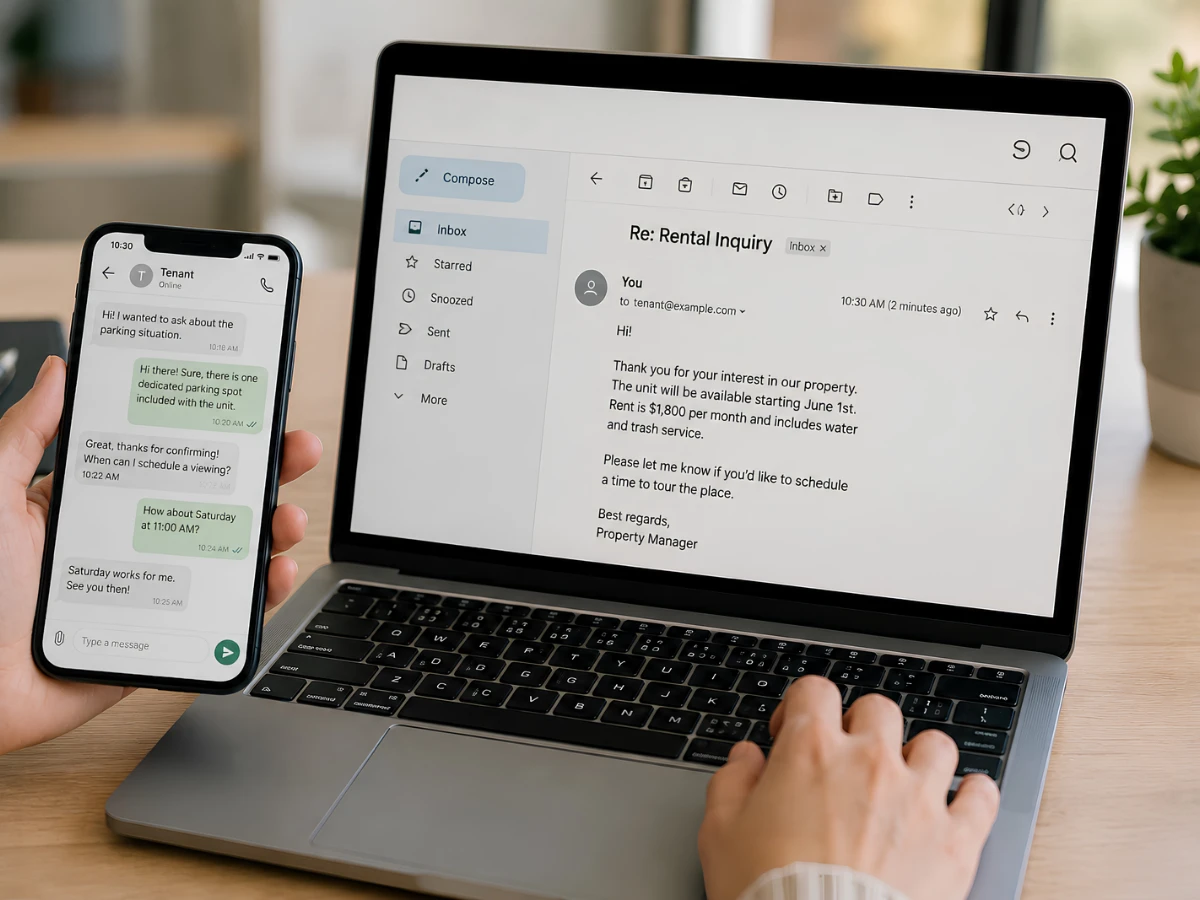
Text is fast, convenient, and well suited for routine, time-sensitive updates: confirming a maintenance appointment, a quick rent reminder, or coordinating a showing time. Most tenants respond quickly to text, which makes it useful for anything that needs a same-day answer.
Text is not appropriate for formal notices, lease terms, or anything with legal significance. A rent increase, a lease violation, or a non-renewal notice should never be communicated by text alone, even if you follow up with a phone call. Use text for convenience and quick response times, not as a substitute for formal written communication when the situation calls for it.
Email Communication
Email is the workhorse of landlord tenant communication. It's more formal than text, creates an automatic written record with a timestamp, and is appropriate for most substantive communications: maintenance updates, lease renewal offers, rent increase notices, and general questions that don't require an immediate response.
Use clear subject lines that describe the content of the email (for example, "Rent Increase Notice for [Address]" rather than a vague subject like "Update"). This helps both parties find and reference the email later if needed. Keep copies of all sent emails for record-keeping, ideally organized by tenant and by property.
Phone Communication
Phone calls are useful for conversations that benefit from real-time back-and-forth: discussing a sensitive issue, working through a payment plan, or addressing a tenant's concerns that are better resolved through dialogue than written exchange.
The downside of phone communication is that it doesn't automatically create a record. If a phone call covers anything important, follow up with a brief email summarizing what was discussed and agreed upon. This gives you the benefit of real-time conversation while still maintaining a written record for anything that matters.
In-Person Communication
Face-to-face interactions remain valuable for certain moments in the tenancy: the initial showing, the move-in walkthrough, in-person lease signings, and move-out inspections. These moments benefit from a human presence that builds trust and allows for the kind of dialogue that written communication can't replicate.
For anything beyond those key moments, most landlords and tenants prefer email or text for convenience, and there's nothing wrong with that. In-person meetings should be reserved for situations that genuinely benefit from being handled face-to-face, not treated as the default for every interaction.
What Requires Formal Written Notice
Some communications carry legal weight and require formal, written notice regardless of how casually you might otherwise prefer to communicate. Landlords must provide clear and formal written notices for rent increases, lease renewals or terminations, lease violations, non-renewal decisions, and entry notices before accessing the unit for non-emergency reasons.
These formal notices should comply with all applicable laws in your state, including required notice periods and, in some cases, specific delivery methods. A text message telling a tenant "just a heads up, rent's going up next month" does not meet the legal standard for a formal rent increase notice in most states, even if the tenant acknowledges receiving it.
For ready-to-use templates covering these formal situations, including move-in letters, rent increase notices, lease violation notices, and security deposit disposition letters, see our complete guide to landlord letter templates for every stage of the tenancy.
Maintaining a Professional Tone Across Every Channel
The tone of your communication matters as much as the content, particularly in text and email where nuance is easy to lose.
Maintain a professional tone in every message, regardless of the channel. This doesn't mean being cold or robotic. A warm, direct, respectful tone builds trust more effectively than either an overly formal tone or an overly casual one. Avoid language that could be read as threatening or dismissive, even when you're addressing a frustrating situation like a late payment or a lease violation.
Keep written communications clear and readable. Use short paragraphs, and bullet points when listing multiple items, so tenants can quickly find the information they need. A long, dense paragraph covering five different topics is harder to read and more likely to result in a tenant missing something important.
Avoid overusing exclamation points, all caps, or an excessively casual tone in text and email, especially for anything related to money, lease terms, or maintenance. These small details affect how professional and trustworthy you come across as a landlord.
Respecting Boundaries and Setting Expectations
Effective communication runs in both directions. Just as tenants need clear channels for reaching you, you need boundaries around when and how they can expect a response.
Landlords should avoid calling early in the morning or late at night for non-emergency matters. Respect the tenant's schedule the same way you'd want your own respected. If you need to schedule a call or a property visit, offer a few time options rather than showing up or calling unannounced.
At move-in, clearly communicate your expected response times for different types of requests: same-day for emergencies, 24 to 48 hours for urgent issues, and a few days for routine matters. This sets expectations early and prevents tenants from feeling ignored when a non-urgent request takes a few days to resolve. For more on structuring this at the start of a tenancy, see our guide on how to set expectations with new tenants before move-in.
It's reasonable to establish your own contact hours for non-emergency communication and to communicate that policy clearly. A landlord who is available for genuine emergencies at any hour but reserves routine communication for business hours is not being less responsive. They're maintaining a sustainable, professional relationship with their tenants.
Handling Difficult Conversations
Some communications are inherently harder: a rent increase, a lease violation, a complaint the tenant may not want to hear, or a decision not to renew a lease.
For these conversations, clarity matters more than softening the message. State what's happening, why (briefly, without over-explaining), and what the tenant needs to do or expect next. Vague or overly hedged language often creates more confusion and frustration than a direct, respectful message.
Where possible, lead with acknowledgment of the relationship before delivering difficult news. A rent increase notice that opens by acknowledging the tenant's reliable payment history lands differently than one that opens with the new dollar amount. For detailed guidance on framing a rent increase in a way that supports tenant retention, see our article on how to raise rent without losing good tenants.
When a tenant brings a complaint or concern to you, listen fully before responding. Tenants who feel heard, even when the ultimate answer is not what they hoped for, generally respond better than those who feel dismissed. For a complete framework on handling tenant complaints professionally, see our guide on how to handle tenant complaints without losing them.
Communicating About Maintenance
Maintenance-related communication is one of the most frequent touchpoints in the tenancy and one of the clearest opportunities to build or damage trust.
Acknowledge every maintenance request within 24 hours, even if you don't have a resolution yet. Give a realistic timeline rather than a vague promise. Follow up after the repair is completed to confirm the issue is resolved. This simple loop, acknowledge, update, confirm, covers the vast majority of what tenants want from maintenance communication.
Most tenant maintenance requests fall into a handful of common categories: plumbing, HVAC, pest control, locks, and appliances. Having a standard response process for each category makes this communication faster and more consistent. See our guide on how to handle common tenant requests for category-specific guidance, and our article on how to handle maintenance requests as a DIY landlord for the full response framework.
Documentation: The Part of Communication Landlords Skip
Retain copies of all written notices, emails, and text communications related to the tenancy. This is the part of communication that's easiest to neglect and the most valuable when something goes wrong.
Keep a simple system: a folder per property or per tenant, organized by date, containing copies of the lease, move-in inspection report, all formal notices, significant email exchanges, and any documentation related to maintenance requests or complaints. If a dispute ever needs to be resolved formally, whether informally between you and the tenant or through a legal process, this documentation is what supports your position.
This applies to text messages too. Screenshot and save any text exchange that covers something substantive: an agreement to a payment plan, a tenant's acknowledgment of a lease violation, or a maintenance issue they reported. Text threads can get lost or deleted, so don't rely on the messaging app itself as your permanent record.
Communication During Lease Renewals
Lease renewal is one of the most important communication moments in the tenancy. How you frame the renewal offer, and how much notice you provide, affects whether a good tenant renews or starts looking elsewhere.
Send renewal offers 60 to 90 days before the lease end date, framed as an invitation to continue the relationship rather than a bureaucratic notice. Clearly state any changes to rent or lease terms. For a complete guide including a customizable template, see our article on how to write a lease renewal letter that tenants accept.
How Communication Supports Retention and ROI
Landlords sometimes treat communication as a soft skill disconnected from the financial side of the business. In practice, it's directly connected to return on investment. Tenants who communicate well with their landlord, and who feel their landlord communicates well with them, renew more often, pay more reliably, and report issues before they become expensive problems.
The cost of a single tenant turnover, including vacancy, cleaning, repairs, and screening, typically runs $4,000 to $6,000. Much of what prevents that turnover comes down to communication: a maintenance request handled promptly, a rent increase framed thoughtfully, a complaint addressed with genuine attention. For more on what tenants specifically look for in a landlord relationship, see our article on what good tenants want from a landlord.
Frequently Asked Questions
What is the best way to communicate with tenants?
There's no single best method. The right choice depends on the situation. Text and email work well for routine updates and convenience. Formal notices (rent increases, lease violations, non-renewals) require written communication that complies with your state's legal requirements. Phone and in-person communication are valuable for conversations that benefit from real-time dialogue, such as resolving a sensitive issue or discussing a payment plan.
How quickly should I respond to tenant messages?
Acknowledge maintenance requests and general questions within 24 hours, even if you don't have a full answer yet. Emergencies require same-day response. For non-urgent matters during off-hours, it's reasonable to respond during your normal business hours rather than immediately, as long as your tenants understand this policy from the start of the tenancy.
Should I put everything in writing, even casual conversations?
Not every conversation needs to be documented, but anything substantive should be. If a phone call or in-person conversation covers an agreement, a decision, or anything related to money or lease terms, follow up with a brief written summary by email. This protects both parties and creates a record you can refer back to later.
How do I communicate a difficult decision, like non-renewal, professionally?
Be direct and give clear, formal written notice consistent with your state's requirements. State the decision, the effective date, and next steps. You're not obligated to provide extensive justification in most states, but keeping the tone respectful and professional, rather than defensive or overly apologetic, tends to result in a smoother transition for both parties.
The Bottom Line
Landlord tenant communication isn't a soft skill separate from running a successful rental business. It's one of the core operational disciplines that affects rent collection, maintenance efficiency, tenant retention, and how smoothly disputes get resolved when they arise.
Choose the right method for each situation. Keep your tone professional and clear. Document what matters. Respect boundaries in both directions. Landlords who build these habits into their communication style see the results in tenants who stay longer, pay more reliably, and treat the property, and the relationship, with the same respect they receive.
Taylor Wilson
Founder
Taylor Wilson is the Founder of Rent with Clara, a modern renter screening platform built to streamline the rental application process. As both a renter and an independent landlord, Taylor sits on both sides of the lease, and built Clara to give renters control over what they share while giving landlords reliable and verified applications.
Read Articles
1099 Tenant Proof of Income: Complete Verification Guide For Landlords



.png)

.png)
.png)

.png)

.png)


