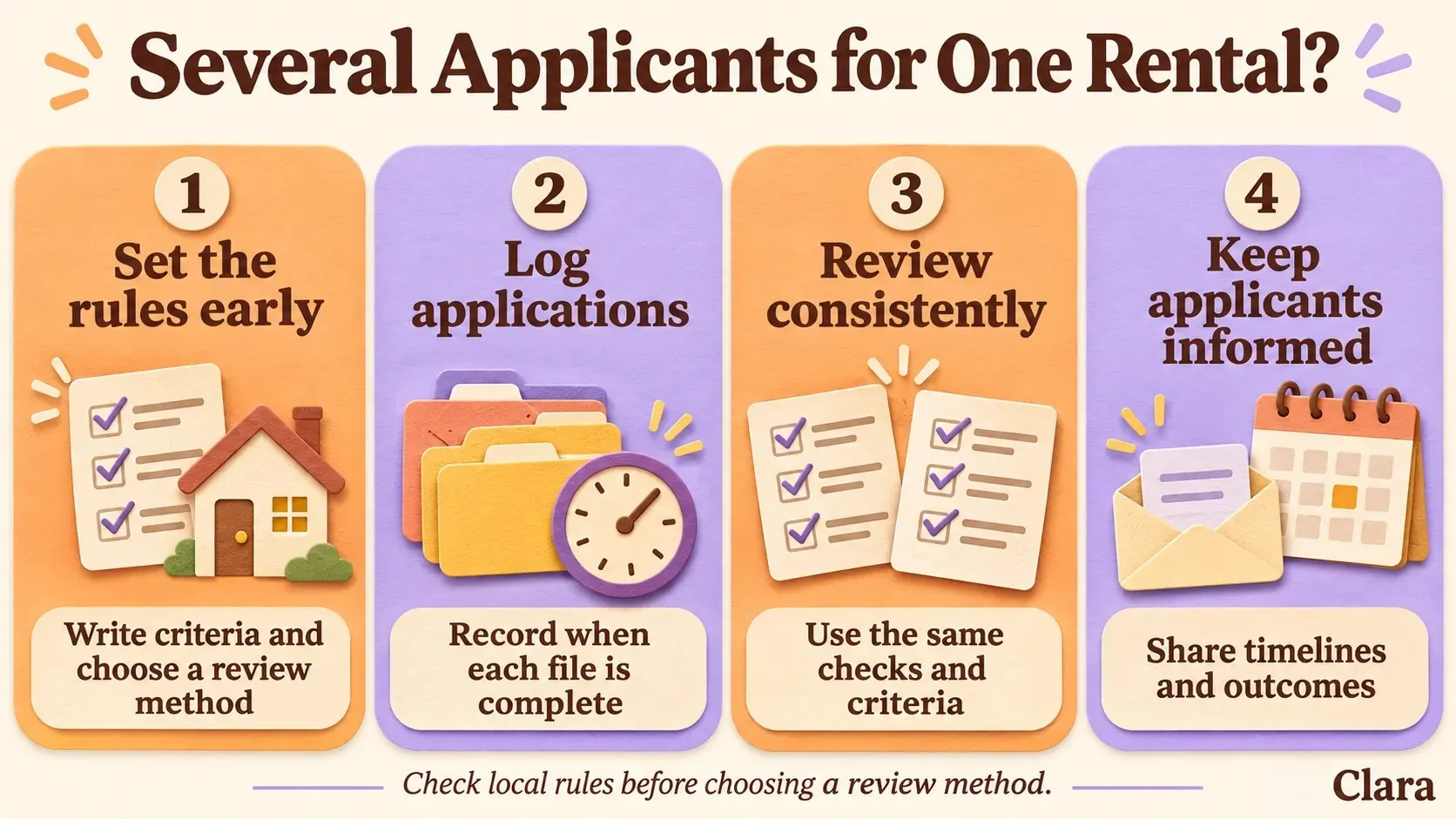
You list a rental, and within days your inbox fills up. Three applications become six. Now you have multiple applicants for one rental, and you need to pick one without losing the others or creating a fair housing problem.
This is a good problem to have, but it is easy to handle badly. Choosing on a gut feeling, or on who seemed friendliest at the showing, can lead to complaints and a poor fit. This guide gives landlords a clear process: set your criteria first, choose a selection method, compare every applicant on the same facts, and keep everyone informed. Writing your landlord screening criteria comes first, so start there if you have not done it yet.
Set Your Criteria Before You Review Any Application
Write your criteria before you advertise the rental, and share them in the listing. Applicants can then decide whether to apply, and you avoid changing the rules after you see who applied. Most written criteria cover these areas:
Minimum income, often set as a multiple of the monthly rent, such as three times.
Credit standards, including how you treat collections and unpaid debt.
Rental history and references from previous landlords.
Eviction and criminal history, within the limits of the rules where you rent.
A complete application, with every required document.
With these in place, each applicant is measured against the same list, not against each other. That one change makes the rest of the process easier to run and easier to explain.
Choose a Selection Method: First Qualified or Best Qualified
There are two common ways to choose between qualified applicants. Pick one before the first showing and use it every time.
With the first qualified method, you review applications in the order you receive them. The first applicant who meets every written criterion gets the offer. It is simple to explain and simple to document, and some cities require it. Log the date and time of each complete application.
With the best qualified method, you collect applications for a set period, screen everyone, and score each one against your criteria. The highest score gets the offer. This can find a stronger fit when several people qualify, but you need a written scoring system and a clear deadline.
Either method works when you write it down and apply it the same way for every vacancy. Mixing them, such as taking the first applicant on one unit and the top score on the next, is where problems start. Fair housing rules apply to both methods, so brush up on fair housing 101 if the basics are new to you.
How to Handle Multiple Applicants for One Rental, Step by Step
These five steps keep the process fair, fast, and easy to defend if someone asks why you chose as you did.
Step 1: Log Every Application With a Date and Time
Keep a simple tracker with each name, the time you received the application, and what is still missing. A spreadsheet is enough. This record shows the order you used and the reason behind each decision.
Step 2: Tell Every Applicant How the Process Works
Tell each person that other applications are coming in, how you will decide, and when they will hear back. Set a deadline for applications and a date for your decision. Send the same message to everyone, so nobody can say they were told something different. Clear expectations cut down on follow-up calls and keep good applicants from walking away.
Step 3: Confirm Each Application Is Complete
Do not screen partial applications. Check that the form is signed, the fee is paid, ID is attached, and the required documents are in. Give everyone the same short window to fix gaps. A rental application form checklist makes it easy to see what a complete file should hold.
Step 4: Screen Everyone the Same Way
Run the same checks on each applicant: identity, income, credit report, rental history, and background check. Verify income with pay stubs or bank statements, and review employment and income history the same way for every person. Apply one consistent method when reviewing credit background, and call each previous landlord to confirm the story. Checking rental history and references the same way for everyone is what keeps the comparison fair. Do not skip a check for someone you like, and do not add one for someone you doubt.
Step 5: Compare Qualified Applicants Side by Side
Place the qualified applicants in one table. Score income against rent, credit, rental history, employment stability, and documents. A tenant screening scorecard keeps the weights the same for everyone. If two applicants tie, use a rule you set in advance, such as the earlier complete application.
What to Do With Co-Applicants and Roommates
Sometimes multiple applicants means several adults on a single application. Decide how you treat them before the first one arrives. Many landlords require each adult to apply and meet the criteria alone. Others accept a household when the combined income meets the rule. Pick one policy and use it for every group.
Screen each person in the group. In many leases, each tenant is responsible for the full rent, a setup known as joint and several liability, so one weak applicant can affect the whole household. Run background checks for roommates and co-applicants the same way you would for a single renter, one person at a time. When one person has a low credit score, let your written policy decide, not your impression.
Keep a Backup and Tell Everyone the Outcome
Once you pick a winner, give a short deadline to sign the lease and pay the deposit. Tell the runner-up that they are the backup, so you can move quickly if the first choice drops out. Keep the other qualified files until the lease is signed. If the first applicant does not respond in time, offer the unit to the next one on the same terms.
Tell everyone else promptly. If you deny an application, base the decision on your written criteria and decline the rental application with a short, polite message. When a screening report played a part, you may also need to send an adverse action letter, so build that step into your process.
Common Mistakes When You Have Several Strong Choices
A few habits cause most of the trouble when you receive multiple applications:
Choosing a potential tenant on a feeling instead of the written criteria.
Changing the criteria after you read the applications.
Holding a unit for one person with no deadline, while other good prospects move on.
Overlooking someone with a long credit history and a record of paying rent on time because another person was easier to talk to.
Skipping the reference call for the applicant you already like.
Telling the winner right away and leaving everyone else waiting for days with no update.
If you manage rental properties with a partner, a helper, or a property management company, share the same written process with everyone on the team. Each showing and each follow-up should work the same way, no matter who handles it. A shared tracker and a shared scorecard make this easy, and they give you one place to look when an applicant asks about the status of an application.
Know Your Local Rules and Fair Housing Limits
The right method depends partly on where your rental sits, because some cities set the order you must follow. In Seattle, the First-in-Time rule requires landlords to offer the rental to the first qualified applicant who submits a complete application, and it sets time windows for fixing missing information and accepting an offer. Check whether your city or state has a similar rule before you choose a method.
Fair housing law applies no matter which method you use. HUD explains that the Fair Housing Act protects people from discrimination based on race, color, national origin, religion, sex, familial status, and disability. Some states and cities protect more groups. Never use these factors, or stand-ins for them, to rank applicants, and do not steer one group toward an application that you withhold from another.
The North Carolina Real Estate Commission advises that every applicant receive the same application form and be asked the same questions, and that owners use an objective and documented system for selection. If your decision rests on a screening report, the FTC outlines the notice steps for using consumer reports in rental decisions. This article is general information, not legal advice, and rules vary by state and city.
Frequently Asked Questions
How do you choose between multiple qualified applicants?
Use the written method you set before listing the rental. That may be the first complete, qualified application or the highest score on your scorecard. Compare income, credit, rental history, and documents the same way for each person, record the reason for your choice, and tell the others once you decide.
Can landlords choose a tenant based on who applied first?
In most places, yes, if you apply the same rule to everyone and use written criteria. Some cities, such as Seattle, require landlords to offer the unit to the first qualified applicant. Check your local rules, log each application with a date and time, and keep your notes.
Can a landlord accept multiple applications for one rental?
Yes. Most landlords accept several applications and screen them in order or together. Tell every applicant that others have applied, how you will decide, and when they will hear back. Be clear about any application fee and whether it is refundable.
Can a renter apply for multiple apartments at once?
Yes, in most cases. Renters often apply to a few places to improve their odds, but each application may carry a fee and a credit check. Renters should read each offer carefully, track deadlines, and avoid signing more than one lease for the same dates.
Should every adult in a household meet your standards?
That is your policy to set, and it should be the same for every household. Many landlords screen each adult and require each one to meet the criteria. Others accept a group when combined income meets the rule. Write the policy down, apply it to every group, and explain it in the listing.
What factors should landlords never use when choosing a tenant?
Never use race, color, national origin, religion, sex, familial status, or disability, which the federal Fair Housing Act protects. Some states and cities protect more groups. Base the choice only on written, objective criteria such as income, credit, rental history, and a complete application.
Make the Choice Easy to Explain
Multiple applicants for one rental should feel like a strong market, not a risk. Set your criteria, pick a method, screen everyone the same way, and keep a record. If you can explain why one applicant won using your written standards, you made a fair choice, and the other applicants will be treated with respect.
Rent with Clara helps independent landlords confirm identity and screen applicants in one place, so you can compare every applicant on the same facts.
Taylor Wilson
Founder
Taylor Wilson is the Founder of Rent with Clara, a modern renter screening platform built to streamline the rental application process. As both a renter and an independent landlord, Taylor sits on both sides of the lease, and built Clara to give renters control over what they share while giving landlords reliable and verified applications.
Read Articles
1099 Tenant Proof of Income: Complete Verification Guide For Landlords