Disclaimer: This article is for general educational purposes only and does not constitute legal advice. Fair housing and tenant screening requirements vary by federal, state, and local law. Landlords should review the rules applicable to their properties and consult a qualified attorney when necessary.
Most landlords don't set out to discriminate against prospective renters. Sometimes, a simple question during a property showing is meant to be friendly or help start a conversation.
But questions like "Do you have kids?" or "Where are you originally from?" can bring personal information into a rental decision when it has no place there.
The challenge is that even well-intentioned questions can create fair housing concerns. They may reveal information about a renter's protected characteristics, influence a landlord's perception, or lead to inconsistent treatment of applicants.
Having rented more than 10 properties across four states and self-managed rental properties, Taylor understands both sides of the rental process. The experience has reinforced one important principle: landlords get better results when they focus on what actually matters, including the property, lawful screening criteria, and consistent verification.
The good news is that you don't have to sacrifice a friendly conversation to maintain a fair screening process. You simply need to ask better questions.
Key Takeaways
Keep rental questions focused on occupancy, identity, income verification, and property needs rather than protected personal details.
Treat assistance animals as reasonable accommodation requests, not ordinary pets.
Check state and local source-of-income protections before evaluating vouchers, benefits, or other lawful income sources.
Apply lawful screening criteria consistently to every applicant.
Focus on verifiable information instead of assumptions or personal impressions.
Why Friendly Questions Can Create Fair Housing Problems
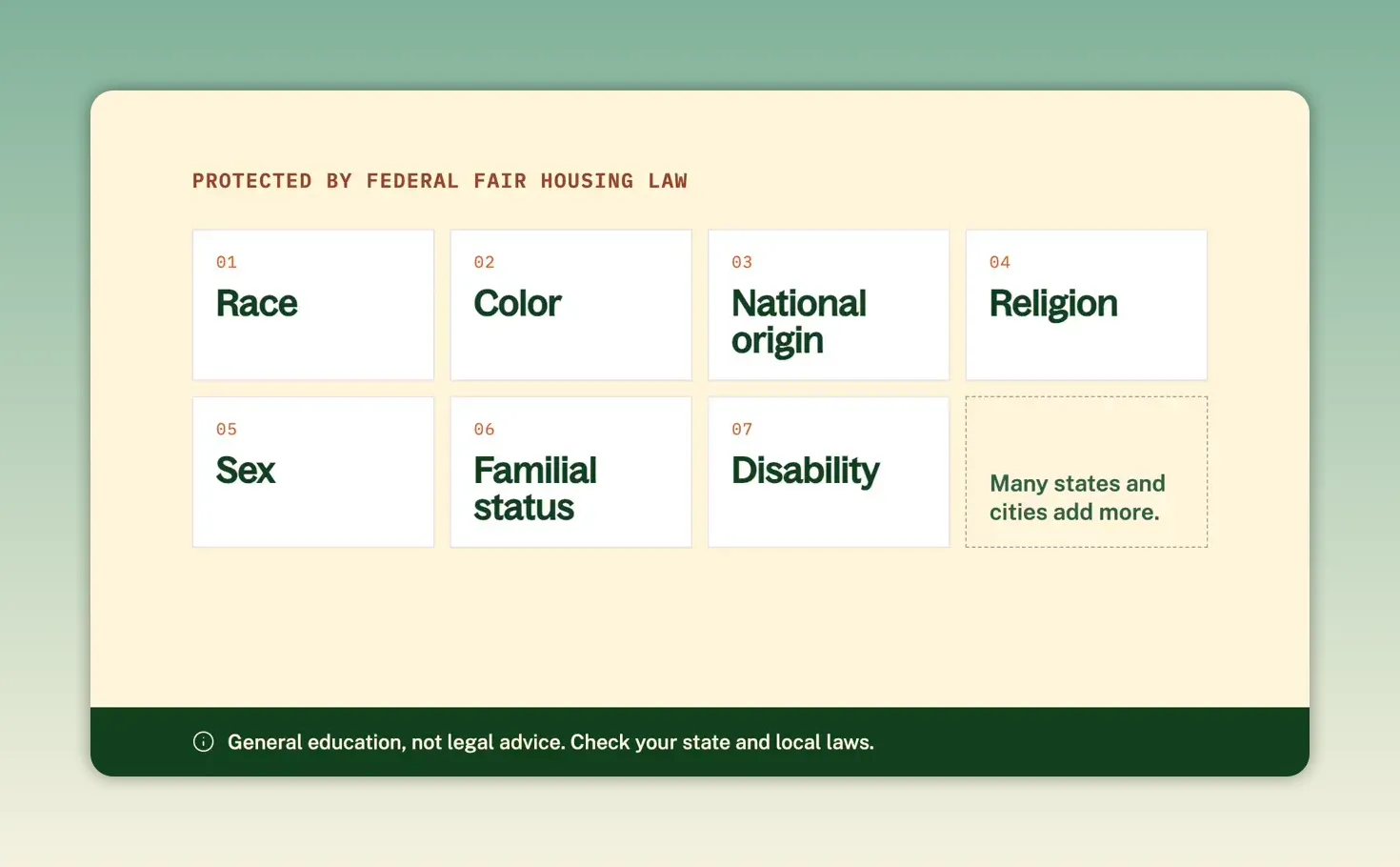
The federal Fair Housing Act protects renters from discrimination based on seven characteristics: race, color, national origin, religion, sex, familial status, and disability.
These protections apply throughout the rental process, including advertising, property showings, applications, tenant screening, and rental decisions. Some states and cities provide additional protections, including protections related to source of income.
The issue isn't simply whether a question sounds polite. It's whether the information you're collecting is relevant to a legitimate rental requirement or concerns something that should not influence your decision.
For example, asking how many people will occupy a property helps establish whether the household meets applicable occupancy standards. Asking whether someone has children or plans to start a family introduces personal information that isn't necessary to answer that question.
The distinction matters.
A better approach is to keep conversations focused on the property and apply the same lawful screening standards to everyone.
1. Instead of Asking About Kids, Ask About Occupancy
Avoid asking: "Do you have kids?" or "Are you planning to start a family?"
Questions about children, pregnancy, or plans to have a family can raise familial-status discrimination concerns under the Fair Housing Act.
As a landlord, you may need to understand how many people will live in your rental property. However, you don't need to know whether those occupants are children, spouses, relatives, or partners to establish the household's intended occupancy.
Ask instead: "How many people will be living in the home?"
This question addresses the actual rental requirement: occupancy.
Apply the same lawful occupancy standards to every applicant, taking into account applicable federal, state, and local requirements, as well as the property's size and configuration.
Avoid making assumptions about how many people should occupy a property based on family composition. The goal is to establish a consistent standard, not to evaluate someone's family plans.
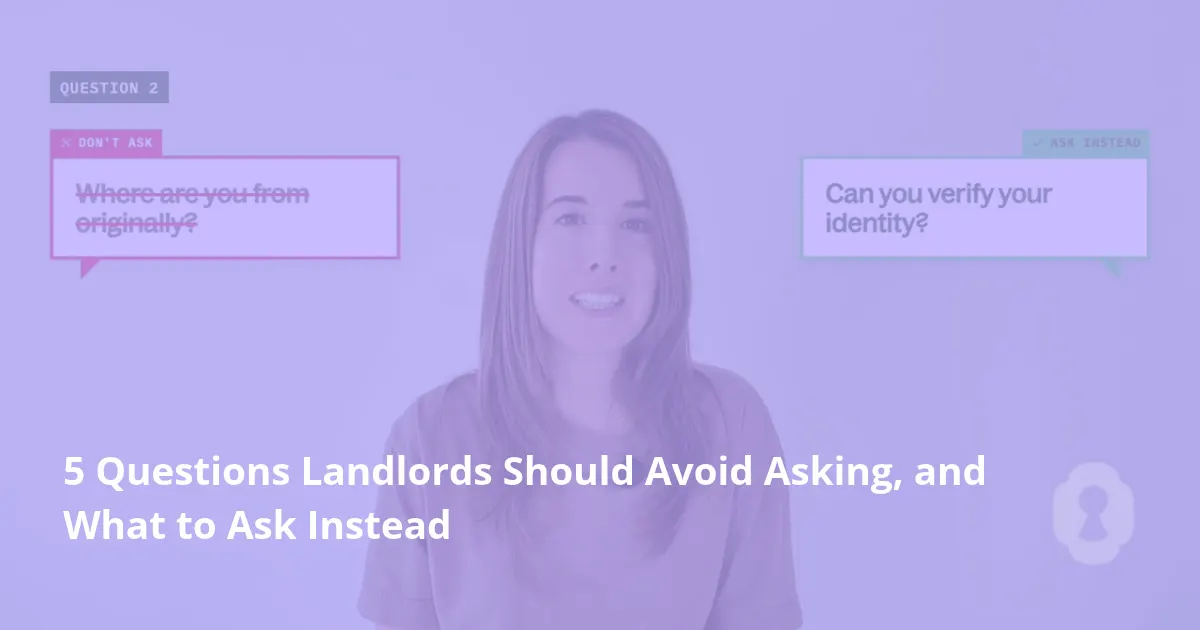
2. Instead of Asking Where Someone Is From, Verify Their Identity
Avoid asking: "Where are you from?" or "Where are you originally from?"
Sometimes, landlords ask this out of curiosity or as a way to build rapport. However, questions about someone's background or country of origin can raise concerns about national-origin discrimination.
If your actual goal is to confirm that an applicant is who they claim to be, asking where they come from doesn't accomplish that.
Identity verification does.
Ask instead: "Can you verify your identity?"
Use the same identity verification process for every applicant. This may involve reviewing appropriate government-issued identification and using reliable verification procedures as part of your screening process.
Don't require additional documentation from certain applicants based on their appearance, accent, name, or perceived background.
The purpose is to confirm an applicant's identity, not investigate their origin.
A consistent verification process also helps landlords avoid relying solely on information that applicants provide themselves. Clara'stenant screening process brings identity verification together with other relevant screening information.
3. Instead of Asking What an Assistance Animal Is For, Handle It as an Accommodation Request
Avoid asking: "What is the animal for?"
When a renter mentions an assistance animal, it's important to recognize that the conversation is no longer simply about an ordinary pet policy.
Disability is protected under the Fair Housing Act. Asking someone to explain their diagnosis, medical history, or personal health circumstances can cross an important boundary.
Under federal fair housing rules, assistance animals are not considered pets. They may include trained service animals and other animals that provide disability-related assistance or emotional support.
Ask instead: "Do you have any pets you plan to keep at the property?"
If a renter requests an assistance animal as a reasonable accommodation, handle that request separately from the property's ordinary pet policy. A renter does not need to explain their diagnosis or disclose unnecessary medical details.
This can be a general property-related question asked consistently of applicants. However, if someone identifies an animal as an assistance animal or requests an accommodation, handle that separately from your ordinary pet policy.
Keep these distinctions in mind:
Don't treat an assistance animal as an ordinary pet. A standard pet policy, including a no-pets rule, generally does not apply in the same way to an assistance animal.
Don't charge pet fees or pet rent for an assistance animal. A reasonable accommodation may require waiving pet-related charges.
Keep documentation requests limited and appropriate. If the disability or disability-related need is not apparent, a housing provider may request reliable supporting information when permitted by applicable rules.
Don't demand a medical diagnosis. A request for an accommodation does not give a landlord permission to investigate someone's private medical history.
There may be specific circumstances in which a reasonable accommodation can be denied under the law, but those decisions require an appropriate assessment rather than an automatic application of pet restrictions.
The important distinction is simple: landlords can manage their properties while still respecting a renter's right to request a reasonable accommodation.
4. Instead of Asking About Church, Ask What Matters in a Home
Avoid asking: "Do you go to church around here?"
A question about church attendance may sound like an easy way to connect with a prospective renter. But religion is a protected characteristic under the Fair Housing Act, and that protection includes people who do not practice any religion.
You don't need to know someone's religious beliefs to understand whether a property meets their needs.
If your goal is to build rapport, there are plenty of property-related topics that can help you start a meaningful conversation.
Ask instead: "What matters most to you in your next home?"
This opens the door to a more useful discussion.
A renter might mention:
A convenient commute to work.
Parking availability.
Access to public transportation.
A quiet neighborhood.
Specific property features or amenities.
These details help you understand what the applicant is looking for without bringing personal beliefs into the rental process.
Being friendly and maintaining fair housing practices aren't mutually exclusive. Keeping the conversation centered on the home creates a better foundation for both the landlord and renter.
5. Instead of Questioning an Income Source, Ask for Verification
Avoid asking: "Is that a voucher?" or "What kind of income is that?"
Landlords need to establish whether applicants can meet the property's rental requirements. But questioning an applicant simply because their income comes from an unfamiliar source can create fair housing concerns.
Source-of-income protections vary by state and local jurisdiction. Some laws protect applicants who receive housing vouchers, public benefits, disability payments, or other lawful income sources.
Where these protections apply, landlords may be prohibited from rejecting an applicant simply because of the source of their income.
Ask instead: "Can you verify the income required for this property?"
Focus on whether the applicant meets the property's lawful financial requirements and whether the relevant income can be verified.
A consistent verification process may include reviewing appropriate documentation, such as:
Pay stubs or employment records.
Bank statements or other acceptable financial records.
Self-employment or freelance income documentation.
Housing assistance or voucher information, where applicable.
Remember that local laws may also affect how income requirements are calculated. For example, some jurisdictions require landlords to consider the portion of rent an applicant is personally responsible for paying when a housing subsidy covers the remainder.
A freelancer with consistent income or an applicant using a housing voucher may meet the property's requirements. Dismissing someone before reviewing the relevant information can mean overlooking a qualified renter.
The goal is not to accept every application automatically. It's to evaluate applicants using lawful, consistent criteria rather than assumptions about where their money comes from.
Make Consistency the Foundation of Tenant Screening
Knowing which questions to avoid is a good start. But fair screening also depends on what happens after the conversation.
A landlord can ask all the right questions and still create problems by applying different standards to different applicants. That's why a repeatable process matters.
Build these practices into your tenant screening workflow:
1. Establish lawful screening criteria. Decide what information is relevant to the property before reviewing applications. Check federal, state, and local requirements, including any additional fair housing protections.
2. Ask the same core questions. Use a consistent set of property-related questions for every prospective renter. Avoid making exceptions based on personal impressions or assumptions.
3. Verify information consistently. Follow the same procedures when confirming identity, income, rental history, and other relevant application details.
4. Handle accommodation requests appropriately. A consistent screening process should still allow for reasonable accommodation requests. Assistance animals, for example, must not automatically be treated as ordinary pets.
5. Evaluate applicants against relevant criteria. Focus on the information that relates to your established requirements. Don't let familiarity, personal beliefs, or assumptions about an applicant influence your decision.
Where Rent With Clara Fits Into a Fair Screening Process
The questions landlords ask are only one part of the screening process. They also need a reliable way to evaluate the information applicants provide.
That's where Rent With Clara fits in.
Clara brings identity, income, and background verification information together in a screening report, helping landlords review relevant applicant information in one place.
Instead of relying on casual conversations or assumptions, landlords can use verified information alongside their established screening criteria to make more informed decisions.
Clara supports the screening process, but landlords remain responsible for setting lawful criteria, reviewing accommodation requests appropriately, and making rental decisions in accordance with applicable fair housing and screening laws.
Better Questions Lead to Better Screening Decisions
You don't need to ask personal questions to become a better landlord. You need to understand what information is relevant to your property and how to evaluate it fairly.
Asking about occupancy instead of family plans, verifying identity instead of questioning someone's origin, and evaluating income rather than making assumptions about its source all help keep the conversation focused on what matters.
The same principle applies throughout the screening process: establish clear criteria, verify relevant information, and apply your standards consistently.
A fair process doesn't mean abandoning your rental requirements. It means giving every qualified applicant an opportunity to be evaluated against them.
Build a More Consistent Screening Process
Want a practical way to organize your tenant screening steps? Explore Clara's freeTenant Screening Checklist to help verify, evaluate, and review applicants with greater consistency.
Frequently Asked Questions
Can a landlord ask how many people will live in a rental?
Yes. Landlords can generally ask about the number of intended occupants to assess whether a household meets applicable occupancy standards. The question should focus on total occupancy rather than asking whether applicants have children, are pregnant, or plan to start a family. Apply lawful occupancy standards consistently.
Can a landlord ask for documentation for an assistance animal?
In some circumstances, yes. When a disability or disability-related need is not apparent, housing providers may request reliable supporting information when permitted by fair housing rules. However, they generally cannot demand a medical diagnosis or detailed medical records. Assistance animal requests should be handled as reasonable accommodation matters, not ordinary pet applications.
Can landlords reject applicants because they use a housing voucher?
It depends on the property's location and applicable law. Source of income is not a separate protected class under the federal Fair Housing Act, but many state and local laws provide source-of-income protections. In jurisdictions where those protections apply, landlords may be prohibited from rejecting applicants simply because they use housing vouchers or other protected lawful income sources.
How can landlords build rapport without asking personal questions?
Focus on the property and the renter's housing needs. Ask questions such as, "What matters most to you in your next home?" This can lead to useful conversations about commute times, parking, amenities, and neighborhood preferences without bringing religion, family plans, or medical information into the discussion.
Does using a tenant screening service guarantee Fair Housing compliance?
No. A screening service can help organize and verify applicant information, but it does not guarantee that a landlord's decisions comply with fair housing laws. Landlords remain responsible for using lawful screening criteria, applying them consistently, handling accommodation requests appropriately, and following applicable federal, state, and local requirements.
Taylor Wilson
Founder
Taylor Wilson is the Founder of Rent with Clara, a modern renter screening platform built to streamline the rental application process. As both a renter and an independent landlord, Taylor sits on both sides of the lease, and built Clara to give renters control over what they share while giving landlords reliable and verified applications.
Read Articles
1099 Tenant Proof of Income: Complete Verification Guide For Landlords