A rental application fee looks like a small line on a form, but it raises big questions.
How much is fair?
What can it cover?
Do you have to refund it?
Set it too high and good renters walk away. Set it without checking local rules, and you may owe money back.
This guide helps independent landlords set a rental application fee they can explain and defend. You will learn what the fee covers, how to work out the right amount, how it differs from a screening fee and a holding deposit, and how the rules change from place to place. Whatever you charge, it should follow from your landlord screening criteria, because the fee pays for the checks those criteria require.
What Is a Rental Application Fee?
A rental application fee is money a landlord collects when a prospective tenant applies for a unit. It usually pays for the cost of processing the application, such as a credit report, a background check, and a rental history check. Most landlords collect it with the rental application, before any screening begins.
The fee is not rent, and it is not part of the security deposit or the lease. It does not reserve the unit, and paying it does not guarantee approval. If you want a refresher on the form itself, what a rental application is covers the basics, and the rental application form checklist shows what to include.
Application Fee vs Screening Fee vs Holding Deposit
These terms get mixed up, and the difference matters because the rules are not the same for each one.
An application fee is a general charge to process an application. Some states limit it or ban it.
A screening fee is a charge tied to specific checks, such as a credit report or a background check. Many state laws use this term.
A holding deposit is money that takes a unit off the market for a short time. It is a different payment with different rules.
Landlords often use "application fee" and "screening fee" for the same thing, and the law in your area may use only one of them. Read the exact wording of your local rules before you name the charge on your form. Holding deposits and move-in money fall under separate rules, which the security deposit guide for independent landlords walks through.
Why Landlords Charge an Application Fee
Every step of the screening process costs real money. A credit report, a criminal and eviction search, and a rental history check each have a price, and your time has a value too. Without a fee, you pay those costs for every person who applies, including people who never finish the process.
A fee also filters out casual applicants. Someone who pays to apply is usually serious about the unit. That said, a fee that feels too high can drive away qualified renters, especially in a market where they have choices. The goal is a fee that covers your cost and nothing more.
How Much Should You Charge for a Rental Application Fee?
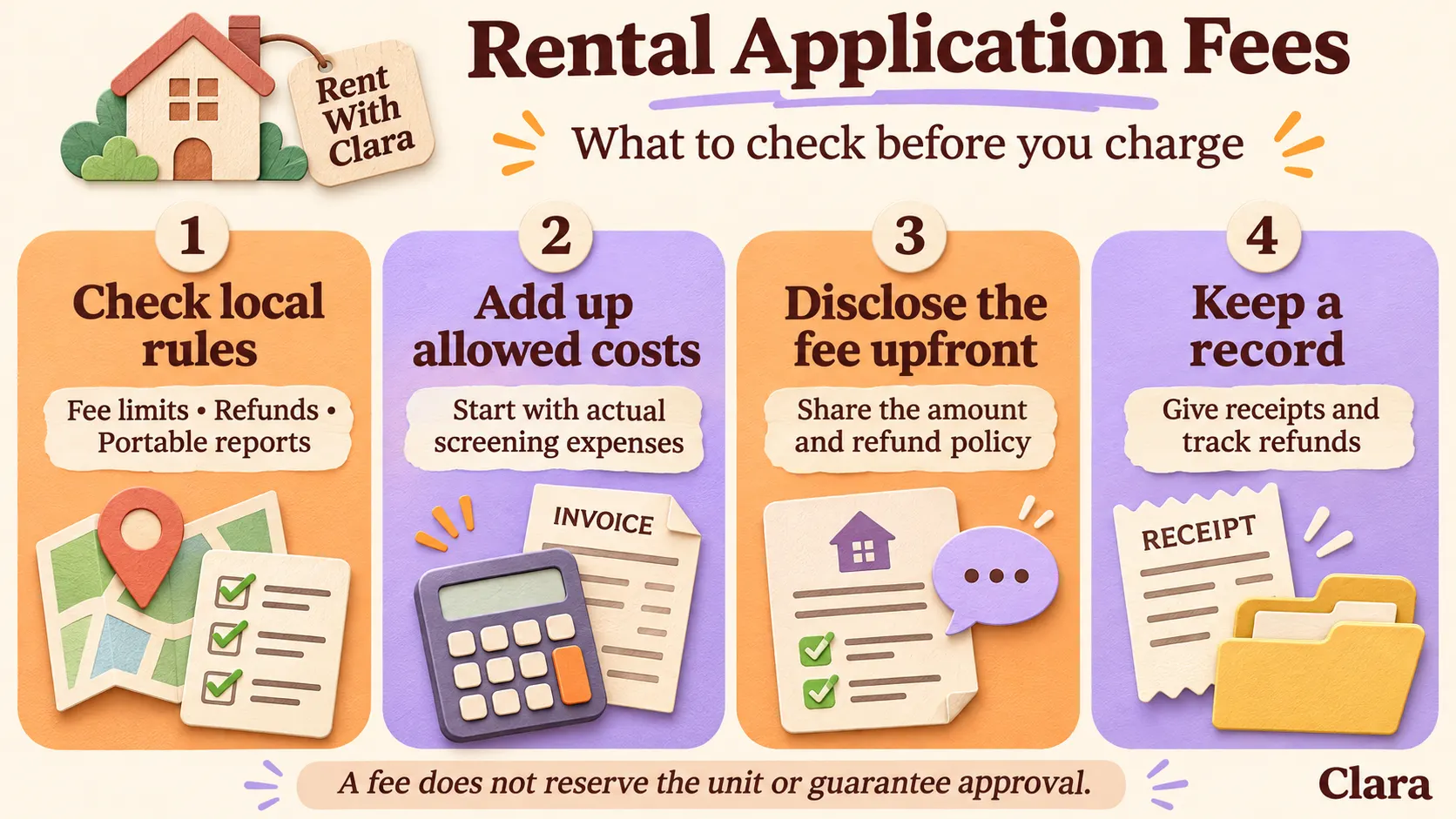
The best answer is to charge what the application costs you to process, and no more. This method keeps you fair, simple to explain, and in line with the many places that tie the fee to actual cost. Follow these four steps.
Step 1: Add Up Your Real Costs
List what you pay for each application. This usually includes the credit report, the criminal and eviction search, and any identity or income verification. If you use a screening service, the price is on your invoice. For a closer look at typical line items, see what tenant screening costs before you build your number.
Step 2: Decide Whether Your Time Counts
Some places let landlords include a reasonable value for the time they spend, and others limit the fee to out-of-pocket costs. Do not guess. If your local rules count only direct costs, leave time out. If they allow time, keep the figure modest and be ready to show how you calculated it.
Step 3: Check the Cap Where Your Rental Is Located
Some states and cities set a maximum, and some tie the cap to the Consumer Price Index so it changes every year. A landlord who charges above the cap may have to refund the difference. Look up the rule before you publish the amount, and check it again each year.
Step 4: Set One Flat Fee and Charge It the Same Way Every Time
A single flat fee for every adult applicant is easier to run and easier to defend. If you manage several rental properties, use the same fee for each unit you offer at the same time. Charging different amounts to different people can look like bias, and it can break rules that require one fee for a unit. Consistent treatment is also part of staying on the right side of fair housing 101.
Here is a simple example. Suppose your screening report costs a set amount per applicant, and you spend a few minutes on reference calls. Your fee is the report cost plus a modest, reasonable amount for that time, if your local rules allow it. If you cannot explain every dollar of the fee, lower it.
Who Should Pay for Screening, You or the Renter?
Many landlords pass the cost to the applicant through the fee. Others absorb it to attract more applicants, or to stand out in a competitive market. Both approaches are common, and each has trade-offs for cost, application volume, and applicant quality. Tenant-paid vs landlord-paid screening compares them in detail.
If you ask the renter to pay, say so before they apply. Put the amount and what it covers in the listing or on the application. Surprise charges damage trust, and they are a growing target for regulators, as the federal section below explains.
If you hire a property management company, ask how it sets and collects the fee. A management company may add its own rental fee, and the local rules apply to the charge no matter who collects it. Get the amount and the refund policy in writing before you list the unit.
Application Fees and Portable Screening Reports
Some states let renters bring a reusable report that they already paid for, called a portable tenant screening report. Where these laws apply, a landlord may have to accept the report, and may be limited in what they can charge. In Colorado, for example, a landlord cannot charge an application fee when the renter provides a qualifying report.
A clear written policy prevents most fee disputes. Include these points in your listing or on the application:
The exact amount, and whether it applies to each adult.
What the fee covers, such as the credit report and the background check.
When you collect it, and by what payment method.
Whether the fee is non-refundable or refundable in part, where your local rules allow either, and when you would refund it.
What happens if the applicant is not selected, or if the unit is rented before you process the application.
Give every applicant a receipt. Many places require one, and it protects you if a renter later questions the charge. Keep a simple record of what you spent on each application so you can show that the fee matched your costs.
Common Mistakes With Rental Application Fees
Most problems come from a few habits. Watch for these:
Charging more than your cost or more than the local cap.
Collecting fees when no unit is available, or from more people than you can fairly consider.
Charging different amounts to different applicants for the same unit.
Keeping a fee when you never ran the checks it was meant to cover.
Skipping the receipt, or never stating the refund policy.
When you turn someone down, the fee is a separate question from the decision. Follow your written criteria, and learn how to decline a rental application clearly and politely. A plain explanation makes it less likely the applicant will challenge the charge.
How to Collect the Fee and Keep Records
Collect the fee only after you confirm that the unit is available and that you can process the application. Use a traceable payment method, and send a receipt right away. A payment trail shows what each person paid, when they paid, and what it covered.
Keep a short file for each application. Note the date, the amount, the checks you ran, and what each one cost. If an applicant asks for a refund or an itemized list, you can answer in minutes. The same file supports your screening decision, and the tenant screening checklist shows which items belong in it.
Review your fee once a year. Screening report prices change, and some caps change with inflation. A fee that was fair last year may be too high or too low now, and a quick yearly check keeps your policy honest.
Know the local laws before you collect a single dollar. In many places a landlord must provide a written receipt, and any part of the fee that was not spent on processing must be returned. Some places say a landlord may not charge more than the cost of the checks, so keep your costs tied to the fee and your records ready to show it.
Rental Application Fee Laws by State and City
Rules differ widely, so treat this section as a sample and not a full list. The state by state screening requirements page is a good place to start your research, and your state's housing or attorney general website is the best place to confirm the current rule.
California: Civil Code 1950.6 limits the screening fee to $30 per applicant, adjusted each year for inflation, and it cannot exceed the landlord's actual out-of-pocket costs plus the reasonable value of the landlord's time. Landlords must give an itemized receipt and refund any unused portion if they do not run the checks.
Colorado: House Bill 19-1106 allows a rental application fee only if the whole amount covers the landlord's cost of processing the application. Landlords must disclose expenses, give a receipt, and make a good-faith effort to refund the unused amount within twenty days.
Washington, D.C.: The Office of the Tenant Advocate reports that the rental application fee cap was $53 for 2025 and is adjusted each year for inflation.
Rhode Island: state law generally bars a general rental application fee, though a landlord may charge up to the cost of an official background or credit check in some cases.
Berkeley, California: the city's tenant screening fee rules set a 2026 maximum of $68.96 and require landlords to refund unused amounts and to avoid charging when no unit is available.
Many other states have their own limits, refund rules, or disclosure rules, so confirm yours before you set the amount.
What Is Changing at the Federal Level
In March 2026, the Federal Trade Commission asked for public comment on whether it should write a rule about unfair or deceptive rental housing fees. Its notice asks, among other things, about fees that are not clearly disclosed and about what providers do with application fees. According to the FTC, this was a request for comment, and no final rule has been issued.
The practical lesson is the same whether or not a rule arrives. Tell renters the amount early, explain what it covers, and avoid hidden charges. A clear fee policy is good practice today and likely to fit whatever rules come next. This article is general information, not legal advice, and rules vary by state and city.
Frequently Asked Questions
How much should a landlord charge for a rental application fee?
Charge no more than it costs to process the application. Add up the screening report and any other direct costs, check your state or city cap, and charge every applicant the same flat amount. If you cannot explain how you reached the number, lower it before you publish the listing.
Are rental application fees refundable?
It depends on where the rental is located. Some places treat the fee as nonrefundable, while others require you to return any unused portion. Colorado, for example, expects landlords to make a good-faith effort to refund what they did not spend on processing. State your refund policy in writing before you collect any fee.
Is it legal to charge a rental application fee?
In most places, yes, but several states and cities limit the amount or what the fee can cover. Rhode Island generally bars a general application fee, while California and Colorado tie the fee to your processing costs. Check the rules where your rental is located before you set the amount.
Can landlords charge an application fee for each adult?
Most landlords charge each adult who applies, because each person needs a credit and background check. Some rules count the cap per applicant, such as California's limit of $30 per applicant, adjusted for inflation. Charge every adult the same amount, and do not charge anyone who is not applying.
Can you charge an application fee if no unit is available?
Avoid it. Berkeley, for example, bars screening fees when no rental unit is available. Even where the law is silent, taking money for a unit you cannot rent invites disputes. Collect fees only when you have a unit ready to rent and can process the application.
Should landlords charge an application fee at all?
Many do, because screening costs money and a fee discourages applicants who are not serious. Some landlords pay the cost themselves to attract more applicants. Either approach can work if you apply it the same way to everyone, state it up front, and follow the rules where your rental is located.
Charge What You Can Explain
The right rental application fee is the one you can explain line by line. Add up your real screening costs, check the cap in your area, set one flat fee, and put the policy in writing. Give a receipt, refund what the rules require, and keep a record of your costs. A fair fee protects your budget and your reputation with renters.
Rent with Clara helps independent landlords screen applicants in one place, so your process stays consistent for every applicant.
Taylor Wilson
Founder
Taylor Wilson is the Founder of Rent with Clara, a modern renter screening platform built to streamline the rental application process. As both a renter and an independent landlord, Taylor sits on both sides of the lease, and built Clara to give renters control over what they share while giving landlords reliable and verified applications.
Read Articles
1099 Tenant Proof of Income: Complete Verification Guide For Landlords