You have a promising application in front of you. The income looks fine, and the references answered. Then a thought crosses your mind: should I look this person up online? Many landlords do. A quick search feels harmless, and it takes two minutes.
It isn't harmless, though, and it can undermine your efforts to protect your rental. Social media tenant screening sits between helpful and risky, and the risk lands on you. This guide explains what a social media check can and cannot tell you, where the fair housing and privacy risks are, how AI tools change the picture, and how to screen tenants fairly instead. If you want the legal basics first, start with our complete guide to the Fair Housing Act and tenant screening.
What Is Social Media Tenant Screening?
Social media tenant screening means reviewing a renter's public online presence as part of your decision. That can be as simple as searching a name on Google, or as detailed as scrolling through a Facebook, Instagram, or LinkedIn profile. Some landlords also pay a service to scan each platform and write a summary.
It is different from a standard tenant screening process. A credit report, an eviction search, and a background check all rely on records tied to a verified identity. A social media search depends on what a person chooses to post and whether you find the right person.
Why Landlords Are Tempted to Look Applicants Up Online
The appeal is easy to understand. You want to know whether a stranger will pay on time, keep the home in good shape, and follow the lease. A profile seems to offer a peek into daily life. Common reasons include:
To confirm the person is real and matches the application.
To look for signs of fraud, such as a job that does not appear to exist.
To spot behavior that might signal future problems, such as posts about parties or damage.
To fill gaps when someone has little rental history or credit.
Some of those goals are fair. The method is the problem. A profile mixes useful clues with a lot of information that should never shape a rental decision.
Is Social Media Tenant Screening Legal and Ethical?
This is the central question, and the honest answer is that it depends on how you use what you see. The Fair Housing Act focuses on discrimination. It does not ask whether you looked at a profile. It asks whether your decision was influenced by who the person is. A profile can reveal a lot about someone, including family status, religion, national origin, race, disability, and sex. Once you have seen it, it is hard to prove you did not use it.
That puts you in a tough spot if a renter is denied and files a complaint. A search history, a screenshot, or a note about a photo can look like evidence. Our post on how to spot discrimination during the rental process covers the kinds of mistakes that lead to complaints.
There is also an ethical side. Most people do not expect their vacation photos, political views, or family news to affect where they can live. Treating a personal profile as an audition for housing can feel invasive, and it can push good renters away. Many states and cities also have their own fair housing and privacy rules, so the right approach can differ by location. A local attorney can tell you what applies where you rent.
What a Social Media Check Can Reveal, and Why It Often Misleads
Even when the law is not a concern, social media is a weak source of information. Several things can go wrong:
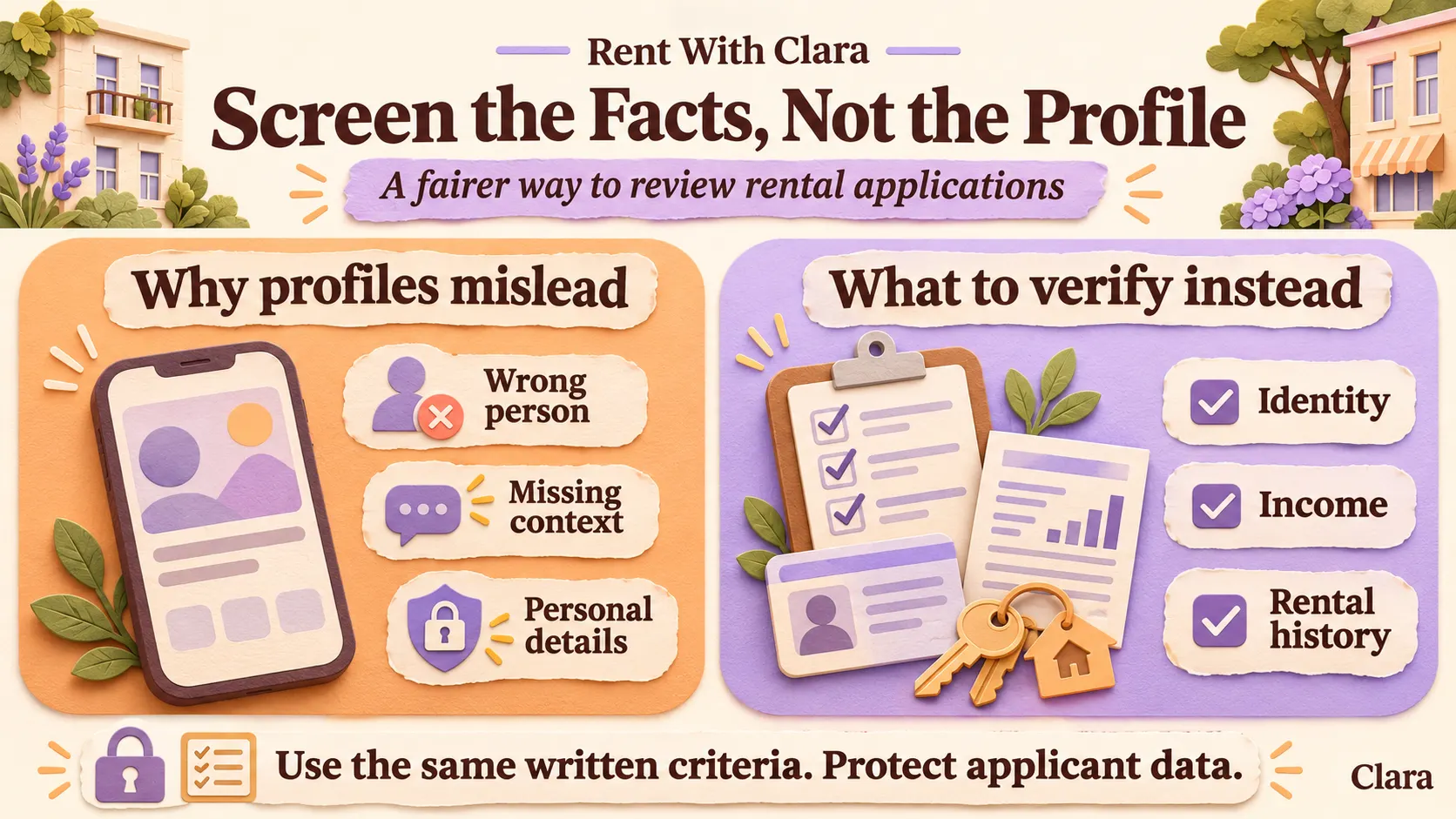
Wrong person. Common names lead to mix-ups. You may judge someone for something a stranger did.
Missing context. A joke, a sarcastic post, or an old photo can look worse than it was.
Outdated information. People change jobs, addresses, and habits. A profile may be years behind.
Fake or edited content. People can create, hide, or clean up accounts in minutes, so a missing profile proves nothing.
Bias. A profile can trigger a gut reaction that has nothing to do with the rental.
Because of these gaps, social media rarely beats a real record. A former landlord saying rent was paid late tells you more than a weekend photo. Our guide to red flags in tenant background checks shows which findings matter and which do not.
Safer Ways to Check What You Truly Need to Know
Go back to the question you are trying to answer. Most reasons for a social media search can be handled with checks tied to a verified identity and your written criteria.
Can they pay? Verify income and employment with pay stubs, bank statements, or a call to the employer, then compare income to rent.
Do they pay on time? Call prior landlords, run a credit check, and review the credit report from a bureau such as Experian, with written consent.
Any history to know about? Review eviction and criminal records through a screening report, and follow your local rules on what you may consider.
These checks support sound decision-making. They are consistent, documented, and based on information the renter agreed to share. Clear landlord screening criteria keep everyone on the same footing, and a tenant screening scorecard makes the final decision easier to explain.
Privacy Laws and Tenant Data: What You Are Responsible For
Screening also brings privacy concerns. Once you collect personal information, such as a Social Security number, credit history, or a copy of an ID, you must protect it. Privacy laws and data protection rules vary by state, and some places regulate how long you can keep records and how you must dispose of them. Good habits help you stay compliant and keep tenant data safe.
Collect only what you need, store it securely, and delete it when you no longer need it. Avoid saving screenshots of profiles or other personal data that played no part in your decision. Our guide on protecting applicant information covers practical steps. If a real estate agent or property management company helps you screen, ask how it handles data and who can see it. Strong compliance habits are among the best practices a rental property owner can adopt because they protect renters and reduce your risk.
What About AI Social Media Screening Tools?
More and more services use AI to scan public posts and flag content. They promise fast reviews and fewer false alarms because the software reads tone and context instead of keywords. For a busy owner, that sounds appealing.
Be careful, though. AI doesn't eliminate fair housing risk. A tool can still surface protected details, and its summary may lean on patterns that reflect bias. If the output is wrong, you may not know why. Many tools also work like a black box, so it is hard to see how it reached a flag or whether it matched the right person.
If you use AI tools at all, treat them as one input, never the decision. Ask what sources the tool uses, how it handles protected information, and how a renter can dispute an error. Our overview of AI tenant screening for landlords explains where these tools help and where they fall short.
If You Still Choose to Check Social Media, Use a Fair Policy
Some owners will look anyway. If you do, keep the process narrow and written down. These six steps reduce the risk:
Step 1: Write the Policy Before You Look
Decide in advance why you might check, what you will look for, and how you will record it, so you can evaluate each case the same way. A written policy shows that your process is planned, not improvised for one person.
Step 2: Limit the Purpose
Use public information only to assess facts tied to your written criteria, such as whether an account matches the identity on the application. Do not browse for personality, family, beliefs, or lifestyle.
Step 3: Separate the Searcher From the Decision Maker
If possible, let one person do the check and pass along only what is relevant, while another person makes the decision. That way, the decision maker never sees protected details.
Step 4: Apply the Same Process to Everyone
Never check some people and skip others. Uneven checks can look like bias, even if you didn't intend them.
Step 5: Keep Notes, Not Screenshots of Personal Details
Record what you checked, when, and what it confirmed. Avoid saving photos, family details, or other private content. Store anything you keep securely, since tenant data is sensitive.
Step 6: Base Every Denial on Your Written Criteria
If you deny an application, tie the reason to each criterion you set for everyone, such as income or rental history. You may reject an application for a documented, neutral reason. Never cite something you saw on a profile. If a screening report played a part, follow the adverse action rules for notifying the renter.
Where the Rules Come From
Two federal frameworks matter most. The first is the Fair Housing Act. According to HUD, it bars discrimination in housing based on race, color, national origin, religion, sex, familial status, and disability. A social media profile can reveal many of these, so a quick look can create risk.
The second is the Fair Credit Reporting Act, or FCRA. It applies when a third party compiles information about a person into a report that you use for a decision. In an employment context, the FTC has explained that when a background report includes social media information, the same FCRA rules apply. That includes accuracy, dispute rights, and notice before an adverse action. FCRA also covers the consumer reports that landlords use, but the details can vary with the facts, so ask a qualified professional about your situation.
For landlords who use screening reports, the FTC offers a guide on using consumer reports. It explains what to do when a report leads to a denial or a higher deposit, including how to notify the renter. Keep in mind that this article is general information, not legal advice.
Frequently Asked Questions
Is it legal for landlords to check an applicant's social media?
Federal fair housing law focuses on discrimination, not on whether you looked. The danger is that what you see, such as family status or religion, influences your decision. That can lead to a complaint. State and local rules vary, so use written criteria, apply them equally, and consult a local attorney.
Can landlords use social media to deny a rental application?
A denial should rest on written, neutral criteria, such as income, rental history, and verified screening results. Denying someone because of a protected characteristic, even one learned from a profile, is prohibited. If a third-party report influenced the decision, follow the adverse action steps for notifying the renter.
What do landlords look for when screening a tenant?
Most landlords review identity, income, employment, credit, rental history, and eviction or criminal records. They compare each item to written criteria, such as a minimum income ratio. Calls to prior landlords add context that numbers cannot. A consistent process gives every renter a fair review.
What could disqualify you from renting a house?
Common reasons include income that is too low for the rent, a recent eviction, unpaid rent or debts to a prior landlord, certain criminal records where local law allows, and false information on the application. Each owner sets criteria, and local laws limit what they can consider. Programs such as Section 8 add their own rules.
Who pays for tenant screening?
In many places, the applicant pays an application or screening fee, while some states cap the fee or shift the cost to the owner. Portable screening reports let a renter reuse one report with several landlords. Check your state's rules before you charge a fee.
Are AI social media screening tools safe to use?
They can add risk. AI may surface protected details, rely on biased patterns, or match the wrong person, and the reasoning is often hard to check. If you use one, treat the result as a lead to verify, never as the decision, and make sure renters can dispute errors.
Verify the Facts, Not the Profile
A quick online search feels like due diligence, but it can create more risk than insight. The safest path is to rely on verified identity, income, rental history, and screening reports, judged against written criteria that you apply to everyone. If you decide to look at social media anyway, keep the purpose narrow, keep notes, and never let what you see drive a decision.
Rent with Clara helps independent landlords confirm identity and review applicants in one place, so you can make a confident decision without scrolling through someone's personal life.
Taylor Wilson
Founder
Taylor Wilson is the Founder of Rent with Clara, a modern renter screening platform built to streamline the rental application process. As both a renter and an independent landlord, Taylor sits on both sides of the lease, and built Clara to give renters control over what they share while giving landlords reliable and verified applications.
Read Articles
1099 Tenant Proof of Income: Complete Verification Guide For Landlords