A pay stub looks official. So does an offer letter. But both documents are only as real as the company behind them, and many landlords never check that. When you verify an employer on a rental application, you confirm three things: the business exists, the contact person is real, and the tenant truly works there.
This guide shows landlords how to verify a tenant's employer, one step at a time. You will learn the red flags to watch for, how to run employer checks for free, and what to do when a company never calls back. If you want the full picture first, start with our guide to employment verification best practices for landlords.
Why You Should Verify an Employer on a Rental Application
Most landlords check income. Far fewer check the company that signs the paychecks. That gap is where application fraud often happens.
Here is a common version of the scheme. A prospective tenant lists a company that does not exist, or one they have no real tie to. They give a friend's cell phone number as the "HR contact." They add a pay stub built from an online template. When you call the number on the application, the "boss" confirms everything. The paperwork matches, the call goes well, and you approve a tenant who cannot pay rent. Months of missed rent, and sometimes an eviction, can follow.
The job is where every income claim starts. If the company is fake, the pay stub, letter, and salary are too. Checking the company first tells you whether the rest of the file deserves your time, and it helps you decide before you sign a lease.
It also helps to know what the form is asking. On a rental application, the employment section usually asks for the company name, address, phone number, supervisor, job title, start date, and pay. Each of those details is a clue you can test. Honest applicants rarely mind this check, and a consistent application process keeps fraudulent tenants from cutting in front of good ones.
Red Flags That a Tenant's Employer May Not Be Real
Certain patterns repeat when an employer is made up. Watch for these:
The company has no website, or the site is a thin template with no real details.
The only phone number is a mobile number, or it goes to a voicemail that never names the company.
The work email uses a free provider such as Gmail instead of a company domain.
The business address is a home, a mailbox store, or an empty lot on the map.
The supervisor's name does not appear anywhere online in connection with the company.
The company name on the pay stub differs from the name on the application.
The tenant pushes you to skip the call or says the company "does not do verification."
One red flag does not prove fraud. Small businesses often have simple websites, and plenty of owners use mobile numbers. Treat each flag as a reason to look closer, not a reason to deny. Several flags together are a different story. Our guide to signs of fraud in rental applications covers the wider pattern, including identity and document problems.
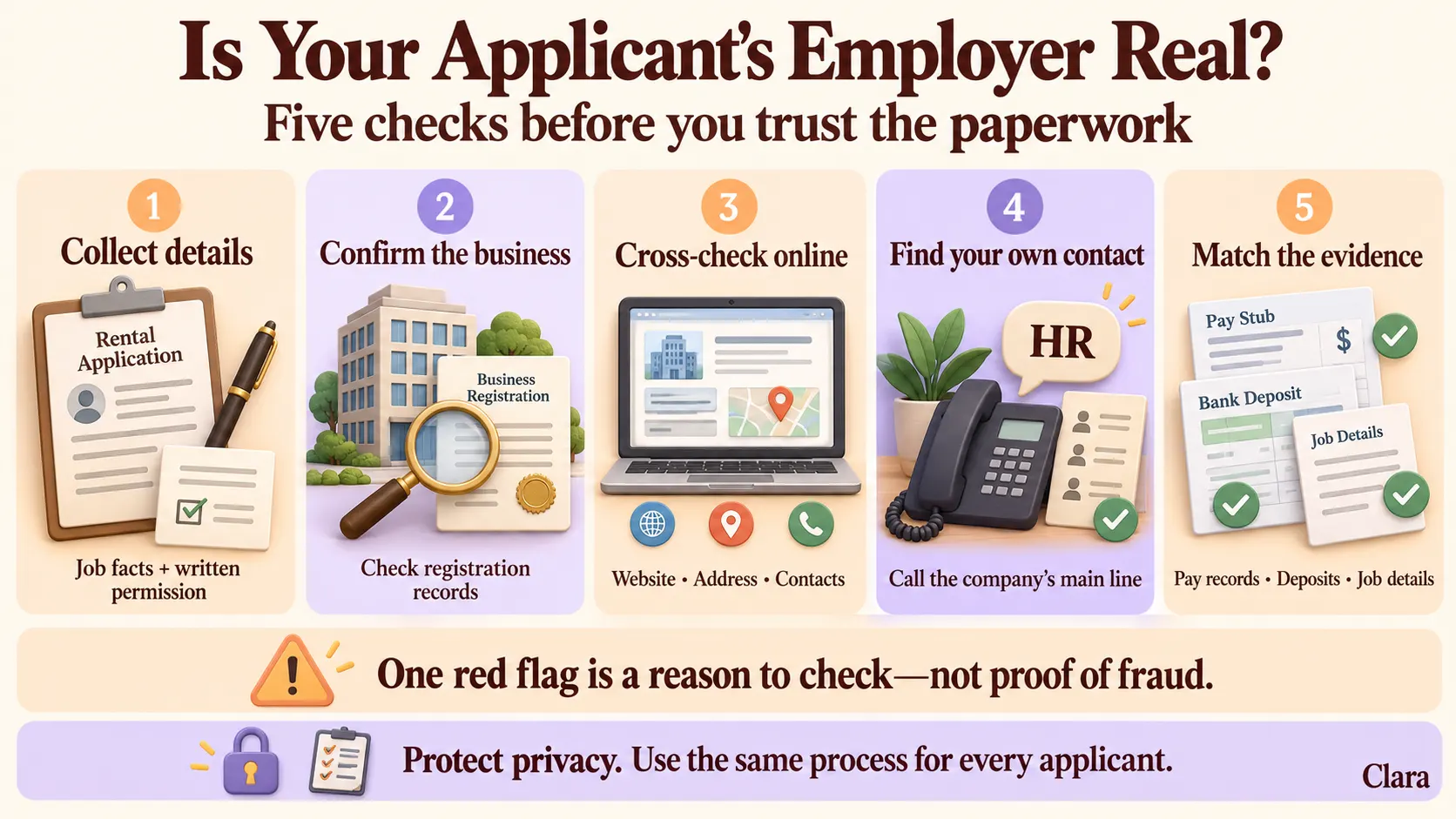
Employment Verification Process: How to Verify an Employer in Five Steps
This process takes about 15 minutes per tenant. Use the same steps for every applicant to keep your tenant screening process consistent.
Step 1: Get Complete Job Details From the Applicant
Start with the employment information on the application. You need the legal business name, street address, supervisor's name and title, company phone number, work email, job title, start date, and pay rate. If any field is blank or vague, ask the tenant to fill it in before you go further.
Also ask for written permission to contact the company. Many companies will share job details only after the employee approves the request. Write down everything the tenant gave you. In the next steps, you will compare it against what you find on your own.
Step 2: Confirm the Business Exists
Search the company name in your state's business registry. In most states, the Secretary of State runs this database, and the search is usually free. A real registered company will show its status, formation date, registered address, and registered agent.
Look for a few things.
Is the status active, or has the company been dissolved?
Does the registered name match the name on the application?
Was the company formed last month even though the tenant claims years of service?
Any of these deserves a polite follow-up question.
Keep one caution in mind. Sole proprietors and "doing business as" names are sometimes registered at the county or city level instead. No result at the state level is not proof of fraud. Ask the tenant for the legal business name and try again.
Step 3: Check the Online Footprint
Real businesses leave a trail. Search the company name and address on Google Maps.
Does the address match the application?
Is there a storefront, an office building, or a warehouse, and do the photos and reviews fit the type of business?
Next, look for a Google Business Profile and a LinkedIn company page. See whether the tenant or the supervisor appears there. Then visit the company website. Check that it lists real contact details and that the work email uses the same domain. A free domain lookup tool can also show when the website was registered. A site that went live two weeks before the application is worth a closer look.
Step 4: Contact the Employer Using a Number You Found Yourself
This is the most important step. Do not rely on the phone number or email printed on the application. Fraudsters often list a number they control. Instead, find the company's main line on its website or Google listing, call it, and ask for HR, payroll, or the supervisor. A short employment verification request by phone or email is enough.
Keep your questions short and limited to job facts:
"Hi, I'm calling to confirm employment for a rental application. Does Jordan Smith work at your company? Can you confirm the job title, the start date, and whether the job is full time?"
Many companies will confirm only the job title, dates, and employment status. Some will discuss pay only with the tenant's written approval. That is normal. Stay away from questions about health, family, age, or anything unrelated to the job.
Protect the tenant's privacy, too. Do not read out a Social Security number or other sensitive details on the call. The company can match the person by name, job title, and start date.
If the person who answers does not know the supervisor your tenant named, ask how to reach that person through the main line. The same trick shows up with phony landlord references, so our guide to spotting fake landlord references applies here too.
Step 5: Match the Documents to What You Found
Now compare the income documents to your research. The company name and address on recent pay stubs should match the registry and the website. Pay dates should follow a steady schedule, and the deductions should look realistic for the pay level. Our guide to how to spot fake pay stubs walks through the details to check.
A bank statement adds a second angle. Deposits should match the pay stub in amount and timing, and the deposit label should point to the company or its payroll provider. When the documents, the registry, and the phone call all agree, you can feel confident the job is real.
Can Landlords Verify Employment Online?
Yes. Online checks are faster, and they close the biggest gap in the manual process: the fake HR contact.
With digital verification, the tenant connects a payroll or bank account, and you see income data pulled directly from the source. You are not relying on a PDF that someone could edit or a phone number someone could fake. Rent with Clara's screening includes payroll and bank income verification, and reports are delivered in minutes. To compare the two approaches, read our breakdown of automated versus manual income verification.
Employment checks also work best alongside other checks. A credit report shows credit history and a credit score, and background checks show public records. Neither tells you whether the job is real, so each one covers a different piece of the picture.
Manual checks still matter. Some tenants have a brand new job, work for a very small company, or cannot connect a payroll account. The five steps above give you a reliable backup in those cases.
What to Do If an Employment Verification Request Goes Unanswered
Sometimes a real company is just slow, and a missed call isn't a red flag on its own. Our guide on what to do when you cannot verify tenant employment covers the full picture. Before you assume the worst, try these moves:
Call again at a different time of day, and ask for payroll instead of HR.
Send a short email to the company's general or HR address, not to the one on the application.
Ask the tenant for the last two or three pay stubs plus matching bank statements.
Ask for a signed employment letter from a manager or HR, then verify the signer through the main line.
If you still cannot confirm the job, talk to the tenant directly. Honest tenants can usually explain a slow HR team or point you to another contact. Keep your approach the same for everyone.
After the Employer Checks Out, Verify Income
A real company is only half the answer. You also need to verify their income and make sure the tenant has sufficient income to cover the rent each month. Many landlords use a rule of thumb such as gross monthly income of about three times the rent, though your own criteria may differ. Whatever number you choose, apply it to every prospective tenant.
Look at gross income on recent pay stubs, then compare it with the deposits on the bank statement. Steady deposits point to stable employment and consistent income. Variable income is not a problem by itself, but reported income should still match the documents. If a tenant lists several income sources, review each one separately and confirm current employment and income instead of relying on last year's numbers.
Proof of Income for Self-Employed, Gig, and New Job Tenants
Not every tenant has a boss or an HR department, so the steps change a little.
Self-employed tenants have no employer to call. Instead, confirm the business registration or license, then look for client deposits on bank statements and for invoices, tax returns, or 1099 forms that support the income. Self-employment income can swing month to month, so review several months instead of one. Our guide to verifying income for self-employed renters explains the full process.
Gig workers follow a similar path. Look at payout history from the platform as it appears in bank deposits, and compare it with the income the tenant claims.
Tenants with a new job usually have no pay stubs yet. Ask for the signed offer letter, confirm the start date and pay with the hiring manager through the company's main line, and consider checking again after the first paycheck.
What a Real Employment Verification Letter Includes
Proof of employment often arrives as an employment verification letter, either instead of pay stubs or alongside them. It is a short letter from the company that confirms the job. Fraud shows up here too, so read it closely. A real letter of employment usually includes:
Company letterhead with the business name, address, and phone number
The tenant's full name, job title, and start date
Employment status, such as full-time, part-time, or contract
Gross income or pay rate, when the tenant has approved sharing it
The name, title, and contact details of the person who signed
A signature and a recent date
Then check the letter the way you checked the application. Call the main line you found yourself and ask for the signer by name. A real HR or payroll contact will remember issuing it or can look it up. Verification letters that cannot be confirmed through the company are worth very little, no matter how polished they look.
Free Tools to Confirm a Business Is Legitimate
You do not need paid software to run the basic checks. Two free resources help.
The Small Business Administration offers a state registration lookup page that links each state and territory to its official business registration site. It is a quick way to reach the right registry without guessing.
The Better Business Bureau shares a guide to researching any business. It suggests checking ratings and complaints, confirming a real physical address, and verifying that the company is registered with a government agency. Those same checks fit a company review well.
Keep Your Tenant Screening Process Consistent and Documented
A good process is one you repeat the same way every time. Run the same checks on every tenant, and write down what you did. Note the date, who you spoke with, what they confirmed, and where you found the phone number. Keep these notes with the application. If a property manager or property management company handles screening for your rental property, ask to see their notes on how each job was verified.
If you also use a tenant screening report and your decision rests partly on it, the FTC explains what landlords must do in its guide on using consumer reports. That includes notifying the applicant and securely destroying reports when you are done with them. Landlord-tenant law and privacy rules can also vary by state and city, so check what applies in your area.
Frequently Asked Questions
How do you verify employment for a rental application?
Collect the employer's name, address, and supervisor from the application, then confirm the business exists in your state registry. Find the company's main phone number yourself and call to confirm the tenant's job title and start date. Finally, match the pay stubs and bank statements to what you learned.
What does "employer" mean on a rental application?
The employer is the company or person that pays the renter. The application usually asks for the employer's name, address, phone number, supervisor, job title, start date, and pay. Self-employed tenants list their own business instead. Landlords use these details to confirm income and judge whether the tenant can afford the rent.
Do landlords verify employment?
Most careful landlords do. They confirm the job through a phone call, an email to HR, a verification letter, or a payroll check. Some skip it, and that is where fake jobs slip through. Verifying employment is one of the simplest ways to catch application fraud before you hand over the keys.
How does an employer verify employment for a landlord?
An HR or payroll contact confirms the tenant's job title, start date, and employment status. Many companies share pay details only with the employee's written approval. The confirmation can come by phone, email, a signed letter, or a payroll service, depending on the company's policy and size.
Can a landlord call a tenant's employer?
Yes. Most applications include a line where the tenant approves contact with the company, and landlords then call to confirm job details. Many will confirm only the title, dates, and status. Keep your questions to the job itself and ask them the same way for every applicant.
What documents can renters use to prove employment and income?
Renters can use recent pay stubs, bank statements, an offer letter, or a letter from the company. Self-employed renters can add tax returns, 1099 forms, and invoices. Landlords should compare the documents with each other and with what they learned from the employer.
Verify the Employer Before You Trust the Paperwork
Pay stubs and offer letters are easy to fake, but a real business is much harder to invent. When you verify an employer on a rental application, you test the one thing every income claim depends on. Collect the details, confirm the business, check its online footprint, call a number you found yourself, and match the documents.
You will not catch every problem with five steps, but you will catch many of them, and you will approve each potential tenant with more confidence that the rent will get paid. Rent with Clara helps independent landlords add payroll and bank data to confirm income during screening, so fewer fake companies get past the front door.
Taylor Wilson
Founder
Taylor Wilson is the Founder of Rent with Clara, a modern renter screening platform built to streamline the rental application process. As both a renter and an independent landlord, Taylor sits on both sides of the lease, and built Clara to give renters control over what they share while giving landlords reliable and verified applications.
Read Articles
1099 Tenant Proof of Income: Complete Verification Guide For Landlords