An applicant falls short of your income or credit standards, and then someone else steps in. A roommate wants to apply together, or a parent offers to help. Is that person a co-applicant or a co-signer? The two terms sound alike, but they carry different rights, different risks, and different screening steps.
This guide explains co-applicant vs. co-signer from the landlord's side. You will learn what each role means, how they differ, how to screen each person, and when to ask for one or the other. The process works best when your landlord screening criteria already say how each role is handled.
Co-Applicant vs Co-Signer at a Glance
Here is the short version:
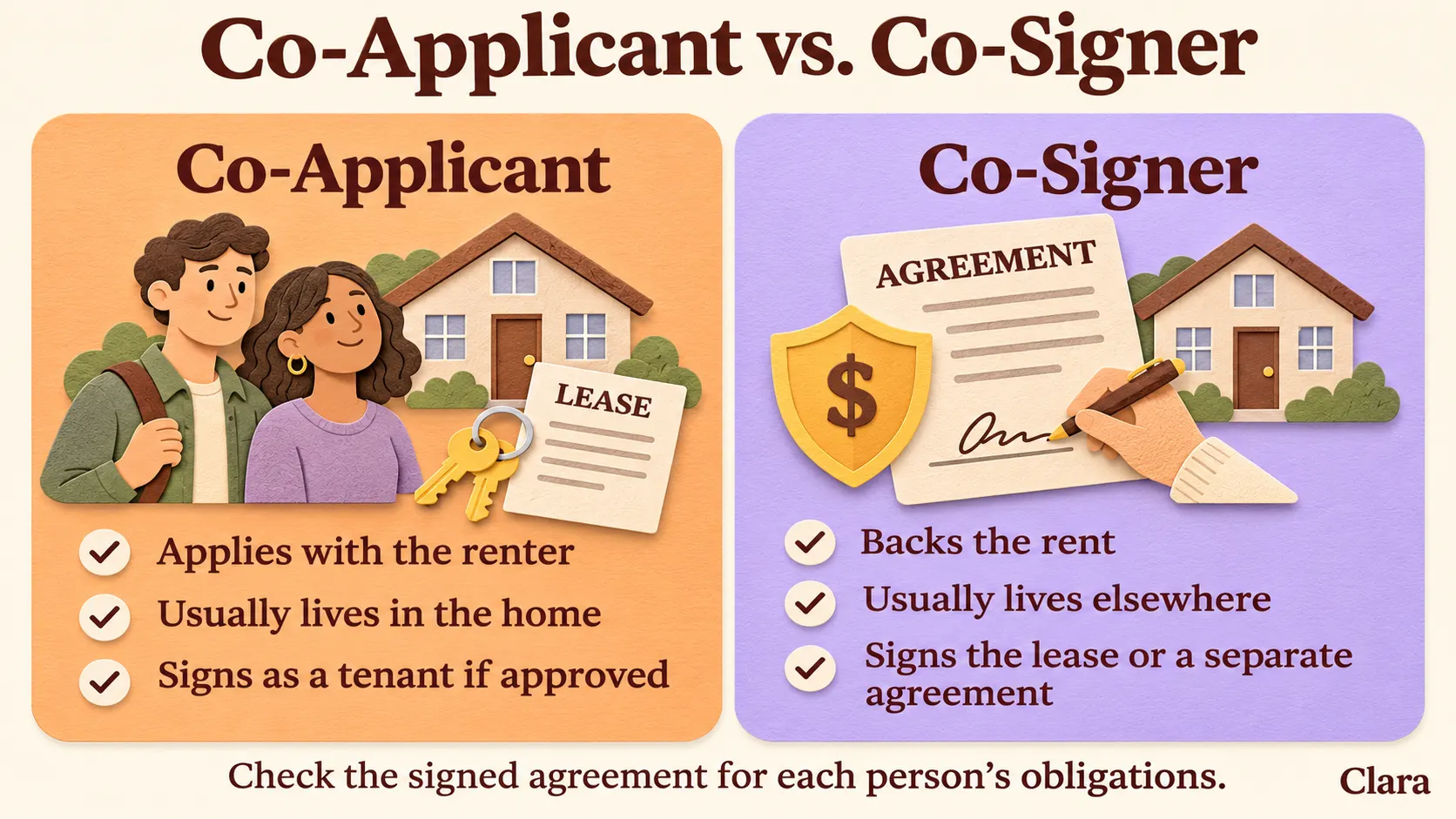
A co-applicant applies with the main renter, signs the lease as a tenant, and usually lives in the unit.
A co-signer backs the rent. They usually do not live in the unit, and they agree to pay if the tenant does not.
A guarantor is much like a co-signer, and many landlords use the two words for the same role.
The labels vary from place to place, so the signed document matters more than the name.
What Is a Co-Applicant?
A co-applicant is a second adult who applies for the rental with the main applicant. Both people are screened, and both usually sign the lease as tenants. They share the home, the rights that come with it, and the responsibility for rent. Common co-applicants are spouses, partners, and roommates. Each is often equally responsible for the rent.
Because a co-applicant is a tenant, their income and credit count toward the household. Two renters who each earn too little alone may qualify together. Screening a group works best with one repeatable method, and tenant background checks for roommates and co-applicants are easier to compare when every adult goes through the same steps.
What Is a Co-Signer?
A co-signer, sometimes written as cosigner, is a person who agrees to pay if the tenant cannot. They add financial strength to an application that is weak on income, credit, or rental history. A co-signer usually does not live in the unit and has no right to occupy it unless the lease says so. A parent for a student or first-time renter is a common example.
A co-signer stays in the background as long as the rent is paid. The role matters when the tenant falls behind, because you may then ask the co-signer for the unpaid amount. The exact terms depend on the lease, or on the separate agreement the co-signer signs.
Co-Signer vs Guarantor: Why the Labels Blur
In practice, co-signer and guarantor often describe the same role. Some people use co-signer for someone who signs the lease itself, and guarantor for someone who signs a separate promise to cover the rent. Others reverse it. Do not rely on the label alone. Ask what the person signs, what they owe, and for how long. The questions behind when to add a guarantor are the same risk questions you ask about a co-signer.
Key Differences for Landlords
These differences shape how you screen, what you write in the lease, and who you can contact for payment.
Lease status: a co-applicant is a tenant on the lease. A co-signer may sign the lease or a separate agreement, and is not there as a tenant.
Occupancy: a co-applicant lives in the home. A co-signer usually does not.
Qualifying role: a co-applicant combines income and credit with the main applicant. A co-signer is a financial backup for the rent.
Screening: a co-applicant gets full screening. Many landlords screen a co-signer mainly on identity, income, and credit.
Responsibility: both can owe unpaid rent, and the wording of the lease or agreement decides the details.
How to Screen a Co-Applicant and a Co-Signer
Treat the two roles differently, and treat every person in the same role the same way.
Screening a Co-Applicant
Run the same checks you run on any applicant: identity, income, credit, rental history, and background. Verify income the same way for each adult, and apply one consistent method when reviewing credit and background. Call previous landlords for each person, because a strong main applicant does not cancel out a weak partner. Keep notes on each call, including the date, the person you spoke with, and what they confirmed, so you can compare every adult on the same basis.
Someone with little or no credit history is a different case from someone with bad credit. It calls for a plan to rent to credit-invisible applicants with other proof of reliability, such as steady income and a record of paying bills on time.
Screening a Co-Signer
A co-signer is the backup for the rent, so check identity, income, and credit with care. Many landlords set a higher bar for a co-signer than for the renter, such as a higher credit score or a larger income. Whatever you choose, write it down so each co-signer gets the same test. Ask for the same proof you would ask from anyone, such as a government ID, recent pay stubs, and bank statements. If the co-signer lives in another city or state, confirm who they are with a live call or video chat before you rely on them. A name and a phone number are not proof of anything. Get written permission before you pull a credit report, just as you do for the renter. The steps for screening tenants with co-signers or guarantors cover what to verify and how to keep the process even.
Red Flags When a Co-Signer Is Offered
A co-signer is your safety net, so a fake or unqualified one defeats the purpose. Slow down when you notice any of these signs:
The co-signer can only be reached through the applicant.
The documents do not match, such as a pay stub from one employer and an ID with a different name.
The co-signer refuses a credit check or says it is not needed.
The only contact detail is a new email address or a number that never answers.
You feel pressure to approve quickly, before you can verify anything.
Any one of these is a reason to pause and confirm the facts. The same patterns that show up in signs of fraud in rental applications apply to co-signer paperwork too.
Three Common Scenarios
Most requests fall into a few patterns. Knowing them helps you answer quickly and consistently.
Two roommates each fall short of your income rule alone. Treat them as co-applicants, and require each person to pass screening. You can apply your rent-to-income ratio to the combined household income, as long as you handle every group the same way.
A student or first-time renter has little income and no rental history, and a parent offers to help. This is a classic co-signer case. Screen the parent for identity, income, and credit, and put the promise in writing. The parent does not move in, and the tenant remains the only person with a right to live in the home.
A solid applicant has a thin credit file but steady pay. A co-signer can help here, but it is not the only choice. Strong income, a good rental history, and a larger deposit may be enough. Choose the lightest option that fits the risk.
When to Ask for a Co-Applicant, a Co-Signer, or Neither
Pick the role that fits the risk. These rules of thumb help:
Ask for a co-applicant when two or more adults will live in the home, and each should be responsible under the lease.
Ask for a co-signer when the renter is a good fit, but the file falls short, as with a student, a first-time renter, or someone with a short work history.
Think twice when the file has serious problems, such as false information or a recent eviction. A co-signer does not fix those, and a larger security deposit may be a better safeguard where your state allows it.
Be careful when a credit report is the reason you ask for a co-signer. That request counts as an adverse action, so you will need to send an adverse action letter that follows the rules.
What to Put in Writing for a Co-Signer
Whatever you call the role, write down the terms. A short agreement should cover:
The full names of the tenant and the co-signer, and the address of the rental.
What the co-signer promises to cover, such as rent, late fees, and damage.
How long the promise lasts, including whether it carries over to a renewal.
A signature and a date from every person, including the co-signer.
How and when you will contact the co-signer if rent is late.
Signing everything together keeps the terms in one place, and a complete lease agreement for independent landlords gives you a natural spot for these clauses. Give each person a copy, so nobody can say they never saw the terms. Decide in advance whether the co-signer's promise carries over to a renewal or a new lease. If it does not, ask for a fresh signature at renewal time, so nobody is surprised later by what they agreed to.
Questions to Ask Before You Decide
Run through these questions for each application:
Will this person live in the home? If yes, treat them as a co-applicant.
Does the main applicant meet your criteria alone? If yes, you may not need either role.
Is the gap in income, credit, or rental history small enough for a backup to cover it?
Can you verify the identity, income, and credit of the second person?
Will you give the same answer to the next applicant in the same situation?
Fair Housing and Notice Rules to Remember
Apply your co-signer rules to every applicant. Do not ask one group for a co-signer and skip another. HUD explains that the Fair Housing Act protects people from discrimination based on race, color, national origin, religion, sex, familial status, and disability.
The FTC lists requiring a co-signer among the actions that call for a notice when a decision rests partly or fully on a consumer report. Its guide on using consumer reports explains what the notice must include. This article is general information, not legal advice, and rules vary by state and city.
Check the Wording in the Lease or Guaranty
Because the labels are not standard, the document is what counts. A Brick Underground explainer on New York City rentals notes that co-signer and guarantor are used interchangeably, even though the obligations can differ. Spell out in your lease or co-signer agreement who signs, what they owe, such as rent, damage, and fees, how long the promise lasts, and when you may contact them for payment.
Liability can be broad. The Iowa People's Law Library explains that when several people sign a lease together, it often says they are jointly and severally liable, and that a co-signer who does not live in the unit could also be held responsible for rent and damage. Rules on enforcing these promises vary by state, so have a local attorney review your forms.
Co-Applicant vs Co-Signer on a Loan or Mortgage
Search results for these terms are full of loan advice, so it helps to know how the words change outside of rentals. On a personal loan, student loan, or mortgage, a co-applicant or co-borrower shares the debt with the primary borrower. Both names are on the loan, both are responsible for the loan, and both usually share ownership of whatever it buys. A co-signer only promises to repay the loan if the borrower fails to make payments. Lenders may ask for one when the borrower's credit history is thin, or the income is low. The co-signer takes on responsibility for the loan even though the borrower normally handles each repayment.
A lender looks at the credit score and credit history of everyone on the application. A co-signer with strong credit may help the borrower get approved and may help secure better loan terms and a lower interest rate. The risk for the co-signer is real, though. The FTC warns that a co-signer can be asked to repay without the lender first going after the borrower, and gets no ownership rights in what the loan pays for. A rental co-signer plays a similar backup role, but the lease or guaranty wording is what controls.
Frequently Asked Questions
What is the difference between a co-applicant and a co-signer?
A co-applicant applies with the renter, signs the lease as a tenant, and usually lives in the home. A co-signer backs the rent and usually does not live there. Both can owe unpaid rent, so read the lease or agreement to see exactly what each person promised.
Does a co-applicant have to live in the unit?
On most rentals, yes. A co-applicant is a tenant who plans to live in the home and share the rent. A co-signer is the one who usually does not live there. Your lease should name every adult who will occupy the unit.
Can a landlord require a co-signer?
In most places, yes, if you apply the requirement to every applicant who falls short of your written criteria and not on a protected characteristic. Some places limit these practices, so check local rules. If a credit report drove the request, send the required notice.
Does being a co-applicant affect your credit?
It can. A co-applicant's credit is screened along with the main applicant's, so weak credit on either person can lower the application's strength. On a loan, late payments can show up on both people's credit reports. Apply the same standard to every adult, and judge the full file.
Can you have both a co-applicant and a co-signer on one lease?
Yes. A pair of roommates who qualify together but still fall a little short may add a co-signer as a backup. Keep each role clear in writing, screen each person, and make sure every signer understands what they are promising before the lease starts.
Can a landlord reject a co-signer?
Yes, if the person does not meet your written criteria for income, credit, or identity. Apply the same test to every co-signer. If a consumer report played any part in the decision, follow the notice steps that the FTC describes for landlords.
Pick the Role That Fits the Risk
A co-applicant joins the lease and the home. A co-signer stands behind the rent. Both can reduce risk when the file is strong and the paperwork is clear, but neither fixes a file with deeper problems. Decide your rules before you list the rental, apply them the same way each time, and write down what every person signs.
Rent with Clara helps independent landlords confirm identity and screen applicants in one place, so every person on an application gets the same careful review.
Taylor Wilson
Founder
Taylor Wilson is the Founder of Rent with Clara, a modern renter screening platform built to streamline the rental application process. As both a renter and an independent landlord, Taylor sits on both sides of the lease, and built Clara to give renters control over what they share while giving landlords reliable and verified applications.
Read Articles
1099 Tenant Proof of Income: Complete Verification Guide For Landlords