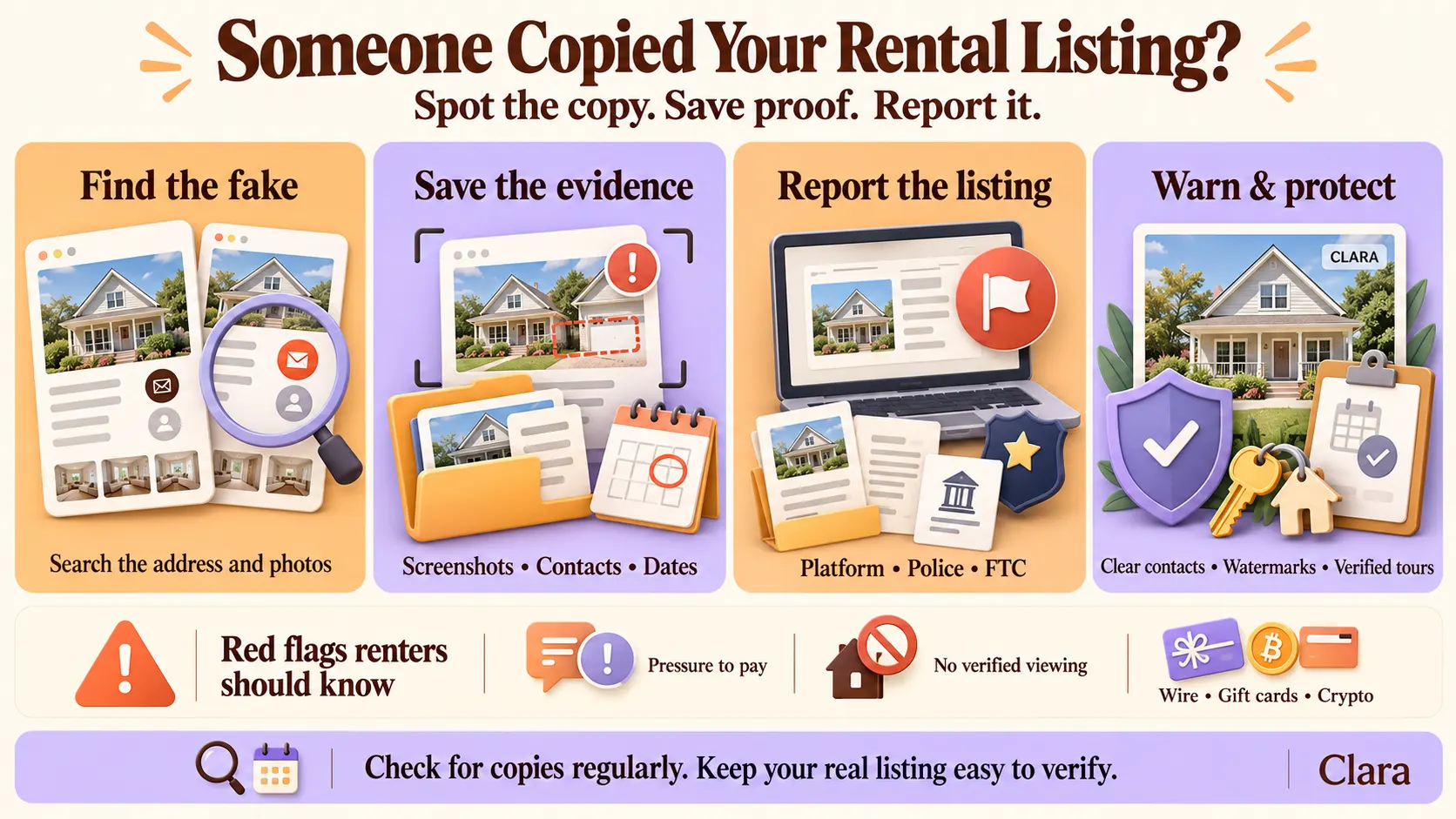
You can confirm a copied ad quickly by searching your property address and running your photos through a reverse image search.
Reporting the fake to the host site, local police, and the FTC puts the scammer on record and flags the ad.
Watermarked photos, scheduled showings, and a visible scam warning make your real listing harder to clone and easier to trust.
Anyone told to pay by wire transfer, gift card, or crypto before seeing the home is being scammed, so say so in your listing.
Verifying identity and income on your real applicants protects you from landlord-targeted scams.
This guide reflects the questions independent landlords ask most often after they find their own listing posted somewhere they never put it.
A stranger is advertising your rental for half the rent, and a renter you have never met asks when to wire the deposit. That is a fake rental listing scam, and your own photos, address, and description do the convincing for the scammer.
You cannot stop people from copying a public listing. You can find the copy fast, get it pulled, warn the renters it targets, and make your real listing hard to impersonate. Here is how a landlord handles all four.
How a Copied Listing Scam Works
Scammers copy the photos and description from a real ad, swap your phone number or email for their own, and repost the fraudulent ad on another site, often at a lower price. Renters who reply reach the scammer instead of you. The fraudster never has to touch your rental property. Some pose as the owner, others as a property manager or letting agent, and none of them will meet the landlord in person or show the property.
The script rarely changes. First comes a sense of urgency, then a request for money upfront: an application fee, a holding deposit, or the first month's rent to hold the apartment. The scammer insists on a wire transfer, gift cards, or crypto.
Some skip the money and ask for a completed application with a Social Security number, a driver's license photo, and pay stubs, which feeds identity theft. A third version steers the renter to a $1 credit check that quietly signs them up for a paid membership with recurring fees.
Picture a renter named Sue, looking for an apartment near a new job and trying to find affordable housing. She spots a three-bedroom single-family home priced well below the rental market. The purported landlord responds only by email and text, says he is overseas, and promises to mail the keys once she pays because three other people want the place. Sue has already sent the first month's rent and filled out the application by the time she meets John, the real landlord, standing on his porch.
A lease hands a renter a leasehold estate, the legal right to occupy a property for a set term. Scammers sell that right without owning it. They also copy ads on sites where people buy or sell homes, so a house you never advertised to rent can still turn up in a fake listing.
Anyone renting out a home can get copied. Your bank account stays untouched, but the damage lands on you. In practice, landlords often hear about the fake from an angry renter, not from the platform. You field confused calls, strangers show up at the door, and your name gets attached to a fraud.
Landlords will also learn about copies from renters, so treat every confused inquiry as a clue. Although landlords rarely get a warning from a platform, a few searches catch a clone early.
Search your property address
Search the street address with the city, then add "for rent" and "for sale." Check Zillow, Realtor.com, Craigslist, and Facebook Marketplace manually, because a copy rarely appears on the same site as the original and can live anywhere on the internet. If the same home appears under a different name, at a different price, or with a different contact number, you found a copy. Setting a Google Alert on your street address will flag new matches.
Run your photos through a reverse image search
Upload your best three or four photos to Google Images or another reverse image tool. Then paste a distinctive sentence from your description into the search bar in quotation marks. Scammers often paste text unchanged, so exact matches surface fast.
Ask every inquiry how they found you
Add one line to your auto-reply so each prospective renter answers: "Where did you see this listing?" If a renter names a site you never use, they handed you the location of the fake. Also ask what rent and payment instructions they were given. If you list properties on several sites, keep a short list of where you market your rental listing so any other site showing your address stands out. If a property management company lists for you, ask its team to run these checks monthly.
What to Do the Day You Find a Fake Listing
Speed matters. When a scammer steals your listing, every day the ad stays up gives another renter a chance to lose money.
Capture proof before anything disappears
Screenshot the fake ad in full. Save the URL, the poster's account name, the phone number, the email address, and the date. Scammers delete ads once they sense attention, so collect evidence first.
Report the listing to the host site and local police
Use the platform's tool to report rental scams and attach your original ad plus proof you own the property, such as a county tax record or your lease. Then file a report with your local police. A case number gives renters who already lost money something to hand to their bank and records which side of the story you are on.
Report it to the FTC and your state attorney general
File a complaint at ReportFraud.ftc.gov and with your state attorney general's consumer protection office. Reports build the data regulators use to investigate. Clara's fraud prevention guide walks through the warning signs landlords see most.
Warn your real audience
Add a short notice to your real listing and your website: you never ask for money before a showing, you never accept wire transfers, gift cards, or crypto, and the only contact number is yours. Tell renters never to send money to anyone who has not shown them the home. Email applicants already in your pipeline with the same message. If a renter says they are the victim of a rental scam and already sent money, tell them to contact their bank and report it to the FTC right away, and be honest that wire transfers, gift cards, and crypto rarely come back.
How to Make Your Listing Harder to Copy
You cannot lock a public ad. You can raise the cost of copying it and make the real version easy to verify.
Watermark your photos
Place a small watermark with your name or business and website in a corner of every photo. Scammers must crop it out or reshoot, which slows them down and leaves a visible trail. Shoot your own images instead of borrowing stock or agent photos so reverse searches point back to you, and follow these tips for taking rental listing photos that stay traceable.
Put a verification path in the ad
A legitimate listing gives renters a way to verify the owner, so name the owner of record or your management company and tell renters they can confirm ownership on the county tax assessment website. Give one phone number and one email, and repeat them everywhere you post. When a renter holds your real number and a stranger's number, the mismatch is obvious. State the occupancy date and lease length too, and spell out how a deposit or rent payment is made, so a copy that changes the details stands out.
Run real showings
A scammer cannot show the property, so meeting in person is your strongest proof. Renters who want to rent the property should be able to meet the landlord or agent, view the home, and inspect it room by room, so bring photo ID to every showing. Offer a walkthrough before any application fee or holding deposit changes hands, and say so in the ad.
A vacant property is easier to fake because no tenant is there to contradict the story, so ask a neighbor or your property manager to check on it. Here is how to show a rental property step by step.
Price against the rental market
Fake ads often undercut real rent to grab attention, and renters who know the local rental market notice the gap. Set your monthly rent based on comparable rentals, and you will price your property close enough that a too-good-to-be-true copy looks wrong next to yours.
Red Flags to Share With Renters
Your listing is a copy target, so make potential renters your early-warning system. Put these ways to spot a fake, plus a few tips to avoid scams, on your website and link them from every ad.
The signs of a suspicious listing
A huge red flag is any demand for money upfront: an application fee, a security deposit, a holding deposit, or a month's rent before a renter has seen the home. Other red flags include a sense of urgency, rent that sounds too good to be true, an owner who is always out of town, and a request for a Social Security number or bank details before any application. Renters should also check whether the property is listed for sale elsewhere, because a property listed both ways is a bad sign. Payment only by wire transfer, Western Union, gift cards, or crypto is the clearest signal, because sending that money is like sending cash.
How big the problem is
FTC data show people reported nearly 65,000 rental scams from 2020 through mid-2025, with about $65 million in losses and a median loss of $1,000. In the 12 months ending June 2025, about half of the people who reported a rental scam said it started with a fake Facebook ad, and another 16% pointed to Craigslist. Renters ages 18 to 29 were three times more likely than other adults to report losing money.
If you offer self-guided tours, copycat scammers can borrow your setup. The FTC reports that scammers copy listings from landlords who use self-tour services, then send renters a code to open the lockbox that holds the keys. Issue a unique code for each confirmed booking so no renter can get the keys without one, confirm each renter's identity before a code goes out, and post a scam warning inside the home. Some renters report that warnings posted inside homes tipped them off.
The scam aimed at you: fake applicants and bad checks
Scammers also play the renter. A fake prospective tenant, eager to move in sight unseen, sends a cashier's check for more than the deposit and asks you to wire back the difference. The check can be counterfeit even after your bank credits it, and you may owe the full amount if it bounces later.
That is check fraud, or cheque fraud in UK coverage, and deposit insurance from the Federal Deposit Insurance Corporation does not cover fraud losses. Never refund an overpayment, and never ask for or accept bank details, a credit card number, or a Social Security number by email or text messaging.
Fake applicants also arrive with doctored pay stubs and stolen identities. Treat pay stubs as a starting point, confirm proof of income and ability to pay rent through the employer or a payroll connection, and call prior landlords listed in the rental history using numbers you find yourself. Run background checks and credit reports on real applicants, and apply the same screening process to every one of them, a core fair housing habit.
Learn how identity theft shows up in rental applications so you can spot the pattern early. Good tenant screening also respects applicant privacy, so collect sensitive data only through a secure screening process.
Clara is built for the applicant side of this problem. Renters photograph a government ID and take a live selfie matched to that ID, and income and employment are verified through payroll and bank connections instead of uploaded documents. Clara cannot remove a copycat ad or stop a scammer from cloning your photos, so the steps above still matter. It helps you confirm that the person applying to your real listing is who they claim to be through tenant ID verification that takes minutes.
Frequently Asked Questions
What should I do if someone copied my rental listing?
Screenshot the fake ad, then report it to the site hosting it and to your local police. File a complaint with the FTC at ReportFraud.ftc.gov and with your state attorney general. Post a notice on your real listing saying you never ask for money before a showing, and email any applicants who mention the fake ad.
How can I tell if a scammer is using my rental listing?
Search your property address and run your photos through a reverse image search. If the same home appears with a different contact name, phone number, or rent, someone copied it. Renters who mention a deposit you never requested, or an overseas owner, point to the same problem.
Do scammers need access to my rental property to run a fake rental listing scam?
No. Scammers usually copy public photos and descriptions, post them with their own contact details, and collect money or personal information remotely without visiting the property. The exception is self-guided tours, where scammers can copy the setup and send renters a lockbox code, so confirm each renter before you share one.
Bottom Line
Two moves you can make before the end of the week. Search your own property address on every major listing site, then set a monthly calendar reminder to repeat it. Next, add one plain sentence to every ad: you never ask for money before a showing, and you never take wire transfers, gift cards, or crypto.
When real applicants do reply to your listing, Rent With Clara lets you check identity, income, and employment in one place. Landlords pay nothing to use it, and renters cover a one-time fee.
Taylor Wilson is the Founder of Rent with Clara, a modern renter screening platform built to streamline the rental application process. As both a renter and an independent landlord, Taylor sits on both sides of the lease, and built Clara to give renters control over what they share while giving landlords reliable and verified applications.
Read Articles
1099 Tenant Proof of Income: Complete Verification Guide For Landlords