Heads up: We're screening experts, not lawyers. This article is here to help you understand the topic, but it's not legal advice. Laws vary by state and locality, and they change. If you have questions about your specific situation, talk to a qualified attorney.
Tenant screening criteria rarely get the same attention as the leasing paperwork wrapped around them, yet they're the single biggest factor in who ends up living in your rental property. Set once and left alone, they slowly drift out of step with your market, your local laws, and the tenants actually applying today.
Key Takeaways
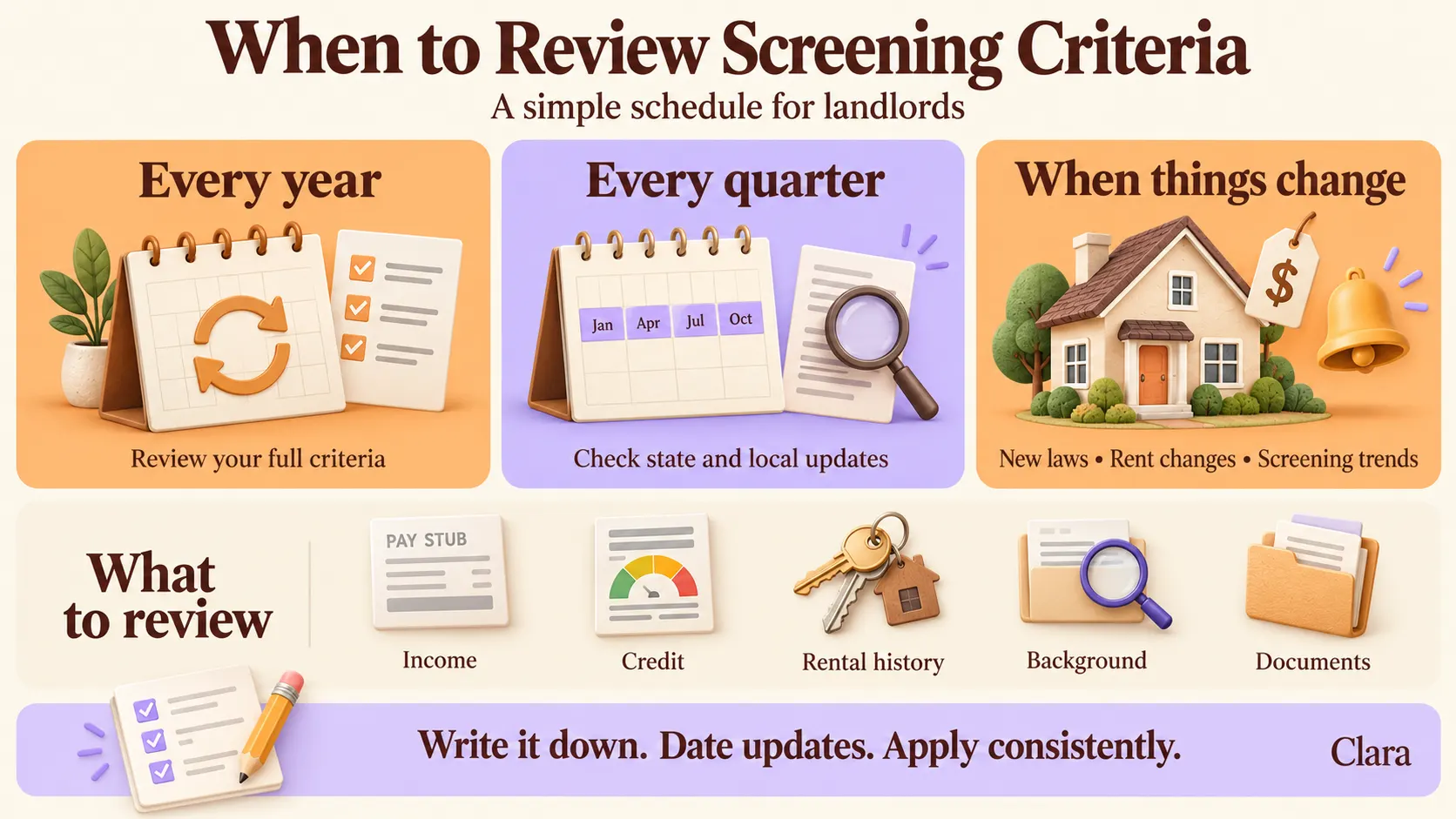
Review your tenant screening criteria at least once a year, and sooner if local or state laws change.
Roughly 32,321 housing discrimination complaints were filed nationwide in 2024, a reminder that outdated or inconsistent criteria carry real legal risk (National Fair Housing Alliance, 2025).
Rising denial rates, repeat problem tenants, or a shifting local rental market are all signs your criteria need a second look sooner than your annual review.
Criteria should be written down, applied the same way to every applicant, and never changed mid-application.
A quick quarterly check on local law changes, paired with a full annual review, keeps most independent landlords covered.
"The true value of a thoughtful screening process isn't just about protecting a landlord's investment; it's about giving every applicant a fair, clear shot at being considered on the same terms as everyone else, because behind every application is someone hoping this is the home they get to move into."
Taylor Wilson, CEO of Rent with Clara
This guide draws on patterns seen across thousands of rental applications processed through Clara's platform, where the landlords who screen well share one habit: they treat their criteria as a living document, not a form they filled out once and forgot about.
Nationwide, private and government fair housing agencies logged 32,321 housing discrimination complaints in 2024, one of the highest totals in more than two decades (National Fair Housing Alliance, 2025).
A large share of those complaints trace back to inconsistent or outdated screening practices. If you set your tenant screening criteria years ago and haven't touched them since, you're not just missing out on better applicants.
You're carrying legal exposure you probably don't know about.
Why Screening Criteria Go Stale Faster Than You'd Think
A tenant screening checklist that made sense two years ago can quietly become a liability. Credit score benchmarks that felt normal in a soft rental market may screen out perfectly good tenants once local rents climb, and income thresholds set for a lower rent don't scale automatically once you raise it.
A number that once separated applicants who could afford the rentfrom those who couldn't stop doing its job the moment your pricing moves and your criteria don't move with it.
Laws move too. Ban the box rules, source of income protections, and limits on how far back a landlord can look into criminal history all vary by state and keep changing.
Local laws often go further than state laws, so a criteria set that's compliant in one city can create a discriminatory outcome in another, and if your written rental criteria still reflect an older legal landscape, every application you screen against them adds risk.
How Screening Reports Have Changed Over Time
It's worth remembering that the tenant screening reports landing in your inbox today look nothing like the ones landlords pulled a decade ago. What used to mean a manual credit pull and a separate criminal records request now typically arrives as one consolidated report, and landlords increasingly conduct background checksthrough the same platform that verifies everything else.
A credit report that once took days to request now often comes back in minutes, which means a threshold set when reports were slower and thinner may no longer match what a modern report actually shows you.
If your last update predates the tools you're now using to screen, that gap alone is reason enough to revisit your numbers.
Signs It's Time to Update Your Criteria Now
You don't have to wait for your annual review if warning signs show up sooner. A climbing denial rate usually means your income or credit thresholds no longer match your local market, while approving tenants who go on to pay late, violate the lease, or leave early suggests your criteria aren't measuring the behavior as a tenant that actually predicts problems down the road.
A change in local law, whether it touches criminal history, eviction records, or source of income protections, should trigger an immediate review rather than waiting for your calendar reminder. The same goes for relying on someone else's generic checklist or adjusting your rent significantly, since either one can quietly change how well your criteria are screening potential renters for your specific property.
What to Actually Review Each Time
A comprehensive tenant screening review covers more than just the credit score cutoff. Walk through each category and ask whether it still reflects your current property and market.
Income and employment
Most landlords set a minimum income requirement relative to rent, along with a standard for current employment. Rather than anchoring to a figure you chose years ago, check whether it still reflects what applicants in your area actually earn, and confirm you still request proof of income in a form you can verify quickly, like recent pay stubs or a signed employer letter, so what's written in your criteria matches what you're actually collecting.
Credit history and credit report
A minimum credit score is common, but check whether your current cutoff still separates applicants likely to pay rent on time from those who aren't, rather than assuming a number set years ago still works.
Confirm your credit check process still requires signed consent before you pull a report, and that it still follows the Fair Credit Reporting Act as written.
Rental and eviction history
Decide how far back you'll look at eviction records and what counts as a disqualifying pattern versus a single circumstance. Consistency matters as much as the standard itself, so document your reasoning once and apply it the same way to every applicant from that point forward.
Criminal background
Criminal background checks are among the most heavily regulated parts of tenant screening, and how you evaluate tenants with a criminal record deserves its own hard look, not a blanket rule left over from your first year as a landlord.
Many jurisdictions now restrict how far back you can look or which convictions are even relevant to a rental decision, so confirm your standard still complies with current state and local law.
Documentation requirements
Confirm the list of documents you request, pay stubs, a government-issued ID, and landlord references, still match what your screening service can process efficiently, and drop anything that no longer adds real signal to your decision.
What a Complete Screening Report Should Confirm
Setting the right thresholds only helps if the screening report you're reviewing actually backs them up. A complete report on any prospective tenant should verify identity, confirm income and employment, and return current credit, criminal, and eviction history in one place, rather than results stitched together from three different sources. Pay attention to whether your credit check process still requires signed consent, and whether the report gives you enough detail, payment history, open accounts, any bankruptcies, to make a real judgment rather than a guess based on a single score.
A criminal record search should tell you not just whether something exists, but how far back it reaches, since that window is exactly what changes when local law changes. If your current report doesn't answer these questions clearly, the report itself may need an upgrade before your criteria do.
Keeping the Process Fair Housing Compliant
Every update to your tenant selection process needs to pass the same test: would this standard hold up if applied identically to every applicant, regardless of race, national origin, disability, or other characteristics protected under the Fair Housing Act and its state and local counterparts?
Discrimination doesn't have to be intentional to create liability. A credit score floor that disproportionately screens out applicants based on a protected characteristic can expose you to real risk even when finding the right tenant was the only goal.
Turning Your Tenant Screening Checklist Into a Living Document
A tenant screening checklist is different from your written criteria, it's the step-by-step list of what gets requested, checked, and documented for every applicant, and it needs its own maintenance schedule. If you manage properties with any help, a property manager, a spouse, a leasing agent, an outdated checklist is often where inconsistency creeps in even when your criteria on paper are fine.
Update the checklist any time your process changes: a new document you now request, a new step in verifying income, a new disclosure a renter needs to see before applying. Keeping this list current and shared with anyone who touches your applications is what actually helps your criteria surface as a good fit, not just fill out a form.
Streamlining the Tenant Screening Process Without Skipping Steps
Reviewing your criteria is also a good moment to look at how you screen tenants day to day. Juggling separate credit bureaus, court record searches, and employment verification calls makes updates slower and consistency harder to maintain, since every extra manual step is one more place things can slip.
Landlords who move to online tenant screening through a single platform tend to find it easier to apply the same standard to every applicant, since there's one report format to check against one set of criteria. It also does basic pre-screening, confirming someone meets your minimum bar before you invest time in a full application, far less manual.
Building a Simple Review Habit
You don't need a formal audit to stay current. Block time once a year to walk through your written criteria line by line for each rental property you manage, and set a recurring quarterly reminder to check for legal updates in your state and city.
Keep a dated record of when you last updated your criteria and what changed, since that record becomes your defense if a denied applicant ever challenges your decision. Landlords who screen well aren't the ones with the strictest criteria, they're the ones who keep their criteria honest, current, and applied the same way every time.
Frequently Asked Questions
How often should landlords update tenant screening criteria?
Most independent landlords should do a full review of their screening requirementsonce a year, ideally before their busiest leasing season. On top of that, check for law changes on a rolling basis, since fair housing and background check rules can shift with little notice at the state or local level.
Can landlords change screening criteria mid-application?
No. Once you've published your rental criteria and started collecting applications, you need to apply that same standard to every applicant in the pool.
Changing requirements mid-process, even with good intentions, creates inconsistency that looks discriminatory and is difficult to defend if challenged.
What happens if a landlord doesn't update screening criteria?
Outdated criteria raise two risks at once. You're more likely to approve a tenant whose payment habits or lease compliance don't hold up over time, and more likely to apply an inconsistent standard that opens the door to a fair housing complaint. Neither risk announces itself until the damage is already done.
Taylor Wilson
Founder
Taylor Wilson is the Founder of Rent with Clara, a modern renter screening platform built to streamline the rental application process. As both a renter and an independent landlord, Taylor sits on both sides of the lease, and built Clara to give renters control over what they share while giving landlords reliable and verified applications.
Read Articles
1099 Tenant Proof of Income: Complete Verification Guide For Landlords