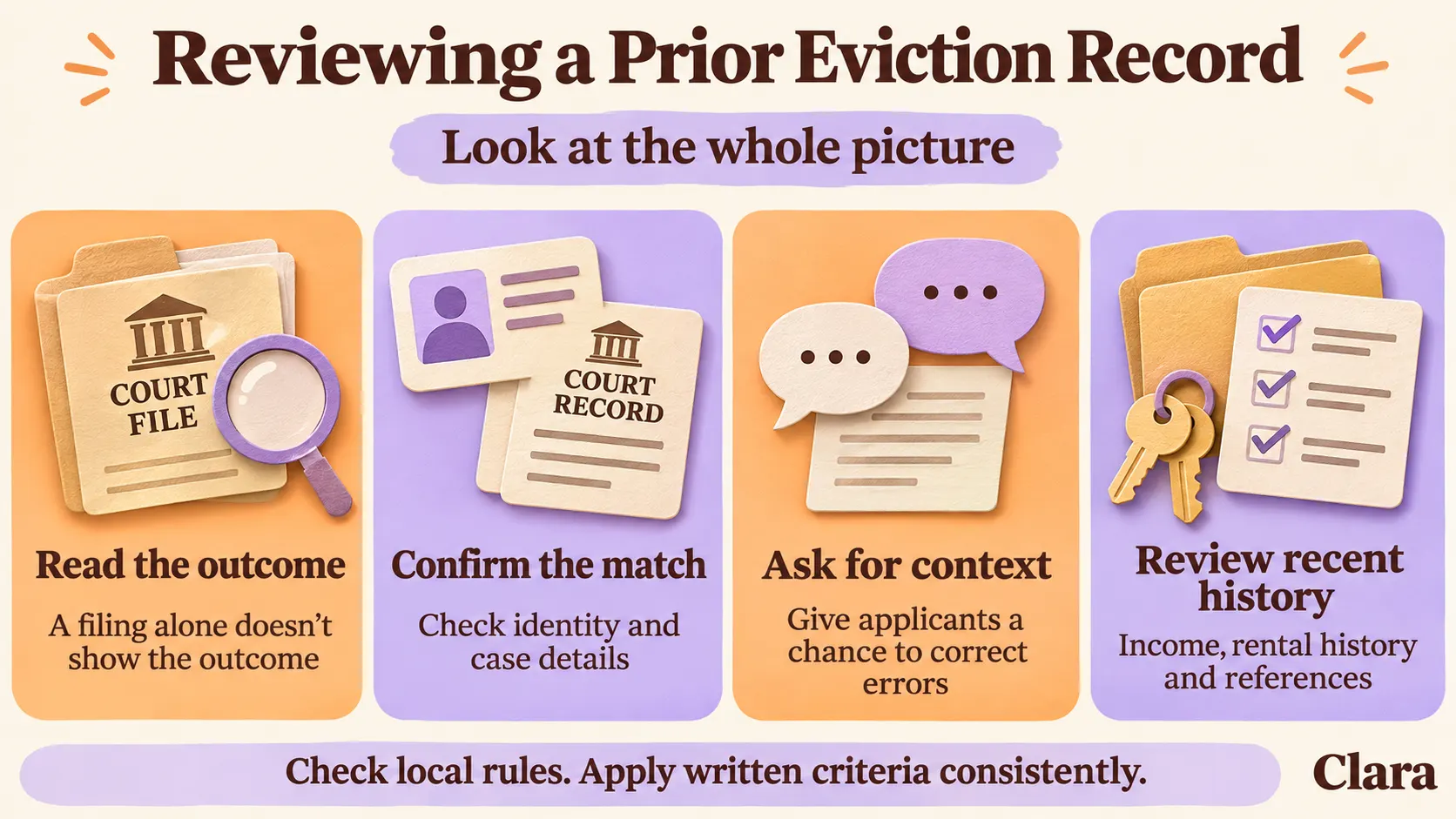
A past eviction on a rental application makes many owners stop reading. It feels like a clear warning. But a prior eviction is not always a clear no, and it is rarely the whole story. Some evictions come from a job loss or a medical crisis years ago. Others point to a pattern you should not ignore.
This guide shows landlords how to think about renting to a tenant with an eviction history. You will learn what an eviction record does and does not tell you, which questions to ask, how to verify the facts, and when to approve with safeguards or say no. Setting your landlord screening criteria first will make every decision below easier.
Can You Rent to a Tenant With an Eviction History?
Yes. In most places, a prior eviction does not bar you from renting to someone. It is one factor in your decision, and the weight you give it is up to you. Some owners deny any application with one in the last few years. Others look at the full picture and approve when the facts support it.
What matters most is that your approach is written down and applied the same way to every applicant. A rule such as "no evictions in the past five years" is clear and easy to explain. A case-by-case guess is harder to defend and easier to get wrong. Some states and cities also limit how these records can be used in screening, so check the rules where your rental property is located.
What an Eviction Record Does and Does Not Tell You
The word "eviction" covers several different events. A single line on a screening report may not tell you which one it is. These are the terms to know:
A filing means a landlord started a case in court. It does not mean the tenant lost.
A judgment means the court ruled in favor of one side, often for unpaid rent or possession of the home.
A dismissal or settlement means the case ended without an eviction, sometimes because the renter paid or the two sides reached a deal.
A writ of possession or lockout means the tenant was removed from the property.
A filing that was dismissed after the renter paid is very different from a judgment with an unpaid balance. Treating them the same can lead you to turn away a good renter, or to miss a real risk. Always read the details, not just the label.
Questions to Ask Before You Decide
Start with the facts of the case. A short conversation or a written explanation can answer most of these:
When did it happen, and how long ago was the case filed?
What was the reason? Unpaid rent, a lease violation, damage, or something else?
Was there a judgment, and was any money owed? Has it been paid?
Was it a single event, or are there other evictions or collections?
What has changed in the renter's income, job, or situation since then?
Can the renter provide proof, such as a receipt, a payment plan, or a letter from the prior landlord?
Many apartment communities and property managers run a second chance program, so a prior eviction does not end every conversation. Pay attention to how the person answers. Someone who explains what happened, takes responsibility, and offers documents is a different risk than someone who blames everyone or refuses to talk. Calm, consistent answers count for a lot.
Why the Reason and the Timing Matter
Not all cases carry the same weight. Unpaid rent is the most common reason, and it tells you something about past ability to pay. A lease violation, such as noise or unauthorized occupants, points to behavior. Property damage is a more serious concern for most owners. Some evictions come from situations outside the tenant's control, such as a landlord selling the home or a property that was foreclosed.
Timing matters too. An eviction from six years ago, followed by steady rental history and stable income, tells a different story than one from last spring. Confirming what has happened since means reviewing rental history and references for the years after the case. If there are gaps in the timeline, ask what the renter was doing during that time.
How to Verify an Eviction History in Five Steps
Do not rely on someone's word, and do not rely on a single source. Follow the same steps every time.
Step 1: Get Written Consent and Run an Eviction Search
Ask for written consent, then run a search through a tenant screening report. Some searches pull from national databases, while others check county court records. Each approach has strengths and gaps, and the gap between instant vs. county searches affects how complete a report can be. When you are ready to choose a provider, compare the best eviction check services for landlords.
Step 2: Read the Record Closely
Look at the case type, the filing date, the court, and the outcome. Check whether the record shows a judgment, a dismissal, or a settlement. Note the amount owed, if any. If the report shows only a filing and no outcome, ask the renter to explain and to provide documents.
Step 3: Ask the Applicant to Explain in Writing
A written explanation gives you a document to compare with the facts. It also helps you see whether the story changes. Ask what happened, what the balance was, and whether it was paid.
Step 4: Call the Prior Landlord and Recent References
Confirm the story with the prior owner, if possible, and with at least one more recent landlord. A reference from a place where the tenant paid on time since then is strong evidence. Be careful with references that seem too friendly or hard to reach, and look up the property owner yourself.
Step 5: Review Income, Credit, and the Rest of the File
A prior eviction should be judged next to the rest of the application. Verify income and employment with pay stubs, a call to the employer, or bank statements, and review the credit report for unpaid debts, collections, or a judgment that was never paid. Read the whole credit file and not just the number, because credit report red flags beyond the credit score can tell you more than the score alone. A tenant screening scorecard can also help you weigh each item fairly.
When a Prior Eviction Should Be a No
Some situations are hard to get past. Be cautious or decline when you see:
More than one case, or a case plus other collections or judgments.
A recent case with an unpaid balance and no plan to pay it.
A reason that involves damage to the property or serious lease violations.
A refusal to explain, or an explanation that does not match the records.
Information on the application that turns out to be false, such as a hidden prior address.
Income that does not support the rent, even without the record.
If you deny an application, base the decision on your written criteria, then decline the rental application with a short, polite message. When a screening report played a part, you may also need to send an adverse action letter, so build that step into your process.
Ways to Lower Your Risk If You Decide to Approve
If the facts check out and you are open to approving, you can add safeguards that match the risk. Not every option is allowed everywhere, so check your local rules first.
Add a guarantor or co-signer with strong credit and income, and decide when to add a guarantor before you offer the option.
Require proof that any old balance has been paid, or sign a written payment plan before move-in.
Ask for the first month's rent and deposit in traceable form before you hand over keys.
Use a clear lease with the rules spelled out, and document the home's condition at move-in.
These steps do not remove risk. They give you a way to say yes with more protection when the rest of the file is strong.
Make Sure the Eviction Record Is Accurate
Screening reports are not perfect. The Federal Trade Commission explains that eviction cases can be reported for up to seven years from the filing date, even if the renter was not evicted. The FTC also advises renters to confirm that a record belongs to them and shows the correct outcome, such as a settlement or payment.
Treat everyone the same. Use the same questions, the same lookback period, and the same written criteria for each person. Mixed treatment can look like bias, even when you did not intend it. If your decision rests partly on a screening report, the FTC explains what landlords need to do when using consumer reports, including how to notify the renter. Rules for landlords and tenants vary by state and city, and this article is general information, not legal advice.
Frequently Asked Questions
Can landlords refuse to rent to someone with an eviction?
In most places, yes, if the decision rests on written criteria applied to everyone and not on a protected characteristic. Some states and cities limit how eviction records may be used. Check your local rules, apply your standard consistently, and keep notes explaining each decision.
How long does an eviction stay on a record?
According to the FTC, eviction cases may be reported on a tenant screening report for up to seven years from the filing date, even if the renter was not evicted. Rules differ by state, and some courts seal or limit records. Check the report and your local rules.
Do landlords ask about previous evictions?
Yes. Most rental applications ask directly about evictions, and most screening reports include searches. Owners also call prior landlords to confirm the history. Renters who answer honestly and offer proof, such as a receipt or a payment plan, usually build more trust than those who hide it.
Should a tenant tell a landlord about an eviction?
Yes, and early. The record will likely appear on the screening report, and a hidden eviction can look like dishonesty. A short, factual explanation with documents helps. Tenants should say what happened, what changed, and whether any balance was paid.
What documents help a renter with a prior eviction get approved?
Helpful documents include proof the balance was paid, a payment plan, recent pay stubs or bank statements, and letters from landlords who have rented to the applicant since. A guarantor or co-signer with strong credit can also help. Landlords weigh these items alongside credit and income.
Does an eviction affect credit and a rental application?
An eviction is usually a court record, not a credit entry. But unpaid rent or a court judgment can lead to a collection account, and that can hurt credit. Landlords may check both the eviction search and the credit report, so a tenant should review both before applying.
Look at the Whole Picture, Then Decide
A prior eviction is a real signal, but it is not the only one. Read the record closely, ask for the facts, verify what you hear, and compare it with income, credit, and recent rental history. Some applicants deserve a second chance, and some do not. A clear process helps you tell the difference.
Rent with Clara helps independent landlords confirm identity and screen applicants in one place, so you can review an eviction in context and make a confident decision.
Taylor Wilson
Founder
Taylor Wilson is the Founder of Rent with Clara, a modern renter screening platform built to streamline the rental application process. As both a renter and an independent landlord, Taylor sits on both sides of the lease, and built Clara to give renters control over what they share while giving landlords reliable and verified applications.
Read Articles
1099 Tenant Proof of Income: Complete Verification Guide For Landlords