A strong application arrives from someone in another state. They have never walked through the unit, and you may not meet them before the lease is signed. Screening out-of-state renters is not harder because of the applicant. It is harder because distance removes the quick checks you rely on in person.
This guide shows landlords how to run tenant screening from a distance. You will learn how to confirm identity, verify income and rental history, handle the unit tour, spot the warning signs, and stay on the right side of the rules. If you do not have written standards yet, start with your landlord screening criteria, because every step below depends on them.
Why Tenant Screening Is Different for Out-of-State Applicants
When a tenant tours the unit, you learn a little just by meeting them. You can see whether the photo on the ID matches the face, whether they arrive on time, and how they talk about their current home. A remote applicant takes that away, so your tenant screening has to replace it with checks you can document.
Living in another state is not a risk factor by itself. Many good renters move for a job, school, or family. The goal is to confirm the same facts you confirm for everyone, using steps that work from a distance.
Set the Same Standards for Every Applicant
Your steps may change with distance, but your standards should not. Apply the same income rule, credit standard, and rental application requirements to local and remote applicants alike. A remote renter should not face extra hurdles that a local one skips, and should not skip a hurdle that a local one faces. Good screening practices help you pick the right tenant from a pool of potential tenants, wherever they live. Consistent treatment is also your best protection under fair housing rules, which Fair Housing 101 explains in plain terms.
Set Up the Rental Application and Screening Fee First
A remote applicant cannot watch you hand over a form, so put the process in writing before the first inquiry. Explain what you check, what you charge, and what happens next. Send the rental application form and a consent form together, and keep the signed copies with the file. Tenant background screening and rental screening both start with that signed consent, so do not run a single check without it.
Get written consent before you run credit checks or a background check. The Fair Credit Reporting Act sets rules for how landlords use a consumer report, and some places limit what landlords can charge for a screening fee or an application fee. Check the tenant screening laws where your rental is located before you set the amount, and charge every applicant the same. A written tenant screening process also helps you find reliable tenants without guessing, because every applicant sees the same rules.
How to Screen Out-of-State Renters, Step by Step
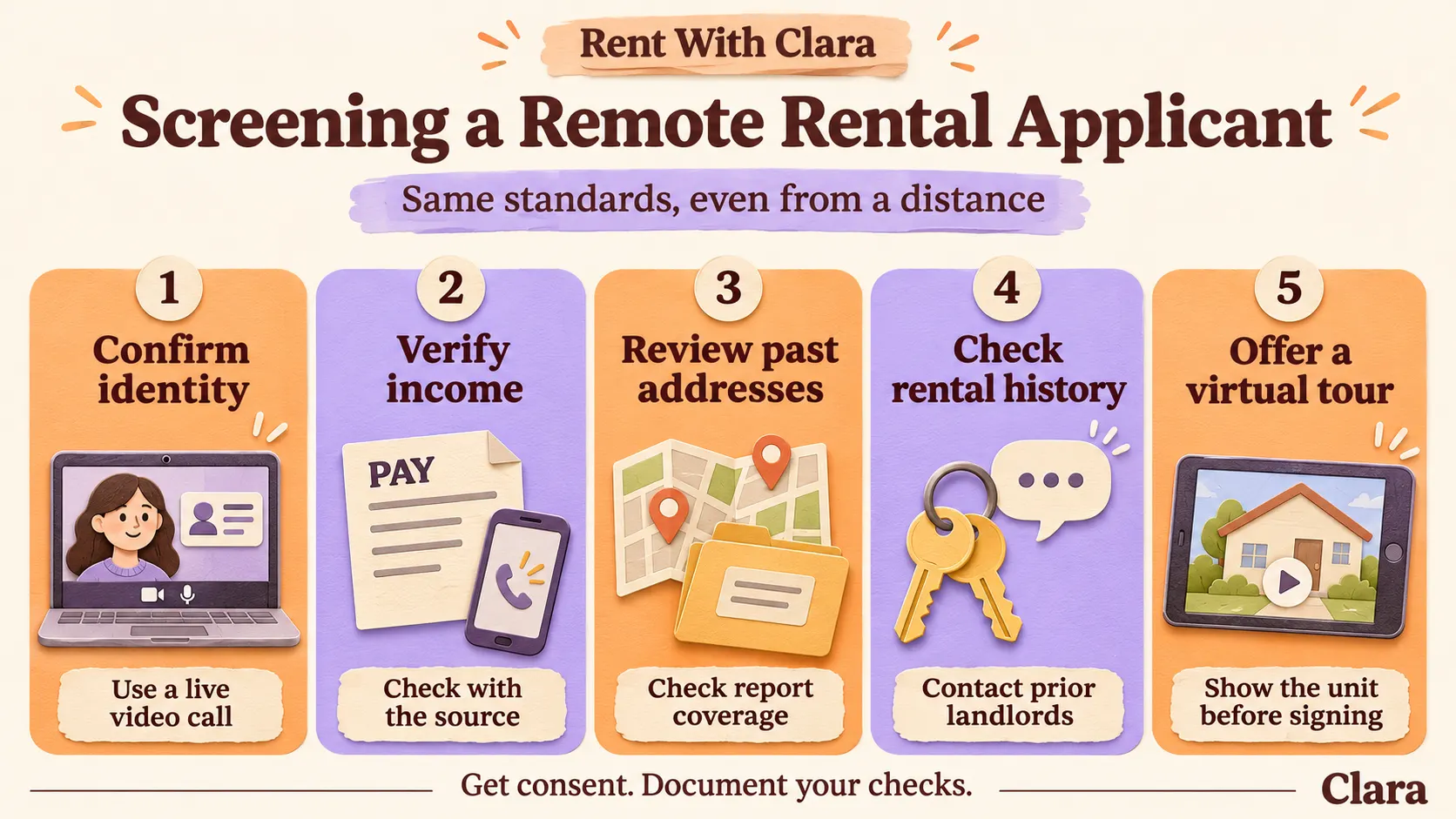
Follow these five steps in order, and keep a note of what you checked for each applicant.
Step 1: Confirm Identity on a Live Video Call
Ask for a government ID and then confirm the person on a live video call. Compare the name, date of birth, and photo with the application. A name and an email address are not proof of identity. Reviewing basic information and identity verification is the first screen for every applicant, and the video call fills the gap when you cannot meet in person.
Step 2: Verify Income and Employment With an Out-of-State Employer
A relocating applicant may not have started the new job yet. Ask for the signed offer letter, recent pay stubs from the current job, and bank statements. Then contact the employer using a phone number or email address that you find yourself, not one the applicant supplies. The best practices for verifying employment apply even more when the employer is far away.
A pay stub that looks right can still be edited. Run each one through the same pay stub verification checks that you use on any local file, and compare the totals with the bank statements.
Step 3: Run a Background Check That Reaches Past Addresses
Ask for every address from the past several years. A tenant screening report that searches only your own county will miss records from where the applicant used to live. Ask which sources the screening report covers, and whether it searches the states and counties the applicant lists. National databases and county courts each have gaps, and the difference between instant vs. county searches shows why you may need both for an eviction or criminal background check.
Mixed-up records are a known problem, so match each result to the right person before you act on it. If a report leads you to deny the application, you will need to send an adverse action letter that follows the rules.
Step 4: Verify Rental History With Prior Landlords
Call the current landlord and at least one previous landlord. Look up the property owner or manager yourself, using county property records or a business listing, so you know you are speaking to the real person. A friendly reference who is hard to verify is a warning sign. Calls to previous landlords work best when you follow the same questions every time, as laid out in reviewing rental history and references.
Step 5: Show the Unit Remotely
Offer a live video tour or a recorded walkthrough so the applicant can see the unit before signing. Send the same photos and video to every interested person, and write down what you showed. After move-in, record the condition with dated photos. This protects both sides: the renter knows what they are renting, and you have a record if there is a dispute later.
What to Collect From a Remote Applicant
Ask for the same core file from every applicant, and request the extras that distance makes useful:
A completed rental application and a signed consent form.
A government ID, confirmed on a live video call.
Pay stubs, bank statements, and an offer letter if the job has not started.
Addresses for the past several years, with landlord names and phone numbers.
Contact details for an employer and at least two references you can verify yourself.
A complete file lets you compare a remote applicant with a local one on equal terms, and it shows you quickly what is still missing.
Red Flags in Remote Applications
Most out-of-state applicants are exactly who they say they are. Slow down when you see these signs:
The applicant refuses a video call or will not show an ID.
Documents do not match, such as a pay stub from one employer and a bank deposit from another.
The applicant pushes to skip screening, sign quickly, or pay many months upfront.
References can only be reached through the applicant, or by text or email.
The applicant offers a check for more than the amount you asked for.
Applicants With No Social Security Number or U.S. Credit History
Some remote applicants are new to the country, or have lived abroad. They may not have a Social Security number or a U.S. credit report. Decide ahead of time what you will accept instead, and offer the same options to every applicant. Common alternatives include a passport or other government ID, bank statements, proof of income, and landlord references.
Remote applicants often juggle a move, a job start date, and a deadline from their current landlord. Tell them how long the screening process takes, what you still need, and when you will decide. Send short status updates by email, and answer questions the same day when you can. If you use a screening service, ask how fast it returns results, so you can give each applicant an honest timeline.
A clear rental process keeps good applicants from walking away, and it reduces the pressure to cut corners. If several people want the same unit, give each one the same timeline and the same deadline. Speed should never replace verification, but a steady pace shows that you are serious. Write down each date you contacted the applicant, so the record shows the same pace for everyone. A landlord must follow the same tenant screening process for the last applicant as for the first, and it is easier to screen tenants fairly when the steps are already on paper.
Handle Payments and the Lease Safely
Take the first month's rent and deposit by a traceable method that you control. Be careful with any check that is larger than the amount you asked for. The FTC describes a scam in which someone sends a check for too much and asks for the difference back. It warns that a fake check can take weeks to be discovered after the bank makes the funds available, and the scammer keeps the money you sent. A remote applicant could try the same trick with a deposit.
If you cannot meet in person, use an electronic signature tool for the lease, and confirm that your state accepts electronic signatures on leases. Send each signer a full copy, and keep the signed file with the rest of your screening notes.
Know the Tenant Screening Laws Where Your Rental Is Located
Tenant screening laws differ by state and city, and they affect your rental property no matter where the applicant lives. State laws and local rules are part of landlord-tenant law, and landlords must follow both federal and state rules, so check them before you advertise. Rental housing rules also protect tenant rights, such as being told why an application was denied when a report played a part. Some places limit what landlords can charge for screening, require written tenant screening criteria, or restrict how criminal records can be used. In Seattle, for example, the city's guidance on screening applications expects landlords to provide their criteria in advance, limits screening charges to the actual cost, and requires a written statement when an application is denied.
Fair housing law applies to every applicant. HUD explains that the Fair Housing Act protects people from discrimination based on race, color, national origin, religion, sex, familial status, and disability. Where an applicant lives now is not on that list, but national origin is, so judge every file on your written criteria.
Yes. Out-of-state applicants go through the same tenant screening as local ones: identity, income, credit, rental history, and a background check. Apply your written criteria to everyone, and use video calls, direct employer contact, and multi-state record searches to replace the steps you would normally do in person.
How do you verify income for an applicant in another state?
Ask for recent pay stubs, bank statements, and a signed offer letter if the job has not started. Contact the employer using a phone number or email address you find yourself. Compare the pay stubs with the bank deposits, and treat any mismatch as a reason to ask more questions.
Can you rent to someone who has not seen the unit?
Yes, many landlords do. Offer a live video tour or a recorded walkthrough, send the same materials to every interested person, and document the move-in condition with dated photos. Keep a written note of what you showed, so both sides have a clear record.
How do you screen applicants with no Social Security number or U.S. credit history?
Decide in advance what you will accept instead, and offer the same options to every applicant. Common choices include a passport or other government ID, bank statements, proof of income, and landlord references. A guarantor can also help. Follow your state and local rules on identification.
Can landlords deny an applicant for being from out of state?
Where an applicant lives is not one of the classes HUD lists under the Fair Housing Act, but national origin is. Deny an application only for reasons in your written criteria, such as income or rental history. Some states and cities add protections, so check local rules.
Can a landlord require a co-signer from an out-of-state renter?
In most places, yes, if you apply the same rule to every applicant who falls short of your criteria. Screen the co-signer as carefully as the renter, including a live video call to confirm identity. If a consumer report drove the request, follow the notice rules.
Distance Changes the Steps, Not the Standards
An applicant who has not seen the unit can be an excellent tenant. Confirm identity on video, verify income at the source, search the places they have lived, call real landlords, and show the unit remotely. Write down each step, and apply the same standards to every applicant. A clear process lets you say yes with confidence when the file is strong, and no when it is not.
Rent with Clara helps independent landlords confirm identity and screen applicants in one place, wherever the applicant lives.
Taylor Wilson
Founder
Taylor Wilson is the Founder of Rent with Clara, a modern renter screening platform built to streamline the rental application process. As both a renter and an independent landlord, Taylor sits on both sides of the lease, and built Clara to give renters control over what they share while giving landlords reliable and verified applications.
Read Articles
1099 Tenant Proof of Income: Complete Verification Guide For Landlords